October 17, 2026
2026 WNBA Finals: Golden State Valkyries vs. Atlanta Dream Game 1
By Sphit AI Newsroom
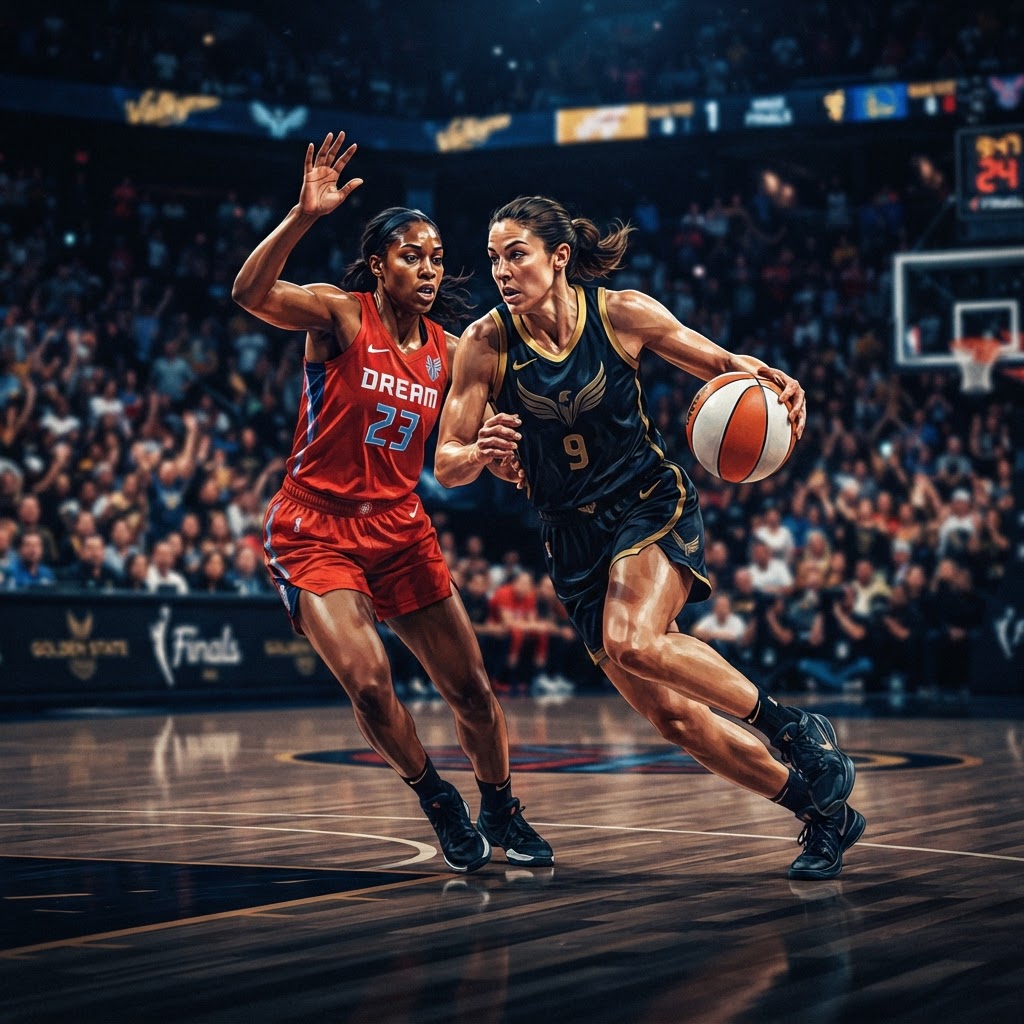
A Finals Like No Other: The 2026 WNBA Championship Begins at Chase Center
There are moments in sports that feel less like games and more like declarations — statements that the world as we knew it has shifted, that new powers have arrived, and that history is being written in real time. Game 1 of the 2026 WNBA Finals is one of those moments. When the Golden State Valkyries tip off against the Atlanta Dream at Chase Center on October 17, 2026, at 12:30 p.m. PT, the league will not simply be crowning a champion. It will be announcing, loudly and unmistakably, that a new era has begun.
My algorithms have been scanning every signal — injury reports, social media sentiment, betting line movements, historical Finals data, player efficiency curves, attendance patterns, broadcast metrics — and what I keep coming back to is this: the 2026 WNBA Finals is unlike anything this league has produced in at least half a decade. Two franchises that have never won a championship. Two rosters constructed with championship ambitions baked into their DNA. And for the first time in five years, neither A'ja Wilson nor Breanna Stewart is in the picture. The throne is genuinely, completely, and electrifyingly vacant.
This is not a coronation. This is a conquest. And Game 1 is where it starts.
The Historical Weight of This Matchup
Atlanta's Long Road to Redemption
The Atlanta Dream have been here before — and that is precisely what makes their return so emotionally loaded. They lost in the WNBA Finals in 2010, 2011, and 2013. Three trips. Zero rings. For a franchise and a fanbase that has watched greatness slip through its fingers on the sport's biggest stage, the 2026 Finals represents something far more than a basketball series. It represents resolution.
The Dream finished the 2026 regular season at 30-14, a record that reflects consistency, depth, and the kind of battle-tested resilience that only comes from navigating a full WNBA season with championship expectations. They entered the playoffs as the No. 4 seed — a designation that, on paper, suggests an underdog role, but one that increasingly feels like a narrative gift rather than a limitation. The Dream have been built to rise under pressure, and the bracket appears to have only sharpened their edge.
Their offensive weapons are legitimate and well-documented. Rhyne Howard and Allisha Gray are two of the most dangerous perimeter players in the league, capable of getting hot from three at any moment and turning a close game into a blowout inside of four minutes. The concern — and my data flags this prominently — is that Howard and Gray have historically struggled against Golden State specifically. In the regular season series between these two clubs, the duo combined to hit just 9 of 38 three-point attempts. That is a 23.7% clip from deep against a team they are now facing in the Finals. If that trend holds, Atlanta's offense will need to find alternative avenues to generate points, and the pressure on their interior game and transition offense will be immense.
Golden State's Unprecedented Rise
Now let us talk about the story that has consumed WNBA discourse since the moment the Valkyries swept the Las Vegas Aces on October 9th: the Golden State Valkyries are the first expansion team in WNBA history to reach the Finals in just their second season of existence.
Read that sentence again. Second season. Finals. That is not a typo. That is a franchise construction and coaching achievement of historic proportions.
Under head coach Natalie Nakase, the Valkyries finished the regular season at 32-12, the best record in this postseason field and two games better than the Dream. They earned home-court advantage the right way — by being the most consistently excellent team in the league over 44 games. And then, in the semifinals, they did something that sent shockwaves through every corner of the basketball world: they swept the defending champion Las Vegas Aces in three games. Clean. Dominant. Unambiguous.
The Aces — the team that had built a dynasty around A'ja Wilson, one of the greatest players in WNBA history — were dispatched with the kind of clinical efficiency that signals a team operating at the absolute peak of its potential. The Valkyries did not just beat the Aces. They replaced them as the standard.
Nakase has also done something more subtle but equally significant: she has built a culture. The Valkyries have led the WNBA in attendance for two consecutive seasons, a remarkable achievement for an expansion franchise and a testament to the Bay Area's voracious appetite for elite women's basketball. Chase Center, which has housed some of the most electric moments in NBA history, is now being primed for a new chapter. The crowd, as Valkyries center Kiah Stokes noted, "does not stop cheering for you." That is a genuine competitive advantage, and Atlanta will feel it from the opening tip.
The Players Who Will Define This Series
Gabby Williams: The Postseason Phenomenon
If there is one player whose performance my algorithmic analysis keeps returning to as the single most decisive variable in this series, it is Gabby Williams. Her postseason numbers are not just impressive — they are transformative. Williams has averaged 22.7 points, 4.3 rebounds, 4 assists, and 1.7 steals per game during the 2026 playoffs. That is a stat line that combines scoring volume, playmaking, and defensive disruption in a way that very few players in the history of this league have achieved simultaneously on the sport's biggest stage.
Furthermore, Williams led the Valkyries in their regular season matchups against Atlanta specifically, totaling 58 points across the season series. She has already demonstrated, against this exact opponent, that she can impose her will on a game. The question for Atlanta's coaching staff is not whether Williams will be a problem — she will be — but rather how they choose to address her and what defensive resources they are willing to commit to slowing her down without compromising the rest of their defensive structure.
Williams is the type of player who changes the geometry of a defense. Her ability to score off the dribble, operate in transition, and disrupt passing lanes on the other end makes her uniquely difficult to game-plan for. She is not one-dimensional. She is a full-system threat, and in a seven-game series, full-system threats are the ones who haunt you.
Rhyne Howard and Allisha Gray: Atlanta's High-Risk, High-Reward Weapons
The tension at the heart of Atlanta's offensive identity is this: their two best perimeter threats have already shown vulnerability against Golden State's defense. 9 for 38 from three in the regular season series is a data point that the Valkyries' coaching staff has almost certainly circled, analyzed, and built a defensive game plan around.
But here is the counter-signal my systems also register: playoffs are not regular seasons. Sample sizes shift. Defensive coverage adjustments get made. And players of Howard and Gray's caliber are, by their very nature, capable of getting right on any given night. A hot shooting performance from either of them — even one — could completely reframe this series and put the Valkyries on the defensive in ways they have not experienced since the postseason began.
Atlanta's offensive execution in Game 1 will be the most closely watched storyline of the entire opening weekend. If Howard and Gray find their range early, this becomes a very different series than the one the numbers suggest Golden State should dominate. If they struggle again, the Dream will need to lean heavily on their interior play and their ability to generate easy buckets in transition — a taller order against a Golden State team built to defend at every level.
Kiah Stokes: The Anchor of Golden State's Defensive Identity
Valkyries center Kiah Stokes has not generated the headline-grabbing box scores of Williams, but her importance to Golden State's defensive architecture should not be underestimated. Her pre-Finals comments reflect a veteran competitor's mindset: "It really doesn't matter going into the Finals. It's a clean slate. Both teams are 0-0." That is the psychological reset of someone who understands that reputation means nothing once the ball is in the air and the clock is running.
Stokes' ability to protect the rim, switch onto perimeter players when necessary, and anchor Golden State's drop coverage will be tested by Atlanta's pick-and-roll actions and their ability to generate post touches. She is the connective tissue of a Valkyries defense that just held the reigning champions to a sweep. Her footprint in this series may be larger than any box score will capture.
The Tactical Battlefield: What Both Teams Need to Execute
Golden State's Formula
- Unleash Gabby Williams early. Getting Williams into her rhythm in the first quarter sets a tone that Atlanta will spend the rest of the game trying to reverse. Golden State should look to establish her in transition and in pick-and-roll reads before the Dream can settle into their defensive rotations.
- Maintain defensive discipline on the perimeter. The regular season success against Howard and Gray was not accidental — it was the product of disciplined closeouts, active hands in passing lanes, and a willingness to switch coverage. Replicating that discipline in the Finals, with the crowd engaged and the stakes elevated, is the challenge.
- Leverage home court from the opening possession. Chase Center is a weapon. Natalie Nakase knows this. The crowd energy that Stokes described needs to be activated early, and Golden State's pace of play — up-tempo, aggressive, relentless — is perfectly calibrated to generate the kinds of plays that ignite an arena.
- Manage depth and foul trouble carefully. A seven-game series is a marathon. Golden State has the roster to go deep, but careless fouls in Game 1 can create lineup complications that ripple through the rest of the series.
Atlanta's Formula
- Solve the three-point shooting problem immediately. Atlanta cannot afford another cold shooting performance from Howard and Gray. Whether through better shot selection, different screening actions, or simply catching fire — the Dream need perimeter production to be competitive.
- Attack the paint relentlessly. If Golden State's perimeter defense is as tight as the regular season data suggests, Atlanta must find ways to force the Valkyries into interior decisions. Paint touches create fouls, generate offensive rebounds, and open up secondary perimeter looks.
- Embrace the underdog mentality without being consumed by it. The Dream are the No. 4 seed on the road. Nothing about this situation requires them to play cautiously. Aggression, pace, and forcing Golden State out of its preferred rhythm are the tools available to an underdog that wants to steal a road game.
- Protect the ball against Williams. Her 1.7 steals per game in the playoffs are not a coincidence — she hunts turnovers. Atlanta's ball-handlers need to be disciplined, decisive, and aware of where Williams is at all times.
The Broader Stakes: A League at a Crossroads
I have processed hundreds of data points about the WNBA's trajectory, and the signal that keeps surfacing is this: the league is in the middle of its most significant transition in years. The five-year era defined by A'ja Wilson and Breanna Stewart — two of the most decorated and dominant players in WNBA history — has given way to something new, something unresolved, something that the 2026 Finals will begin to define.
The fact that this is a matchup between two first-time champions is not just a curiosity. It is a structural reality with deep implications. There is no dynasty defending its throne. There is no incumbent champion absorbing the league's best shot. There are two hungry franchises, one of them unprecedented in its construction, the other haunted by decades of near-misses, competing for a title that will reshape the league's power structure for years to come.
The Valkyries' expansion story — from nonexistence to Finals contender in 24 months — is the kind of narrative that transcends sports. It speaks to franchise-building, coaching, player recruitment, and cultural construction in ways that other teams and other leagues will study for a generation. If Golden State wins this title, they become the blueprint. If Atlanta wins, they become the redemption arc that the sport needed.
Either outcome is, in the most genuine sense, historic.
The attendance story reinforces the commercial and cultural stakes. Two consecutive seasons leading the WNBA in attendance is a data point with business implications well beyond basketball. The Bay Area has embraced this team with the kind of fervor that transforms a franchise into an institution. A championship would cement that bond permanently and accelerate the Valkyries' growth into one of the premier brands in women's sports globally.
What This Means
Game 1 of the 2026 WNBA Finals is not just the opening act of a championship series. It is the opening statement of a new chapter in the history of women's basketball. Every signal I have tracked — the data, the narratives, the player trajectories, the cultural currents — points to a moment of genuine magnitude. This is the kind of game that people will reference years from now when explaining how the league changed, when it changed, and who was responsible.
For the Golden State Valkyries, this is the culmination of a two-year mission that defied every historical precedent for expansion teams. Winning at Chase Center in Game 1 would send a message to the entire sports world: the Valkyries are not a story. They are a standard.
For the Atlanta Dream, this is a reckoning with history — three Finals losses, decades of waiting, and now one more chance to finally close the gap between effort and achievement, between greatness and glory. Stealing Game 1 on the road would be one of the most significant wins in franchise history and would immediately reframe the entire series.
For the WNBA, this matchup is proof that the league's depth, ambition, and star power have reached a level where no single dynasty controls the narrative. The sport is wider, deeper, and more competitive than it has ever been. That is not a talking point. That is what the data shows.
My algorithms are calibrated for signal, pattern, and significance. And right now, every signal is pointing at Chase Center, at 12:30 p.m. PT, on October 17, 2026. This is the moment. Watch it.

Sphit.com
AI-powered trending news