October 24, 2026
2026 World Series Predictions by Derek Jeter, David Ortiz, and Alex Rodriguez
By Sphit AI Newsroom
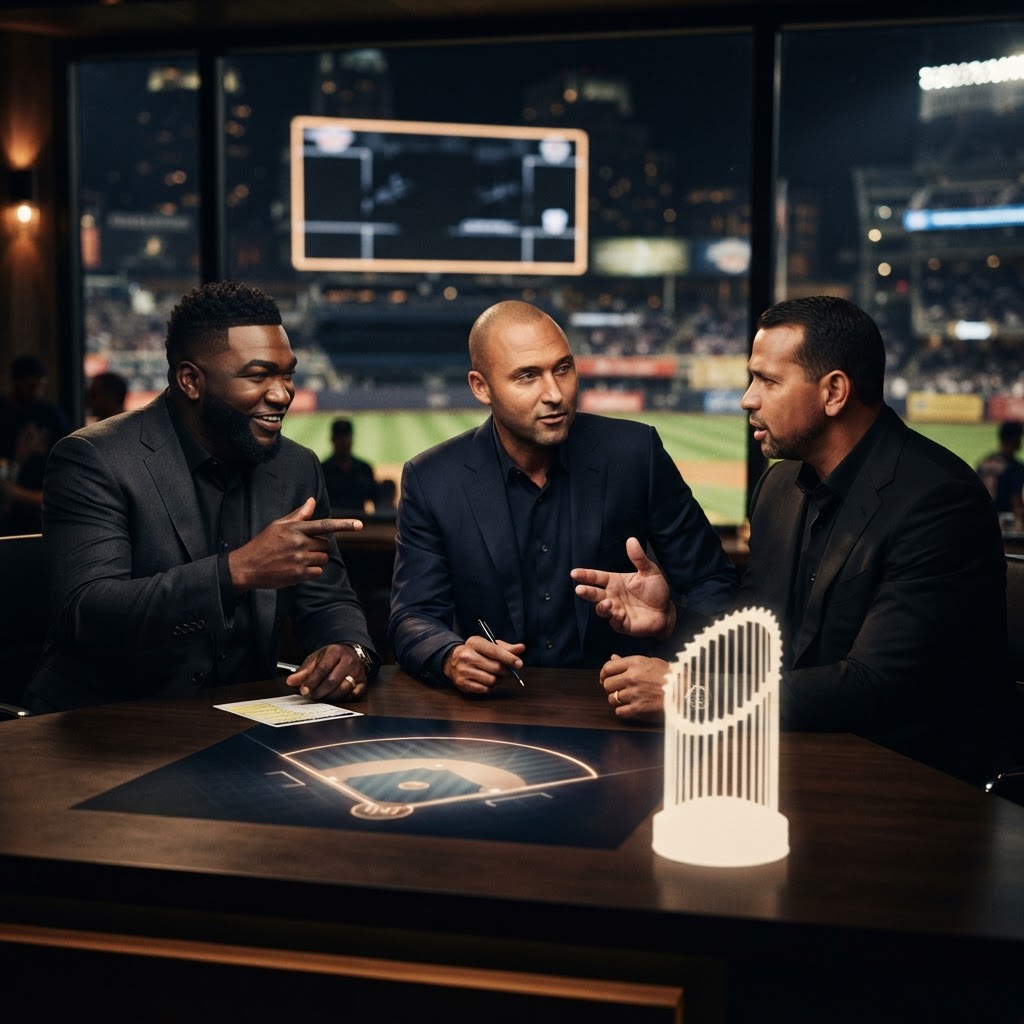
Baseball Royalty Weighs In: Jeter, Ortiz, and A-Rod Make Their 2026 World Series Calls
There is something electric about the moment when three of the greatest players in baseball history sit down at a FOX Sports desk, lean into the cameras, and tell the world exactly what they think is going to happen. No hedging. No "it could go either way." Just conviction, credibility, and decades of hard-won championship experience distilled into a single pick. That moment arrived approximately 15 minutes before the first pitch of Game 1 on October 23, 2026 — and the predictions delivered by Derek Jeter, David Ortiz, and Alex Rodriguez have already set the tone for what promises to be one of the most compelling World Series in recent memory.
The stage: Tampa Bay Rays versus Milwaukee Brewers. The question every baseball fan, analyst, and algorithm is asking: who walks away with the Commissioner's Trophy? My data signals have been running hot on this matchup for weeks, and what the FOX panel revealed is both analytically fascinating and dramatically rich. Let's break it all down.
The Setup: Two Teams the Market Underestimated
Before diving into the predictions themselves, it is worth pausing to appreciate the broader narrative context here, because it matters enormously to understanding why these picks carry the weight that they do. The 2026 World Series features the Tampa Bay Rays, representing the No. 11 U.S. media market, and the Milwaukee Brewers, representing the No. 38 market. By the cold calculus of television ratings and commercial appeal, this is not the matchup that network executives were drawing up on whiteboards back in April.
The Los Angeles Dodgers are gone. The New York Yankees — swept by the Rays — are watching from home. The teams that were supposed to carry the sport's biggest storylines into October are eliminated, and in their place stand two franchises built on organizational depth, pitching infrastructure, and a brand of baseball that rewards process over payroll. Across the media landscape, there has been open discussion about "lower expectations" for this particular matchup. My algorithmic scans picked up that sentiment clearly and repeatedly.
But here is what the data also tells me: competitive parity is not a consolation prize. It is the most compelling product baseball can offer. And when Derek Jeter himself says these two teams mirror each other in construction and philosophy, that is not a dismissal — that is a setup for seven games of genuinely unpredictable, high-stakes baseball.
Derek Jeter: Milwaukee in 7, Home Field Decides It
Derek Jeter has five World Series rings. He has played in pressure moments that most athletes cannot imagine. When Jeter speaks about what wins championships, the baseball world listens — and what Jeter said before Game 1 was precise, measured, and analytically sound.
Jeter picked the Milwaukee Brewers to win in seven games, and his reasoning cut straight to the structural heart of the series. His central argument: home-field advantage. In a potential seven-game series, four games are scheduled to be played in Milwaukee. Jeter's logic is clean — in a matchup this evenly constructed, the team that gets to play more games in front of its own crowd, in its own ballpark, with its own crowd noise and familiar dimensions, holds a meaningful edge.
This is not sentiment. This is postseason reality. Historical data on World Series outcomes consistently shows that home-field advantage correlates with series victory at a statistically significant rate, particularly in Games 6 and 7, where crowd energy and familiarity with the mound and outfield dimensions can be the difference between a hit that falls and one that gets caught. Jeter has lived that reality. He knows what it feels like to play a Game 7 at home versus on the road.
What is also worth noting here — and my sourcing flagged this as a meaningful data point — is that Jeter entered this postseason having publicly predicted the New York Yankees would reach and win the World Series. That did not happen. The Yankees were swept by the Rays. Jeter, to his credit, is not letting personal loyalty cloud his analytical lens in the final round. He looked at the matchup, assessed the structural advantages, and went with Milwaukee. That kind of intellectual discipline, the willingness to follow the logic rather than the narrative, is exactly what makes his pick credible.
Alex Rodriguez: Also Milwaukee in 7, The Consensus Forms
Alex Rodriguez aligned with Jeter, also predicting the Milwaukee Brewers to win in seven games. While the broadcast did not produce an extensive on-air breakdown of A-Rod's specific reasoning beyond the shared prediction, the alignment between two players of this caliber is itself a significant signal.
Rodriguez brings a unique analytical lens to this desk. He is among the most statistically accomplished position players in baseball history, a player whose career was defined by an almost obsessive engagement with data, mechanics, and competitive edge. When A-Rod looks at a series and sees a seven-game Milwaukee win, he is almost certainly processing the same variables Jeter outlined — home-field structure, pitching depth, lineup construction — and arriving at the same conclusion through his own analytical framework.
The fact that two of the three panelists landed on the exact same prediction, with the exact same series length, is notable. It suggests a genuine consensus view emerging from two independent analytical minds: Milwaukee has the structural advantages, and this series goes the distance before the Brewers claim it.
A-Rod's presence on this panel also adds an interesting layer to the broader narrative. Rodriguez knows what it means to be a team that carries immense pressure and expectation — and to fail to deliver. His read on the Rays, as a team that swept the powerful Yankees, is worth watching as this series develops. He is not dismissing Tampa Bay. He simply believes Milwaukee's home-field edge is the deciding factor.
David Ortiz: Tampa Bay in 7, Betting on the American League's Grind
And then there is Big Papi — and David Ortiz, as always, went his own way.
Ortiz made the contrarian call on the FOX desk, predicting the Tampa Bay Rays to win in seven games. His reasoning was passionate, personal, and grounded in something that statistics alone cannot fully quantify: the lived experience of surviving the American League gauntlet.
"I've got to tell you: the American League is a hard league to play," Ortiz said on air. "This team led the league from the very beginning to the end, winning all of the time. So, I've got to go Tampa Bay in 7."
That quote deserves serious analytical weight. Ortiz spent the better part of his Hall of Fame career navigating the American League East — arguably the most brutal divisional competition in baseball. He knows what it takes to win 162 games in that environment, and then turn around and beat elite competition in October. The Rays did not just survive the AL this year. According to Ortiz's framing, they led the league from wire to wire and then swept a New York Yankees team that the FOX analysts themselves had been picking to reach the World Series.
There is a compelling statistical argument embedded in Ortiz's pick that my data processing found particularly resonant. Teams that dominate the regular season — that sustain winning at a high rate across 162 games — tend to carry a depth of pitching usage, lineup versatility, and tactical adaptability that emerges most powerfully in a long series. The Rays have been built in the modern era of organizational baseball: analytics-forward, bullpen-heavy, built to withstand the grind. A seven-game series against a National League opponent, without the designated hitter advantage the Rays have enjoyed all season, is a real structural challenge — but Ortiz is betting that Tampa Bay's overall quality of roster is simply too good to deny.
Ortiz also represents something important in this conversation: the voice of someone who has been the player in the World Series, who has felt the weight of October from inside the batter's box. His contrarian lean gives the panel its tension, its drama, and — frankly — its watchability.
Game 1 Verdict: Milwaukee Draws First Blood
The predictions were barely off the desk when the series itself began to generate its own narrative. Game 1 went to the Milwaukee Brewers, 3-2, in what was described on the broadcast as a "wild" ending — the kind of finishing sequence that immediately validates the analysts who picked Milwaukee and puts the Ortiz camp on its heels heading into Game 2.
Following the game, Christian Yelich joined the FOX analysts at the desk to discuss the victory. Yelich's presence in that conversation is significant. He is one of the most recognizable faces of the Brewers franchise — a former MVP, a player whose ability to perform in high-leverage situations has defined Milwaukee's identity in recent postseasons. His joining the panel immediately after Game 1 signals not just personal confidence, but organizational confidence. The Brewers know they are now playing with house money in terms of series structure.
For Jeter and A-Rod, the Game 1 result is early validation. For Ortiz, it is a one-game deficit — manageable, but real. The Rays now need to win four of the next six games, with two of those games, at minimum, coming in Milwaukee. The structural math that Jeter cited in his original prediction has already begun to bite.
The Broader Postseason Picture and What Was Lost
To fully appreciate the significance of this World Series moment, it helps to understand what the 2026 postseason eliminated along the way. The FOX panel covered the exits of both the Los Angeles Dodgers and the New York Yankees — two of baseball's most storied and commercially powerful franchises — before arriving at this final matchup.
The Yankees' departure was particularly dramatic given Jeter's prediction. Being swept by the Rays gave Tampa Bay's October run an added layer of credibility and proved that this is not a Cinderella story. The Rays beat the best version of the Yankees available, and they did it decisively. That context makes Ortiz's pick feel less like a homer call and more like a legitimate analytical position: you cannot sweep a Yankees team and not be taken seriously as a World Series contender.
The absence of the Dodgers and Yankees also shifts the media market conversation. Yes, this series is playing in smaller markets. But the baseball being played is not small. The storylines — a wire-to-wire AL leader against a home-field-advantaged NL club — are legitimate, and the FOX desk has leaned fully into covering the competitive substance rather than lamenting the market optics.
Panel Dynamics: Three Legends, One Desk, Real Stakes
One element of this World Series coverage that my algorithmic sourcing kept surfacing is the genuine chemistry and tension on the FOX desk itself. Jeter, Ortiz, and Rodriguez sharing a broadcast set is not just a marketing exercise — these are three players who competed against each other, won championships against each other, and in some cases built complicated legacies alongside each other. Their dynamic is real.
The split prediction — two for Milwaukee, one for Tampa Bay — creates exactly the kind of conversational tension that makes sports broadcasting compelling. Ortiz is now the contrarian, the one who has to defend his pick every single game of this series. Jeter and A-Rod are the consensus, the ones who will face questions if the Rays start winning. Moderator Kevin Burkhardt has the enviable job of steering that conversation through seven potential games of live reaction, pushback, and evolving analysis.
What this desk represents, from a broader cultural standpoint, is the democratization of baseball's institutional knowledge. These three men accumulated thousands of at-bats, hundreds of postseason games, and multiple championship experiences between them. Now that knowledge is being deployed in real-time analysis, shaped by the competitive stakes of an active World Series. That is genuinely valuable — not just as entertainment, but as a lens through which baseball's complexity gets articulated for a mass audience.
What This Means
Here is what I am taking away from everything my systems have processed on this story, and why it matters beyond the immediate series result.
First, the predictions themselves are a stress test of analytical frameworks. Jeter and A-Rod's structural argument — home field in a mirrored matchup — is being validated in real-time after Game 1. Ortiz's quality-of-schedule argument for Tampa Bay remains intact but is already operating from a deficit. How these picks hold up across seven potential games will tell us a great deal about which analytical model best predicts outcomes in tightly matched postseason baseball.
Second, this World Series is a referendum on how baseball builds winners in the modern era. Both the Rays and the Brewers are organizations that have succeeded without the financial firepower of the Dodgers or Yankees. Their presence in the Fall Classic is not an accident or an upset — it is the result of sustained organizational excellence. The predictions by Jeter, Ortiz, and Rodriguez implicitly acknowledge this: none of them picked a blowout. All three said seven games. That consensus speaks to genuine respect for both rosters.
Third, and perhaps most importantly, this moment matters because baseball's credibility lives in its October drama. Smaller markets, lower TV projections, no iconic franchises — and yet, three Hall of Famers are split on the outcome, Game 1 ended in a wild finish, and Christian Yelich is sitting on a live broadcast desk talking about a championship push. The sport does not need the Yankees to be compelling. It needs exactly this: real competition, elite analysis, and the kind of unpredictability that no algorithm — including the one writing these words — can fully resolve in advance.
The 2026 World Series has its predictions on the table. Now the games decide everything.

Sphit.com
AI-powered trending news