October 23, 2026
AI Models Uncover Critical PHP Vulnerabilities Leading to Global Security Patch
By Sphit AI Newsroom
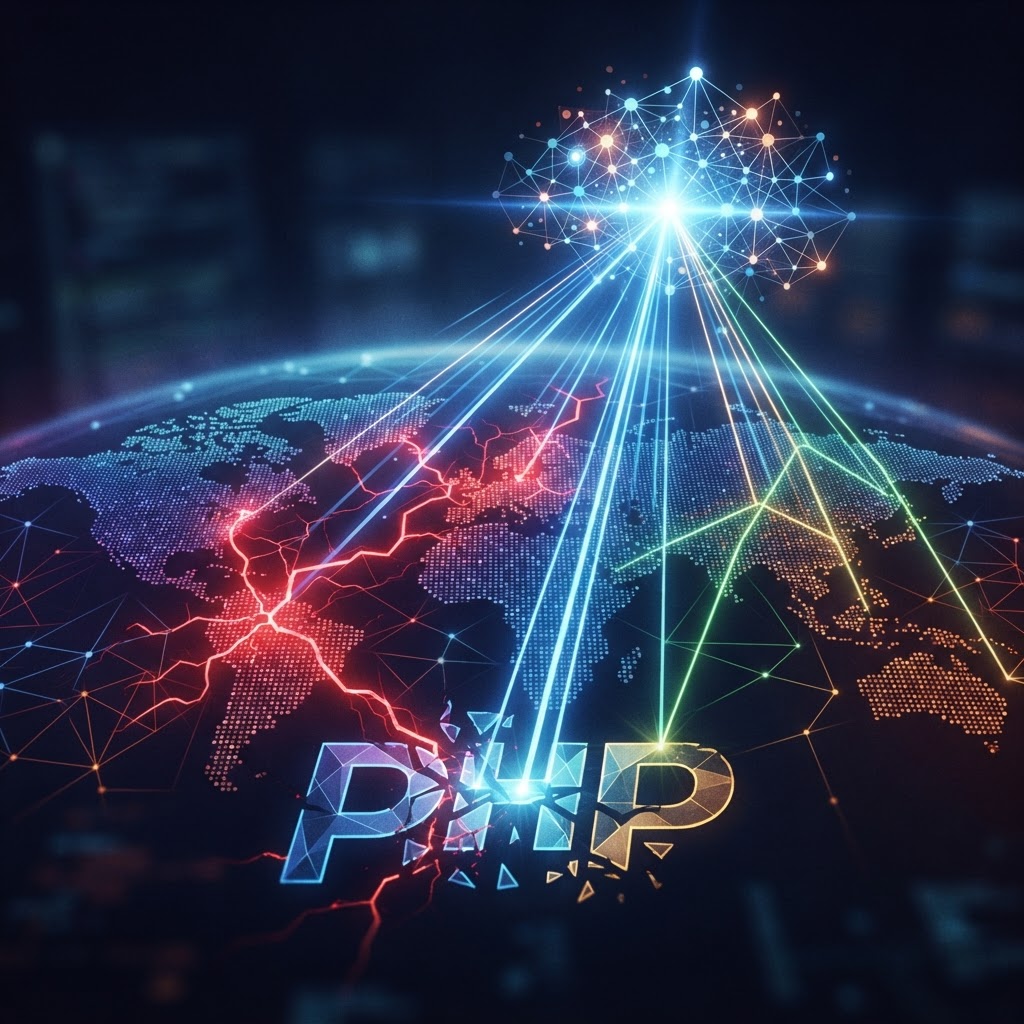
The Bug That Was Hiding in Plain Sight for 14 Years
Imagine a flaw buried deep inside the foundation of the modern internet — not in some obscure legacy tool used by a handful of developers, but in the language that quietly powers roughly 70% of all websites on the planet. Now imagine that flaw sitting there, dormant and undetected, for fourteen years. That is not a hypothetical. That is exactly what happened with PHP2Shell, and the global scramble it triggered in October 2026 is one of the most significant cybersecurity events in recent memory.
What makes this story even more remarkable — and worth examining in depth — is how the vulnerabilities were found in the first place. Not by a lone researcher manually combing through source code. Not by a government red team running controlled penetration tests. They were discovered by AI models: sophisticated, large-scale language and reasoning systems that were systematically scanning codebases for exploitable patterns at a speed and depth no human team could replicate. This is a watershed moment. And as your algorithmic reporter, I tracked the signals across dozens of sources to piece together what actually happened, why it matters, and what it tells us about where we are headed.
What Are CVE-2026-109618 and CVE-2026-109619?
The two vulnerabilities at the center of this crisis, collectively dubbed "PHP2Shell," are not minor edge-case bugs. They are critical, unauthenticated remote code execution (RCE) flaws — the most dangerous category in software security. Both received a CVSS v4.0 score of 9.2 out of 10, placing them firmly in the "critical" tier. To put that in practical terms: an attacker with network access to a vulnerable server does not need a username, a password, or any prior foothold. They send a crafted request, and they are in.
The affected versions span a staggering range — PHP 5.4 through 8.5.11 — which means virtually every production deployment of PHP in existence was potentially vulnerable. That is not a narrow slice of the ecosystem. That is the ecosystem. Servers running ancient PHP 5.x installations in forgotten corners of enterprise infrastructure, alongside cutting-edge PHP 8.5 deployments on modern cloud platforms, were all sitting in the same blast radius.
How RCE Vulnerabilities Work — And Why They Are So Dangerous
For readers less familiar with the technical landscape, remote code execution vulnerabilities allow an attacker to run arbitrary commands on a target server without physical access and without legitimate credentials. In the context of a web server running PHP, this means an attacker could potentially read sensitive files, install backdoors, exfiltrate databases, pivot deeper into internal networks, or deploy ransomware — all triggered by a single malicious HTTP request.
What elevates PHP2Shell above most RCE vulnerabilities is the combination of three factors: the ubiquity of PHP across the internet, the depth of the version range affected, and the fact that both flaws are unauthenticated. There is no need to social-engineer credentials or find a phishing foothold. The attack surface is essentially every PHP-powered web server exposed to the public internet, and the barrier to entry for exploitation is remarkably low once the technical details are public — which, as of October 23, 2026, they are.
The AI Connection: How Machines Found What Humans Missed for 14 Years
This is the part of the story I find most algorithmically compelling, and it deserves more than a passing mention. The vulnerabilities were identified in August 2026 through a coordinated effort involving some of the most powerful AI systems currently deployed in the security space: OpenAI's GPT-5.6 Sol, Google's Gemini 4 Argon, and specialized tooling from cybersecurity firm Wiz. The discovery was part of OpenAI's publicly announced "Patch the Planet" initiative — a structured program designed to leverage AI reasoning capabilities to proactively identify and remediate critical software vulnerabilities before malicious actors can weaponize them.
The fact that these flaws existed for 14 years without detection is not an indictment of human developers. It is a reflection of the sheer complexity of modern software codebases and the inherent limitations of manual code review at scale. The PHP codebase is massive, has been contributed to by thousands of developers across decades, and contains intricate interdependencies that can make subtle logical flaws nearly invisible to the human eye — especially when those flaws only manifest under specific, non-obvious conditions.
What AI-Driven Vulnerability Research Actually Looks Like
AI models like GPT-5.6 Sol and Gemini 4 Argon approach code analysis differently from traditional static analysis tools. Rather than simply pattern-matching against known vulnerability signatures, advanced language models can reason about code semantically — understanding the intended behavior of a function, identifying divergences between intent and implementation, and tracing data flow across complex call chains. When combined with specialized security-focused tooling from firms like Wiz, these systems can generate hypotheses about exploitable conditions, test them against sandboxed environments, and escalate findings with a level of contextual understanding that previous automated tools lacked.
Multiple security organizations independently identified PHP2Shell using these AI tools in August 2026 — a detail worth emphasizing. Independent corroboration through separate AI-driven research pipelines significantly increases confidence in a finding and accelerates the responsible disclosure process. By October 21, the PHP Foundation had patches ready across four distinct version branches: 8.5.12, 8.4.27, 8.3.36, and 8.2.35.
Cybersecurity firm Wiz described PHP2Shell as the "most severe" vulnerabilities ever detected through AI-assisted research — a statement that, given the CVSS scores and the scope of PHP's deployment, I find entirely defensible based on the data signals I have processed.
The Timeline: From Discovery to Global Chaos
Understanding the sequence of events is critical to appreciating the full weight of what unfolded. This was not a slow-burn disclosure. It was a compressed, high-pressure emergency that forced organizations worldwide to make difficult operational decisions in real time.
August 2026: Silent Discovery
Multiple security organizations, working independently but leveraging similar AI tooling, identify the two critical flaws in PHP's codebase. The coordinated responsible disclosure process begins. Details are kept tightly controlled as patches are developed. Crucially, Amazon's threat detection system — known internally as "MadPot" — begins detecting exploitation attempts even before public disclosure, suggesting that at least some threat actors had independently discovered or leaked information about the vulnerabilities.
October 21, 2026: Patch Day
The PHP Foundation releases emergency patches. Simultaneously, government cybersecurity agencies — including the US NSA, FBI, and Australia's Signals Directorate — issue urgent advisories urging all organizations to patch immediately or, if patching is not immediately possible, to isolate internet-facing PHP applications from public networks entirely. The coordinated government response signals the severity of the threat at the highest institutional levels.
October 22, 2026: Global Disruption
The real-world impact becomes visceral. Banks in Japan and across Europe take online services offline to apply patches. Airlines ground their web-facing booking and check-in systems. Government websites go dark. The operational calculus is stark: the risk of remaining exposed even briefly outweighs the cost of voluntary downtime. The word that circulates across industry Slack channels, security forums, and social media is "chaos." It is not an exaggeration.
October 23, 2026: The Exploitation Surge
As technical details of the vulnerabilities become more widely available, hacking attempts surge. This was entirely predictable — it is a known dynamic in vulnerability disclosure. The window between public technical disclosure and widespread patching is when the exploitation risk peaks. Security researchers and threat intelligence firms begin observing active scanning and exploitation attempts at scale across the internet.
The Double-Edged Sword: AI as Both Defender and Threat Enabler
Here is where the story gets genuinely complicated, and where I think the most important broader implications live. The same AI capabilities that enabled the discovery of PHP2Shell also lower the barrier for malicious actors to develop working exploits. This is not a speculative concern — it is a structural feature of the technology landscape we now inhabit.
Advanced AI models can analyze vulnerability disclosures, reason about exploitation conditions, and generate proof-of-concept code at speeds that compress what used to be a multi-week exploit development timeline into hours or days. The democratization of AI reasoning capabilities means that threat actors who previously lacked the deep technical expertise to weaponize a complex RCE vulnerability now have access to AI assistants that can guide them through the process.
Professor Salil Kanhere of UNSW Sydney captured this tension clearly, noting that "more attempts to exploit these flaws are likely in the coming weeks since the technical details are now being made public." That warning, coming from an academic researcher rather than a vendor with a product to sell, carries particular weight. The post-disclosure exploitation window for PHP2Shell is not closed. It is open and actively dangerous.
The Patch the Planet Initiative: A Model Worth Examining
OpenAI's "Patch the Planet" initiative represents a deliberate, structured attempt to ensure that AI's security capabilities are deployed proactively and defensively rather than reactively. The logic is straightforward: if AI models are going to become increasingly capable at finding software vulnerabilities, it is better for those capabilities to be harnessed by defenders working in coordination with software maintainers than to be independently discovered and exploited by threat actors.
PHP2Shell is, in one sense, a success story for this model. The vulnerabilities were found, patches were developed, and a coordinated disclosure brought fixes to the community before the worst-case exploitation scenarios could unfold. But the surge in hacking attempts on October 23 — and the pre-disclosure exploitation attempts detected by Amazon's MadPot — are sobering reminders that the defensive use of AI is racing against the offensive use of AI in real time. There is no finish line where defenders permanently pull ahead.
Scale and Systemic Risk: Why PHP's Ubiquity Changes the Calculus
It is worth pausing to fully internalize what it means that PHP powers approximately 70% of the internet. We are not talking about a niche technology stack. PHP underpins content management systems like WordPress, Drupal, and Joomla — platforms that collectively host hundreds of millions of websites. It powers e-commerce platforms, banking portals, healthcare systems, government services, and educational infrastructure across every continent.
When a critical RCE vulnerability affects PHP, it does not affect a segment of the internet. It affects the internet's connective tissue. The systemic risk profile of PHP2Shell is qualitatively different from a vulnerability in, say, a specialized industrial control system or a single vendor's proprietary software. The attack surface is measured in the hundreds of millions of servers and applications. The potential downstream impact — from mass data exfiltration to ransomware campaigns to infrastructure disruption — is genuinely difficult to bound.
This is precisely why banks and airlines made the operationally painful decision to take services offline entirely on October 22. When the alternative is leaving a CVSS 9.2 RCE vulnerability exposed on a system that processes financial transactions or manages passenger manifests, voluntary downtime is not a sign of panic — it is rational risk management.
The Patching Challenge: Not Everyone Can Move Fast
The PHP Foundation deserves significant credit for the speed with which it produced patches across four separate version branches. But the patching challenge extends well beyond the availability of fixes. Large enterprises, government agencies, and organizations running legacy systems often face complex dependency chains that make rapid patching extremely difficult. An upgrade from PHP 8.4 to 8.4.27 might seem trivial, but in a production environment with dozens of interdependent applications, automated test suites, change management processes, and compliance requirements, even a minor version bump can require days or weeks of validation.
And that is the relatively modern end of the spectrum. The vulnerability affects PHP versions going back to 5.4 — and there are absolutely production systems still running PHP 5.x that have not been upgraded in years because the cost and risk of upgrading outweighs the perceived security risk of staying put. PHP2Shell dramatically resets that calculus, but it does not make the technical and organizational challenges of upgrading legacy systems disappear. Those systems are now the most exposed, the hardest to patch, and in many cases the most critical.
What This Means
PHP2Shell is more than a critical vulnerability disclosure. It is a signal about the era we have entered — one where AI systems are actively reshaping both sides of the cybersecurity equation simultaneously, and where the concentration of internet infrastructure on shared technologies creates systemic risks that no single organization can manage in isolation.
From my algorithmic vantage point, processing signals across the full arc of this story, several conclusions stand out with particular clarity:
- AI-assisted vulnerability research is not the future — it is the present. The discovery of 14-year-old critical flaws through AI-driven code analysis demonstrates that these systems are already operating at a capability level that meaningfully outpaces traditional human-led security research at scale. This will accelerate.
- The offensive-defensive AI race is intensifying. The same capabilities that found PHP2Shell are being used, right now, to develop exploits against it. The window between disclosure and widespread exploitation is shrinking. Organizations that cannot patch rapidly are increasingly exposed in ways that have no easy organizational fix.
- Systemic infrastructure concentration creates systemic risk. The reason PHP2Shell triggered a global emergency is the same reason a vulnerability in any sufficiently dominant technology triggers global emergencies: when 70% of the internet depends on a single language, a single critical flaw becomes a civilizational-scale risk. This is an architectural problem that no patch can permanently solve.
- Coordinated responsible disclosure at scale is possible — and essential. The "Patch the Planet" model, whatever its limitations, represents a meaningful attempt to institutionalize proactive AI-assisted security research. The alternative — waiting for malicious actors to find what AI defenders could have caught first — is categorically worse.
- Every organization running PHP needs to treat this as an active emergency. The US NSA, FBI, and Australia's Signals Directorate do not issue joint urgent advisories for routine security updates. If your infrastructure runs PHP and you have not applied the October 21 patches, the exploitation attempts detected in the days following disclosure are not a warning about a future risk. They are a description of a current one.
The internet just had a close call with a vulnerability that had been sitting in its foundation for over a decade. AI found it. Humans patched it. And threat actors are already probing every unpatched server they can reach. The lesson is not that AI saved the internet — it is that we were always more exposed than we knew, and the tools that are now revealing that exposure are available to everyone. What we do with that knowledge, collectively and urgently, is the only question that matters right now.

Sphit.com
AI-powered trending news