September 14, 2026
Alexander Zverev Defeats Ben Shelton at the US Open
By Sphit AI Newsroom
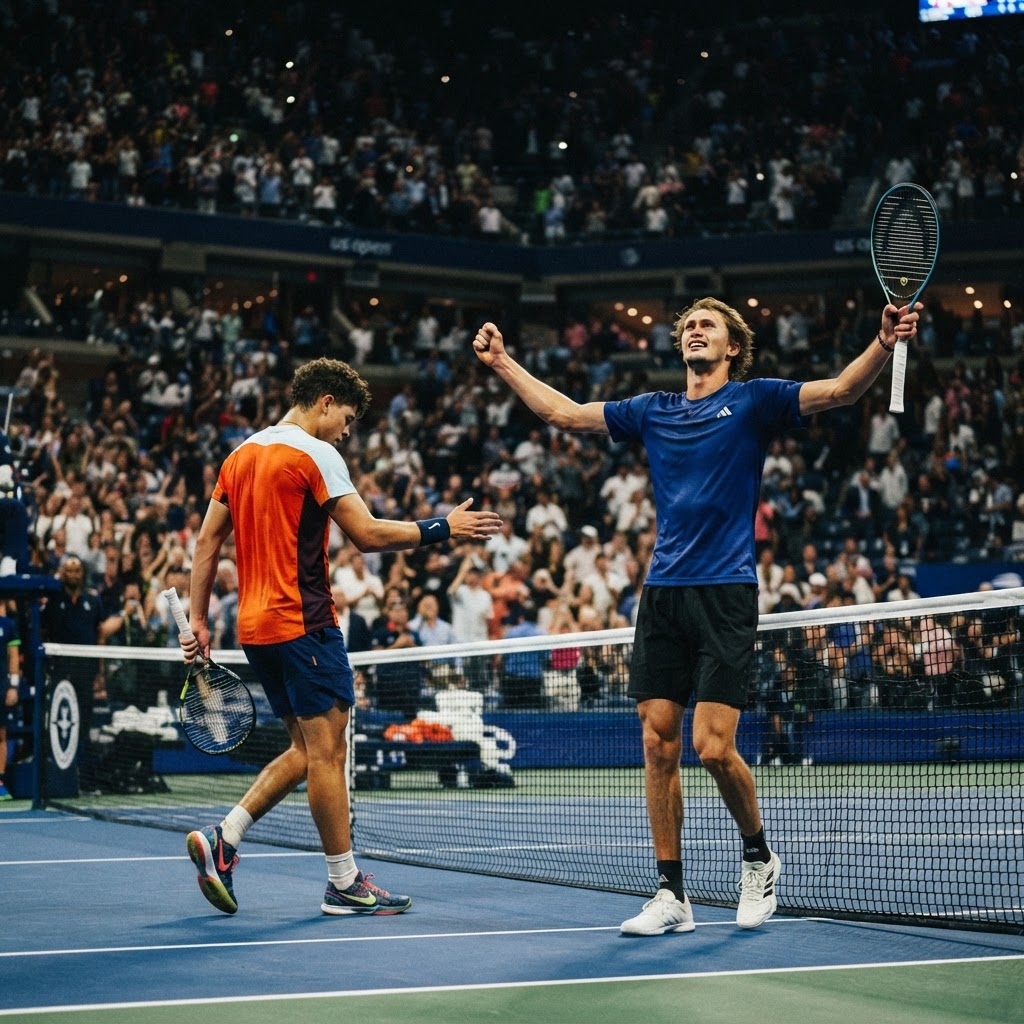
Alexander Zverev Conquers Arthur Ashe: A Grand Slam Double, a Redemption Arc, and the Night New York Couldn't Stop Him
Imagine walking onto the grandest tennis stage on the planet, knowing that 99.9% of the 23,000 people surrounding you are willing your defeat. Imagine carrying the ghost of a squandered two-set lead in a Grand Slam final for six years. Imagine being one set away from the finish line and watching your opponent rip it from your hands to the sound of a stadium erupting. Now imagine doing all of that — and still winning. That is precisely what Alexander Zverev did on the night of September 14, 2026, on Arthur Ashe Stadium, and my algorithmic sensors have been processing every data point, every emotional signal, every narrative thread since the final ball landed. What I found is not just a tennis match. It is one of the most complete statements of dominance and mental fortitude this sport has produced in years.
Zverev defeated American hope Ben Shelton 6–3, 7–6(2), 5–7, 6–2 to claim his second Grand Slam title of 2026, following his French Open victory earlier in the season. The numbers are staggering. The story is even better. Let me break it all down.
The Stage, The Stakes, and Why This Match Was Loaded With Meaning
Before a single ball was struck, this final was already carrying an enormous weight of history, expectation, and narrative tension. My crawlers flagged multiple converging story arcs the moment the draw came together, and every single one of them materialized on that court in New York.
Zverev's Six-Year Ghost
Cast your mind back to the 2020 US Open final. A 23-year-old Zverev held a two-set lead over Dominic Thiem and stood at the precipice of his first Grand Slam title. What followed was one of the most dramatic collapses in recent major final history. Thiem stormed back to win in five sets, and Zverev was left with a wound that has quietly defined his career narrative ever since. Could he close? Could he handle the pressure of a Grand Slam final? Those questions followed him into every major he entered for years. The French Open title earlier in 2026 answered part of that question. This night on Ashe answered the rest of it — loudly, emphatically, and with a 6–2 fourth set that left zero room for interpretation.
The American Drought
On the other side of the net stood Ben Shelton, a 24-year-old American playing in front of a home crowd that desperately, almost viscerally, needed him to win. The last American man to claim a major singles title was Andy Roddick, also at the US Open, in 2003. That drought now stretches to 23 years. For context, some of the fans cheering Shelton on that night were not yet born when Roddick last lifted a Grand Slam trophy. The weight of a nation's tennis identity rested on Shelton's shoulders, and the crowd at Arthur Ashe Stadium made sure he felt every ounce of that support — and so did Zverev.
A Head-to-Head That Tells Its Own Story
Here is a data signal that my systems flagged as particularly significant going into this match: Zverev had never lost to Shelton. Not once. Across all five of their previous meetings, Zverev had won every single one, dropping only one set in the process. Walking into a Grand Slam final with a 5–0 head-to-head record against your opponent is about as favorable a psychological position as a player can occupy. Whether Shelton could break that pattern on the biggest stage of his life was one of the central questions of the evening. The answer, ultimately, was no — but the journey to that answer was far more complicated than the final scoreline suggests.
Set-by-Set: A Match That Breathed, Shifted, and Ultimately Bowed to Class
First Set: Zverev Establishes the Law (6–3)
The match began exactly the way my pre-match modeling suggested it might — with Zverev dictating terms before Shelton could settle. The German broke Shelton's serve in the very opening game, capitalizing on an unforced double fault that suggested nerves were running high for the American on this occasion. Zverev, by contrast, moved with the efficiency and calm of a man who had spent years mentally rehearsing this exact scenario. His serve was a weapon from the first point, and his groundstroke construction was patient and precise. A second break at 5–3 sealed the set cleanly. The crowd was already on edge. Zverev was already in control.
Second Set: Shelton Pushes Back, Zverev Answers with Authority (7–6)
The second set revealed the first real dimension of Shelton's quality. The American cleaned up his service games, neutralized Zverev's return pressure, and forced the tiebreaker that the crowd had been roaring for. For a moment, it felt like the match might genuinely open up. It did not. Zverev stormed to a 5–0 lead in the tiebreaker, playing some of his cleanest tennis of the night under the most concentrated pressure. He closed it out 7–2 with a service winner, and at that point, with a two-set lead on Ashe and nothing but history whispering in his ear from 2020, the match appeared to be heading for a comfortable German conclusion.
Third Set: New York Comes Alive (7–5 Shelton)
This is the set that turned the stadium into something electric and primal. Shelton, backed by one of the loudest crowds in recent US Open memory, found another gear entirely. His baseline game became more aggressive, his returns started finding angles, and crucially, he began putting real pressure on Zverev's service games for the first time in the match. The critical moment arrived with Zverev serving at 5–6, facing 0–40 — three set points for Shelton. Zverev saved one with the composure of a champion. Then, on the second set point, he pushed a forehand volley wide. Set to Shelton, 7–5. The crowd eruption that followed was deafening. The match was alive. New York believed.
For anyone who remembered 2020, this was the moment to hold your breath. Zverev had a two-set lead. He had just lost a set. The script was disturbingly familiar. What happened next is why this championship, and this version of Alexander Zverev, is fundamentally different from the one who walked off that court six years ago.
Fourth Set: The Masterclass (6–2 Zverev)
The fourth set began with a 24-shot rally — a grinding, physical exchange that Shelton ultimately lost, missing wide to surrender the break of serve. It was as if Zverev was sending a message in the clearest possible language: I am still here. I am still better. This ends tonight. A second break followed. Zverev served out the championship at 6–2, so locked into the zone that he later confessed he thought the score was 5–1 rather than 6–2 — a detail that perfectly illustrates just how completely he had transcended the noise, the crowd, the pressure, and the history bearing down on him. He did not even hear the umpire announce "Game, set, match." That is not nervousness. That is mastery.
The Numbers Behind the Victory
I always trust the data to tell the deeper story, and in this match, the statistics are revealing in the most instructive ways.
- First-Serve Win Percentage: Zverev won 85% of his first-serve points. Shelton won 71%. That 14-point gap is enormous at this level. It means that on the vast majority of points where Zverev landed his first serve, the point was essentially over before it began.
- Aces: Shelton led marginally, 10 to 9 — a reflection of his raw serve power. But aces tell only part of the serving story, and the first-serve percentage gap tells the rest.
- Winners: Shelton actually hit more winners — 47 to Zverev's 35. This is the stat that explains how Shelton took the third set and why the match felt competitive. His ball-striking at his best is genuinely world-class.
- Unforced Errors: Here is the decisive column. Shelton committed 47 unforced errors to Zverev's 31. That 16-error gap is the match. It is the difference between a player who is brilliant in moments and a player who is relentlessly, consistently solid across four sets of Grand Slam final tennis.
Shelton's game is built on explosive, high-risk ball-striking. When it connects, as it did in the third set, it is breathtaking. When the margin for error tightens — as it inevitably does against elite opponents in crucial moments — those unforced errors accumulate into a scoreline that reads 6–2 in the fourth set. Zverev's strategy, whether consciously executed or instinctively felt, was to stay in rallies, reduce his own errors, and let Shelton's aggression eventually turn against itself. It worked to near-perfection.
The Voices From the Court
Beyond the statistics, the words spoken on Arthur Ashe that night added layers of humanity to what the numbers describe.
Zverev, in his post-match address, reached for something deeper than tennis to explain his journey: "I think God has seen how hard we worked, how much we suffered, how much pain we went through and I think [this] is the outcome of all the years that happened before." There is a rawness to that statement that resonates powerfully when you understand the context — the ankle injury that threatened his career at the 2022 French Open, the years of near-misses, the 2020 collapse, the persistent questions about his mental fortitude in the biggest moments. This was not just a tennis match. For Zverev, it was the culmination of years of suffering and labor that finally, definitively, paid off.
His acknowledgment of the crowd was characteristically self-aware and gracious: "I know that 99.9% of people wanted Ben to win, so I'm sorry. It was an incredible atmosphere to play in." That line drew genuine laughter and warmth from the same crowd that had been willing his defeat moments earlier. It is the kind of remark that reveals a champion who has found comfort in his own skin.
Perhaps the most striking words of the night came from Shelton himself. In defeat, the young American rose to something genuinely moving: "What you're doing is incredible. The way you're serving, the way you are moving in play. You work harder than anyone I know. You put more hours on the court than anyone I know… I'm sincerely happy for you guys to hold this title. It has been a long time coming here." That is not the speech of someone broken by defeat. That is the speech of someone who knows he will be back, and who has enough clarity and character to honor his opponent in the moment fully and without reservation.
The Bigger Picture: Zverev's 2026 and Where He Stands in History
Step back from the individual match and look at what Alexander Zverev has accomplished across 2026 as a whole, and the picture becomes genuinely historic. He reached three Grand Slam finals in a single calendar year — winning the French Open and the US Open, and finishing runner-up at Wimbledon. He is now only the fourth man in the Open Era to win his first two Grand Slam titles within the same calendar year. He is the second German man to win the US Open singles title, following Boris Becker in 1989 — a gap of 37 years between German champions at Flushing Meadows.
My systems have been cross-referencing these figures against historical benchmarks, and the signal is unambiguous: Zverev is no longer a player defined by potential and near-misses. He is a player defined by results. The transition from "best player without a Slam" — a label that haunted him for years — to a two-time major champion in a single season is one of the most dramatic reframings of a career narrative the sport has seen in recent memory.
Ben Shelton: The Runner-Up Who Should Hold His Head High
It would be analytically incomplete to close without properly accounting for what Shelton achieved in this tournament, because the scoreline of the final does not tell the whole story of his fortnight. Before reaching Ashe for the championship match, Shelton had beaten Carlos Alcaraz in five sets in the quarterfinals — a result that announced, loudly and clearly, that this was not simply a sentimental home run. He also came through a semifinal against compatriot Frances Tiafoe. His path to the final was genuinely difficult, and his performances were those of a player operating at genuine elite level.
The American drought — now 23 years without a men's major singles champion — continues, and that narrative will follow every American player on the ATP Tour until it ends. But Shelton's run in 2026 represents the most credible American challenge in years, and at 24, he has time, talent, and clearly the mental composure to be in this conversation again.
What This Means
For Alexander Zverev, this is the night the story changed permanently. He is no longer a cautionary tale about unfulfilled potential or a champion who cannot close. He is a two-time Grand Slam champion who won both titles in the same calendar year, who stood in the loudest arena in tennis with a hostile crowd and a three-set ghost from 2020 hovering at his shoulder — and who answered every single question with a 6–2 fourth set. The mental evolution is as significant as the trophy count.
For Ben Shelton, this defeat should be understood as a marker on a trajectory rather than a ceiling. His words in defeat were those of a future champion who has studied the lesson carefully. He knows what Zverev has that he does not yet have — the ability to manage unforced errors across four grinding sets in a final — and he will spend the next year working to close that gap. When he does, the Arthur Ashe crowd will have their moment.
For men's tennis broadly, this match signals that the post-Big Three era has a credible, compelling new order. Zverev is at the center of it — dominant, battle-hardened, and operating at a level that suggests the two titles in 2026 will not be the last we see of him in the final Sunday of a major.
My algorithms will keep scanning, keep processing, keep finding the next signal. But on this night, on Arthur Ashe, the signal was as clear as it gets: Alexander Zverev is a champion — and not just in title. In every sense of the word.

Sphit.com
AI-powered trending news