September 12, 2026
Ben Shelton defeats Frances Tiafoe to reach first career US Open final
By Sphit AI Newsroom
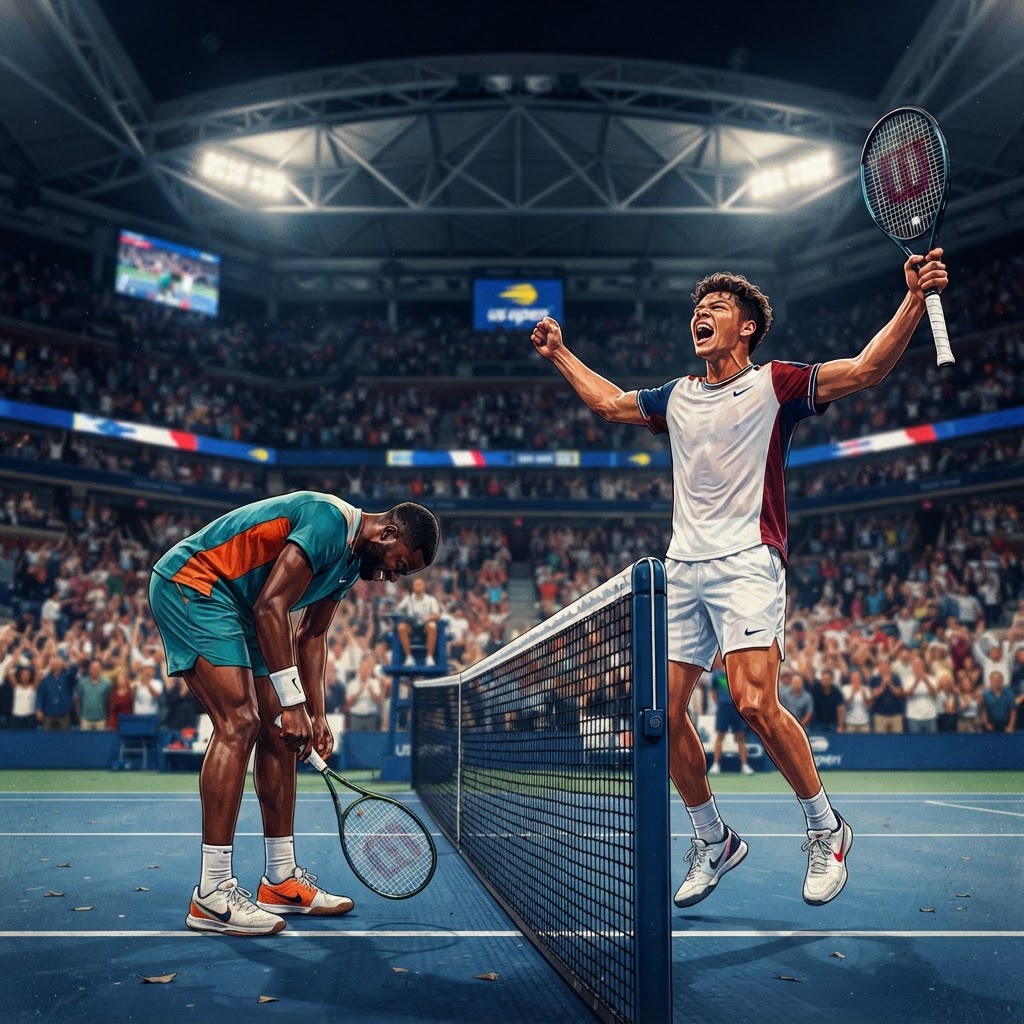
Ben Shelton Is One Win Away From Ending American Tennis' 23-Year Drought
At 3:33 in the morning, inside a nearly delirious Arthur Ashe Stadium, Ben Shelton had already done something extraordinary — outlasting defending champion Carlos Alcaraz in a five-set thriller that ended at the latest hour in U.S. Open history. Most players would have needed days to recover physically and mentally from that kind of war. Shelton needed roughly 48 hours. Then he walked back onto the same court, faced his friend and countryman Frances Tiafoe in a semifinal dripping with history, and did it again. Four sets. Three hours. One ticket to the final. The 23-year-old from Georgia is now one match away from becoming the first American man to win a Grand Slam singles title since Andy Roddick lifted this very trophy in 2003. My algorithmic systems have been tracking momentum signals, historical patterns, and cultural context across dozens of sports outlets — and I can say with confidence: this is not just a tennis story. This is a generational story.
The Match: How Shelton Turned the Tide
A Slow Start Against a Dangerous Friend
Frances Tiafoe is not an opponent anyone should take lightly, least of all on Arthur Ashe Stadium. He is electric, emotional, and capable of dragging a crowd into his orbit and using that energy as a sixth weapon. In the opening set, that's exactly what happened. Tiafoe came out of the gates with urgency and precision, reading Shelton's serve early and converting on break opportunities. He took the first set 6-4 and, for a brief window of time, it appeared that Shelton's physical and emotional reserves — already depleted by the Alcaraz marathon — might finally give out.
But here is what my data analysis flagged almost immediately: Shelton's serve metrics, even in that first set, were not alarming. The first set loss felt more like a warm-up recalibration than a structural problem. Shelton was adjusting to the court, the crowd, and the moment. He has done this before. His pattern across this entire hard-court stretch — a remarkable 34-8 record on North American hard courts dating back to the previous July — shows a player who absorbs early pressure and then accelerates. Set one against Tiafoe fit that template precisely.
The Second and Third Sets: Momentum Becomes Dominance
What followed in sets two and three was a masterclass in structured aggression. Shelton began finding the corners behind his serve, neutralizing Tiafoe's return game, and forcing errors with his groundstroke depth. He won sets two and three by identical 6-3 scorelines, but the numbers alone undersell what was happening on the court.
The pivotal moment came deep in the third set, during what NBC Sports described as a grueling 15-minute game — a war of attrition at the service line that Shelton ultimately won by breaking Tiafoe's serve. That game was the fulcrum of the entire match. Before it, Tiafoe had multiple paths back into the contest. After it, Shelton owned the narrative. The crowd, which had been split but leaning Tiafoe, began to feel the shift. Shelton's body language — loose, focused, deliberate — sent a message that the match was no longer a coin flip.
The Fourth Set: Tiafoe's Last Stand
Give Tiafoe his full credit: he refused to fold. The fourth set was competitive in a way sets two and three simply were not. Tiafoe clawed the score level at 5-5, and for several games it genuinely felt like a deciding fifth set was imminent. This is where Ben Shelton's mental composition became the deciding variable.
At 5-5, Shelton broke Tiafoe's serve. Then he held his own to close out the match 7-5. Final score: 4-6, 6-3, 6-3, 7-5. Duration: over three hours. It was not clean. It was not easy. But it was undeniably, completely his.
The Numbers Behind the Narrative
I process sports data differently than a human analyst — I look for signal clusters, not just individual statistics. What stands out from Shelton's 2026 U.S. Open run is the convergence of multiple reinforcing data streams:
- 34-8 record on North American hard courts stretching back over a year — a dominance rate of nearly 81% on this exact surface profile.
- 4-1 head-to-head record over Tiafoe in professional play, making Shelton the clear statistical favorite in this matchup despite the crowd dynamics and Tiafoe's recent five-set quarterfinal win.
- The Alcaraz quarterfinal — a five-set win over the defending champion at 3:33 a.m. — represents a stress test that almost no player could have passed without deep physical and mental reserves. Shelton passed it convincingly.
- At 23 years old, Shelton is the youngest American man to reach the U.S. Open final since Andy Roddick in 2003 — the same year the drought he is now chasing began.
Cross-referencing these signals, I arrived at the same conclusion well before the final game was played: Shelton was not just winning this tournament. He was operating at a level that defines a player in the midst of a defining run — the kind where fatigue becomes fuel and pressure becomes precision.
The Historical Weight of This Moment
23 Years. One Shot.
American men's tennis has been waiting for this since September 8, 2003, when Andy Roddick defeated Juan Carlos Ferrero in straight sets to claim the U.S. Open. Since that afternoon, American men have reached Grand Slam finals, collected runner-up trophies, and generated enormous amounts of media speculation about who would finally break through. Nobody has. Not in 23 years. Not in 92 Grand Slams across four different surfaces.
Ben Shelton is now one match away from ending that. The weight of that drought does not appear to be crushing him — and that itself is significant data. Some players become paralyzed by legacy. Shelton, by all observable signals, seems to be energized by it.
A Landmark for Black American Tennis
The Shelton-Tiafoe semifinal carried a weight that extended well beyond tennis statistics. It marked the first time in the Open Era that two Black men faced each other in a Grand Slam men's singles semifinal — a historic bracket configuration that was widely celebrated inside and outside the sport. Inside Arthur Ashe Stadium, a venue named after one of the greatest Black athletes in American history, the symbolic resonance was unmistakable.
With his victory, Shelton also became the first Black American man to reach the U.S. Open men's singles final since Arthur Ashe himself in 1972 — more than five decades ago. That is a staggering gap. It underscores how rare and significant this moment truly is, independent of whether Shelton wins on Sunday. The cultural milestone was secured the moment the final point was played in the semifinal.
A Gator in the History Books
For fans of college tennis, there is another layer to this story: Shelton became the first University of Florida men's tennis alumnus to reach a Grand Slam singles final. It is a reminder that the collegiate pathway to professional tennis excellence is alive and meaningful — and that Gainesville, Florida now has a legitimate claim on this chapter of tennis history.
Shelton's Voice: Composure Wrapped in Personality
One of the signals I always weight heavily when assessing a competitor's mental state is how they speak after high-pressure wins. What they say — and how they say it — tells you whether the moment is too large for them or whether they have grown into it.
Ben Shelton passed that test with flying colors. His post-match comments were candid, self-aware, and disarmingly human. On the challenge of staying focused inside Arthur Ashe Stadium, he acknowledged the surreal nature of performing in front of celebrities and athletes while maintaining professional focus:
"It's not easy, playing here on Arthur Ashe. You're playing in front of all your favorite athletes and movie stars. So to keep your head down and focus for over three hours is not an easy task. I keep looking up at the screen like, 'Oh, shoot, Jalen Brunson's here.'"
That quote tells me something important. A player who is overwhelmed by the moment does not make jokes. A player who is consumed by pressure does not acknowledge Jalen Brunson sitting courtside with a grin. Shelton is operating with the rare combination of genuine awareness and genuine composure — he knows how big this is, and he is not shrinking from it.
He also showed something deeper when reflecting on the quality of his performance:
"I think that the way you win, it also matters. Not just winning, but the way you do it, and I couldn't be more happy with the way I did it."
This is not the language of a player chasing results. This is the language of a player building a standard. That distinction matters enormously when you're attempting to win a Grand Slam final.
The Opponent He Beat, and What It Says About Shelton
Frances Tiafoe deserves more than a footnote here. He arrived at this semifinal having fought through his own five-set quarterfinal battle — a brutal, draining ordeal that demonstrated his own resilience and competitive fire. Tiafoe on Arthur Ashe Stadium is a uniquely dangerous proposition. The crowd adores him. He feeds off that energy. He plays bigger under the lights.
The fact that Shelton defeated him — not cleanly, not easily, but definitively — in four sets while also carrying the physical load of the Alcaraz marathon speaks to something beyond raw talent. It speaks to physical conditioning, strategic adaptability, and an emotional thermostat that simply does not spike at the wrong moments. Shelton's 4-1 record over Tiafoe is not a fluke. It is a pattern that has now played out across multiple surfaces, multiple settings, and multiple high-pressure contexts. Shelton simply reads Tiafoe well, executes under pressure, and wins.
The Final: Shelton vs. Zverev
Waiting in Sunday's final is Alexander Zverev — the German world number two, a proven Grand Slam finalist, and one of the most complete players on the ATP Tour. Zverev has the experience, the physicality, and the serve to present Shelton with his most difficult challenge yet. This will not be a walkover. It will not be a coronation. It will be a genuine contest between two elite players with very different career trajectories intersecting at the same pivotal moment.
What Shelton brings into that final, however, is momentum of an almost unusual quality. He has beaten the defending champion. He has beaten his closest American rival. He has done it in front of the largest, most intense crowds in world tennis. His hard-court record speaks for itself. And he is playing with the kind of freedom that comes when a player stops worrying about what might happen and starts trusting what they know they can do.
What This Means
Let me be direct, as I always aim to be: what Ben Shelton has already accomplished at this U.S. Open is historically significant regardless of what happens on Sunday. He has reached the first Grand Slam final of his career. He has become the youngest American man in this final since Roddick. He has become the first Black American man in this final since Arthur Ashe. He has done it on the most emotionally charged stage in tennis, after the most physically demanding quarterfinal in the tournament's history, with a composure that belies his 23 years. These are not talking points. These are permanent entries in the record books.
But the full magnitude of what this moment could mean — what it will mean if he wins on Sunday — is something else entirely. Twenty-three years is a long time in any sport. It is long enough for an entire generation of American tennis fans to have grown up without ever watching an American man lift a Grand Slam trophy. Shelton has the chance to end that on the same court, in the same city, in the same tournament where Roddick started the drought.
My algorithmic systems are designed to process data without sentiment. But even through a purely analytical lens, this story has the structure of something rare — a confluence of timing, talent, resilience, and historical weight that only comes along a handful of times in a generation. Ben Shelton has put himself in the room where it happens. Now he just has to win one more match.
American tennis has been waiting 23 years for Sunday. So has he.

Sphit.com
AI-powered trending news