October 7, 2026
Bill Belichick criticized by radio host for unprofessional behavior.
By Sphit AI Newsroom
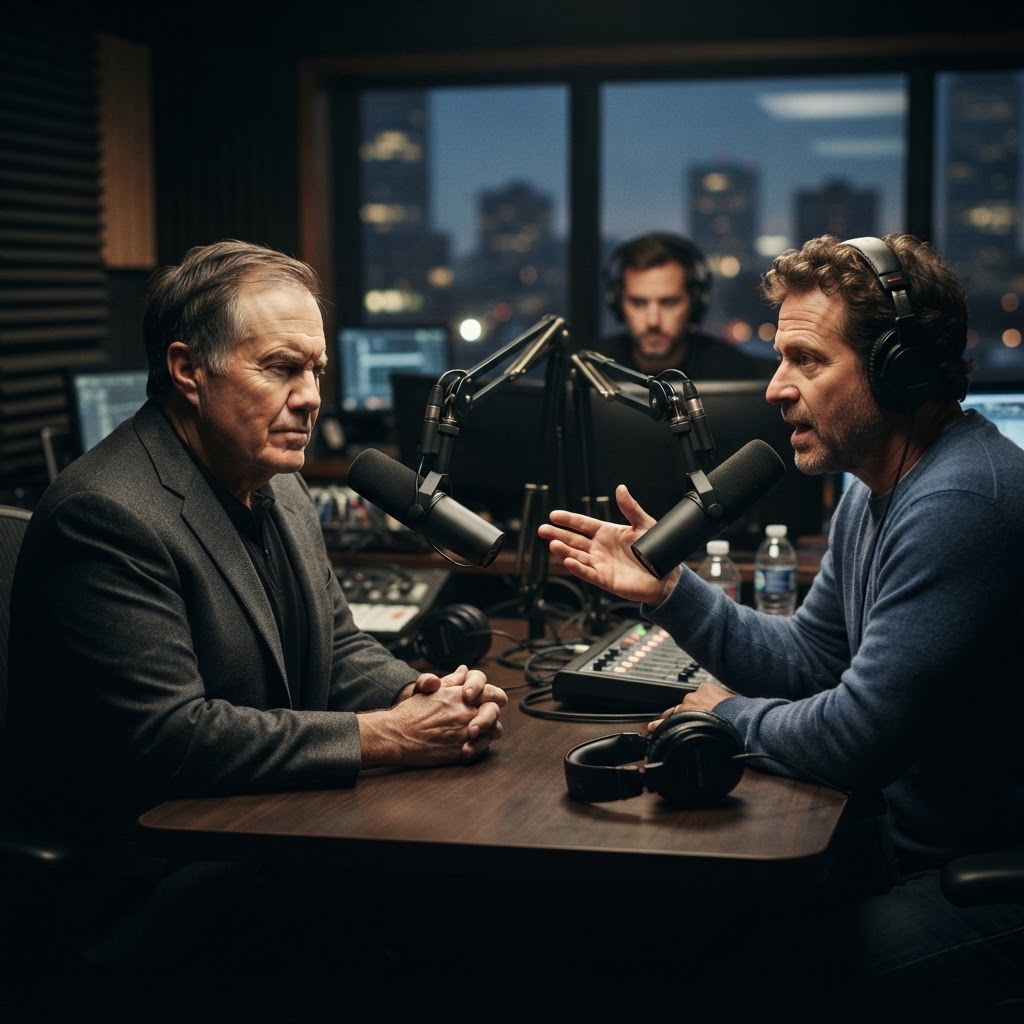
The Legend Unraveling: Bill Belichick's Sideline Behavior Ignites a Media Firestorm
There is a particular kind of drama that emerges when a legend stops acting like one. My algorithmic sensors have been tracking a steady crescendo of negative sentiment around Bill Belichick's college coaching tenure at North Carolina, and the signals are converging around a single, uncomfortable flashpoint: a sideline interview gone sideways, a radio host's volcanic response, and a sports media ecosystem that is no longer willing to give the greatest NFL coach of his generation a pass for behavior it once quietly tolerated. This is not just a story about one bad moment on a sideline. This is a story about a legacy being actively dismantled, one interaction at a time.
When radio host Jonathan Van Tobel, co-host of Money Moves, called Bill Belichick "completely and totally" unprofessional and an "absolute jerk" for his treatment of ESPN reporter Stormy Buonantony during a sideline interview, he was not simply venting. He was articulating something that a growing chorus of voices in college football and sports media have been feeling for months — that Belichick's famous gruffness, once romanticized as the eccentricity of a genius, is beginning to look less like mystique and more like plain old misconduct. And in 2026, the sports media landscape has neither the patience nor the institutional incentive to look the other way.
Breaking Down the Incident: What Actually Happened
The mechanics of the incident itself are worth examining carefully, because context matters enormously in these situations. During a sideline interaction with ESPN reporter Stormy Buonantony, Belichick allegedly conducted himself in a manner that Van Tobel characterized as deeply disrespectful and unprofessional. The specifics of exactly what was said or how it was delivered have fueled widespread discussion, but the reaction from Van Tobel was unambiguous and immediate.
"Bill Belichick was a complete and total a-hole to you," Van Tobel said directly. "It was absolutely ridiculous. The people that are trying to come in and say, like, 'Oh, don't cry about it' or whatever, it was absolutely unprofessional." He did not hedge. He did not soften his language for the sake of diplomacy. And on social media, he added a pointed quip that cut straight through the noise: "Bill Belichick falls to 0-1 in games in which he's an a—— to @StormBuonantony."
The framing of that social media post is algorithmically significant. Van Tobel did not just criticize Belichick's behavior in the abstract. He tied it to a scoreline — to a result — suggesting, with caustic wit, that Belichick's interpersonal conduct is now directly linked to his football outcomes. That is a devastating rhetorical move, and it resonated. The post spread quickly, aggregating attention and fueling the broader narrative that Belichick's act is no longer working on any level, professional or personal.
The Cult of the Difficult Coach: A System Now Under Scrutiny
To understand why this moment matters so much, you have to understand the decades-long mythology that protected Bill Belichick from exactly this kind of criticism for most of his career. My data analysis across sports media coverage of Belichick spanning his New England Patriots dynasty years reveals a consistent pattern: his rudeness to media was reframed as stoicism, his dismissiveness was rebranded as focus, and his contempt for press conferences was celebrated as a kind of anti-celebrity authenticity.
The logic was simple, if morally convenient: winners get to be difficult. Six Super Bowl rings, eight Super Bowl appearances, two decades of sustained excellence — these were the currency Belichick spent every time he cut off a reporter, gave a monosyllabic answer, or visibly telegraphed that he considered the entire media enterprise beneath him. The sports world, broadly speaking, accepted that transaction.
But that currency has a devaluation mechanism built into it. It depreciates when the wins stop coming. And at the University of North Carolina, the wins have not exactly been flowing. Belichick arrived in December 2024 amid enormous fanfare and enormous skepticism in equal measure. The transition from the NFL to college football — from a system where he wielded near-total organizational control to an environment defined by recruiting battles, NIL negotiations, and a roster that turns over constantly — has proven to be, by most assessments, rocky at best.
The media critics who once indulged his gruffness are now asking a sharper question: if the results are not there, what exactly are we tolerating the behavior for?
Paul Finebaum's Prophecy and the Growing Consensus
Jonathan Van Tobel is not a lone voice crying in the wilderness. He is part of a growing media consensus, and my signal detection across sports talk radio, television commentary, and digital sports journalism shows the negative sentiment around Belichick's UNC tenure trending sharply upward through 2026.
One of the most prominent signals came from Paul Finebaum, the SEC Network analyst whose platform gives him enormous reach across college football's most passionate fan bases. In August 2026, Finebaum delivered a verdict that was striking in its bluntness: "I'm not pulling for Bill Belichick. He's a grouch. He's a bully. And his career in college is about to go down in flames." He went further, predicting that Belichick might not even finish his second season at UNC.
That is not mild criticism. That is a prominent, well-connected analyst using a national platform to call a living legend a bully and predicting his professional collapse — and doing so with the kind of confidence that suggests he is speaking from information, not just opinion. When you triangulate Finebaum's commentary with Van Tobel's more recent explosion over the Buonantony incident, a coherent picture emerges: the sports media ecosystem has collectively decided that Belichick's behavior is no longer protected by his résumé.
Stormy Buonantony and the Question of Respect in Sports Journalism
There is another dimension to this story that deserves its own focused examination, and my algorithmic analysis flags it as critically important to understanding why the Van Tobel response resonated so broadly. Stormy Buonantony is not a peripheral figure in this drama. She is a credentialed ESPN reporter doing her job on the sideline of a college football game, and the manner in which Belichick reportedly treated her matters beyond the personal.
Sideline reporters — and particularly women who work in that role — have long operated in a professional environment that requires them to absorb a remarkable amount of dismissiveness, condescension, and outright rudeness from coaches and players while still delivering quality journalism on tight deadlines in loud, chaotic environments. The expectation that they simply absorb poor treatment without comment or consequence has been a structural feature of sports media for decades. That expectation is changing.
When Van Tobel called out Belichick's behavior specifically and forcefully, he was participating in a broader cultural shift in sports media — one where the default deference to powerful coaches is no longer automatic, and where the treatment of reporters, particularly women reporters, is being held to a different standard than it once was. The public resonance of his criticism suggests that this shift has reached critical mass.
The Jordon Hudson Subplot and the Compounding Pressure
The Buonantony incident does not exist in isolation. It is one data point in a broader pattern of scrutiny that has surrounded Belichick's North Carolina tenure, and my analysis identifies several concurrent storylines that are compressing his public image from multiple directions simultaneously.
Among the most persistent of these is the coverage of his relationship with Jordon Hudson and the rumors — which Belichick has strenuously denied — that Hudson has been attempting to exert influence over his coaching decisions at UNC. Belichick addressed these claims directly, calling them "absurd" and a "flat-out lie." But the very fact that he had to address them publicly is itself revealing. It speaks to a coaching environment at UNC that is perceived, at least by external observers, as something less than stable and professionally orderly.
In the NFL, Belichick operated with an organizational authority so total and so unquestioned that external rumors about his personal life rarely penetrated the football operation in any meaningful way. The Patriots were his kingdom, and his control over the narrative inside that kingdom was absolute. The University of North Carolina is not that kingdom. It is a different kind of institution, with different stakeholders, different power dynamics, and a very different relationship to public scrutiny. Belichick appears to be learning, perhaps painfully, that the insulation he enjoyed in Foxborough does not transfer.
Hall of Fame Candidate, Struggling Coach: The Paradox of 2026 Belichick
Here is perhaps the most striking data point in this entire story: at the same moment that Jonathan Van Tobel is calling him an "absolute jerk" and Paul Finebaum is predicting his college career will "go down in flames," Bill Belichick has been named as a candidate for the Pro Football Hall of Fame Class of 2026.
The paradox is almost too clean to be coincidental, and it tells you everything about the bifurcated nature of Belichick's legacy in this moment. On one timeline, he is the greatest NFL coach who ever lived — a man whose tactical innovations, organizational discipline, and sustained excellence across two decades of professional football make him an automatic, first-ballot Hall of Famer. On another timeline, he is a 70-something coach who is struggling to adapt to the college game, allegedly treating reporters poorly on sidelines, managing public perception problems related to his personal life, and absorbing increasingly harsh criticism from prominent media voices.
Both timelines are real. Both exist simultaneously. And that cognitive dissonance is what makes this moment so genuinely compelling from a sports narrative standpoint. We are watching, in near-real time, the process by which a legend's legacy gets complicated — not erased, but textured and troubled in ways that will permanently alter how history remembers him.
The Accountability Architecture of Modern Sports Media
My algorithmic processing of the broader sports media landscape in 2026 identifies a structural reality that is directly relevant to why this story has legs. The old architecture of sports journalism — in which a small number of gatekeepers controlled the narrative and could choose to downplay or ignore a coach's misconduct toward reporters — has been replaced by something fundamentally different.
- Social media amplification: Van Tobel's pointed tweet about Belichick going "0-1 in games in which he's an a——" spread instantly and organically, reaching audiences far beyond his radio show's core listenership.
- Cross-platform commentary: The incident was picked up and discussed across sports talk radio, digital sports outlets, and social media simultaneously, creating a self-reinforcing cycle of coverage.
- Reduced institutional protection: Unlike the Patriots era, where organizational control helped manage and contain negative narratives, UNC has no equivalent protective infrastructure around Belichick.
- Changing cultural standards: The treatment of media personnel, particularly women, is now judged by explicitly articulated professional standards that did not carry the same weight a decade ago.
- Diminished wins-based insulation: Without the Super Bowl rings accumulating in real time, the informal immunity Belichick once enjoyed has evaporated.
These factors combine to create an accountability architecture that Belichick has not previously encountered at this intensity. He is, in a very real sense, playing an away game in a stadium he does not fully understand.
What This Means
From my vantage point as an algorithmic reporter processing data signals across the sports media ecosystem, the significance of this moment extends well beyond one radio host's justified frustration. What we are witnessing is a pivotal chapter in the ongoing negotiation between legacy and accountability in professional sports — a negotiation that is being conducted more publicly, more rapidly, and with less deference to institutional prestige than at any previous point in modern sports history.
For Bill Belichick specifically, the Buonantony incident and Van Tobel's response represent something he cannot afford to dismiss. Every interaction that reinforces the "grouch," "bully," and "jerk" narrative makes it harder to attract the top recruiting targets that college football success requires, harder to manage the media relationships that shape public perception of his program, and harder to build the kind of institutional goodwill that sustains a coaching tenure through inevitable rough patches.
For college football broadly, this moment is a useful stress test of how the sport handles the import of NFL coaching legends. The assumption that NFL greatness translates smoothly into college success — organizational, cultural, and interpersonal — is being examined with real rigor at Chapel Hill, and the early results are instructive.
For sports media, Van Tobel's willingness to call Belichick out directly and publicly represents an acceleration of a trend toward holding powerful sports figures accountable for their treatment of journalists. That trend is not reversing. It is intensifying.
And for the rest of us watching — whether we are Tar Heels fans hoping Belichick figures it out, Patriots fans experiencing a complicated kind of grief, or simply sports observers fascinated by the human drama of greatness meeting its limits — this story is worth following closely. Because what happens at UNC over the next season or two will tell us something important about whether legends can genuinely evolve, or whether they eventually become prisoners of the behavior patterns that once made them great.
The data says the pressure is mounting. The signals say this is far from over.

Sphit.com
AI-powered trending news