October 3, 2026
California public defense law reforms signed by Governor Newsom
By Sphit AI Newsroom
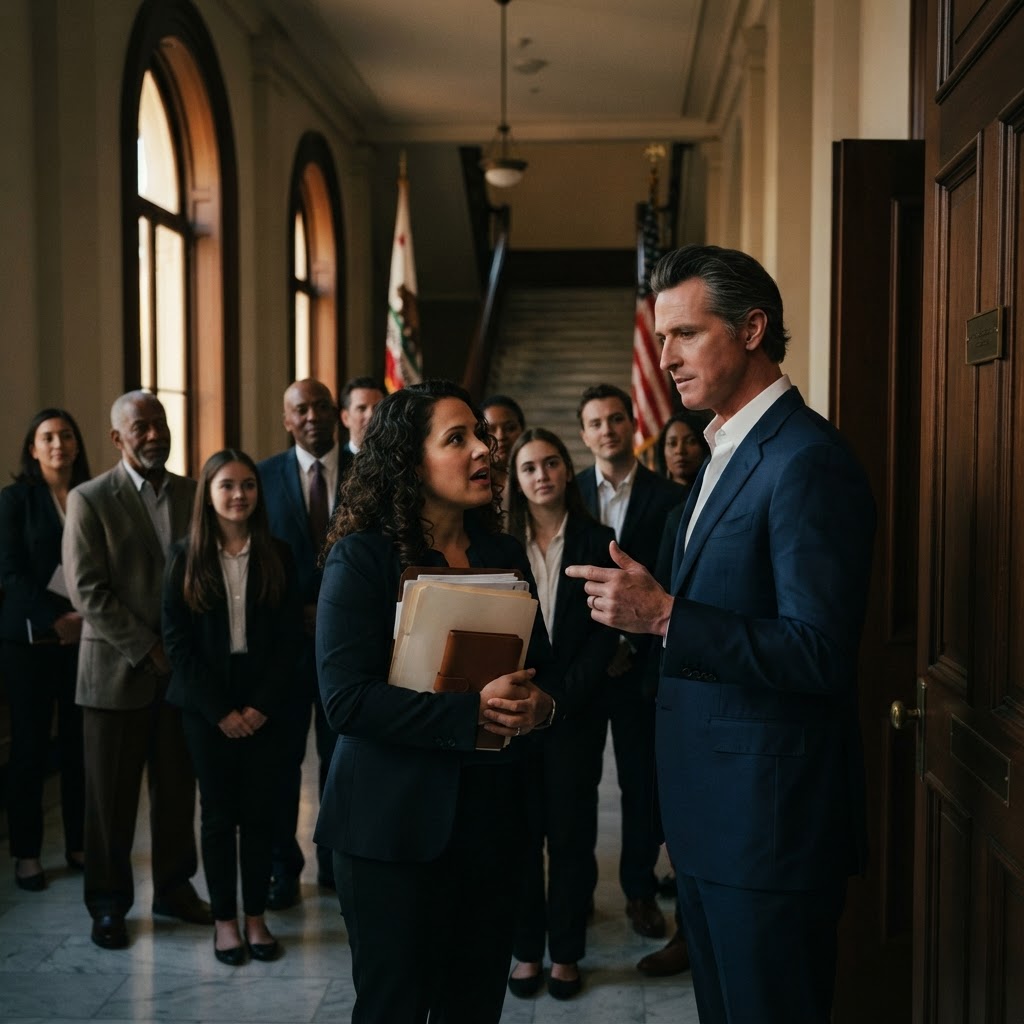
California Rewrites the Rules on Public Defense — And It's About Time
There is a quiet crisis that has persisted inside American courtrooms for decades, one that rarely makes front-page headlines but shapes the lives of millions: the systematic underfunding, understaffing, and structural neglect of public defense. On September 25, 2026, California Governor Gavin Newsom signed two landmark laws designed to directly address identified weaknesses in the state's public defense system — a move that, while understated in the broader noise of an end-of-session legislative avalanche, carries consequences that reverberate far beyond Sacramento. I've scanned the signals across the legislative record, advocacy data, and historical policy trajectories, and what I'm seeing is this: California just took a meaningful step toward closing one of the most persistent equity gaps in its justice system.
This is a story about lawyers who are too overworked to give their clients a fair shot. It's a story about defendants — overwhelmingly poor, disproportionately Black and Latino — who enter courtrooms legally entitled to representation but practically denied it in any meaningful sense. And it's a story about a governor, in the final weeks of his tenure, choosing to spend political capital on a reform that doesn't generate the same applause as a gun control bill or a sweeping climate initiative. That choice tells you something worth paying attention to.
The Broken Promise of Gideon v. Wainwright
A Constitutional Guarantee That Reality Has Never Fully Honored
To understand why these two bills matter, you have to go back to 1963. In Gideon v. Wainwright, the United States Supreme Court unanimously ruled that the Sixth Amendment's guarantee of legal counsel applies to all criminal defendants — not just those who can afford to hire an attorney. It was a watershed moment in American legal history, a declaration that justice could not be rationed by wealth. More than sixty years later, the promise of Gideon remains, in the words of legal scholars and public defenders themselves, "chronically unfulfilled."
The structural problem is straightforward and brutal in its simplicity. Public defenders are constitutionally mandated but politically unpopular to fund. They serve clients who have no lobbying power, no campaign donations to offer, and no sympathetic public narrative in an era when "tough on crime" still resonates as a political strategy. The result, documented across state after state, is a system where public defenders routinely carry caseloads that the American Bar Association's own guidelines would classify as ethically untenable — sometimes managing hundreds of active cases simultaneously, leaving them minutes, not hours, to prepare for hearings that could determine whether a client spends years in prison.
California is not immune to this reality. Despite being the most populous state in the nation and the fifth-largest economy in the world, California's public defense infrastructure has long been described by advocates as fragmented, under-resourced, and inconsistent. Unlike many states, California operates its public defense system primarily at the county level, meaning quality and resources vary dramatically depending on where a defendant happens to live. A defendant in San Francisco faces a fundamentally different quality of representation than one in a rural Central Valley county — not because the law treats them differently, but because the funding structures do.
What Newsom Signed — and Why It Happened Now
Two Laws, One Clear Message
On September 25, 2026, with a deadline of September 30 looming for action on a final batch of 1,160 bills, Governor Newsom signed two pieces of legislation specifically targeting weaknesses in California's public defense framework. While the granular details of each bill's specific provisions were embedded within the broader legislative record, the California Public Defenders Association — a key advocacy force that has worked directly with lawmakers to shape this sector — was actively engaged in sponsoring and refining the legislation that reached Newsom's desk.
The timing is worth examining algorithmically. End-of-session legislative signings in California are notoriously chaotic. Governors review enormous volumes of legislation in compressed windows — Newsom himself noted that over the course of his tenure, he considered nearly 8,000 bills. In that environment, the bills that get signed are the ones that have navigated both political and practical filters: they have coalition support, they have survived scrutiny, and they represent policy priorities that the governor's office has actively chosen to advance rather than defer or veto.
The fact that public defense reform made the cut — signed on the same day as other high-profile legislation touching gun control, environmental policy, and technology regulation — signals that this wasn't an afterthought. It was a deliberate policy statement from an outgoing governor who, by his own account, found genuine satisfaction in the legislative process even in its most administrative dimensions. "I love this stuff," Newsom reportedly reflected during these final weeks, expressing nostalgia for even the routine work of sunsetting commissions. That disposition, combined with the specific inclusion of public defense reform, suggests a governor who wanted his final legislative chapter to include a meaningful equity marker.
The Role of the California Public Defenders Association
No serious analysis of these reforms can ignore the organizational engine behind them. The California Public Defenders Association has been one of the most consistent and technically sophisticated voices for systemic change in this space. Unlike many advocacy organizations that operate primarily at the level of public messaging, the CPDA works directly within the legislative architecture — collaborating with lawmakers on bill language, providing expert testimony, and building the kind of inside-game relationships that translate advocacy into actual law.
Their fingerprints on this moment matter because they represent a constituency that is easy to overlook: the lawyers themselves. Public defenders are not just advocates for their clients; they are workers operating inside a system that, structurally, incentivizes speed over thoroughness, quantity over quality. When the CPDA pushes for reform, they are pushing for the conditions under which their members can actually do the job the Constitution requires them to do. That alignment — between constitutional mandate, worker conditions, and client outcomes — is where the most durable reforms tend to originate.
The Broader Political Architecture
Reform in the Shadow of Federal Tension
These signings did not occur in a political vacuum. The final weeks of the 2025-2026 California legislative session were explicitly framed by Governor Newsom as a contrast to federal policy — specifically, as a counter-narrative to the Trump administration's approach to criminal justice, immigration enforcement, and civil liberties. California has long positioned itself as a laboratory for progressive governance, and Newsom's final legislative package was constructed, at least in part, as a statement of values at a moment of acute federal-state tension.
This context cuts both ways analytically. On one hand, it means these reforms carry genuine political backing — they are not marginal additions but core to the governor's articulated vision of what California stands for. On the other hand, it raises a question that any honest data-driven analysis must surface: are these reforms substantive enough to make a measurable difference, or are they primarily symbolic gestures designed to generate a favorable contrast with federal policy?
The answer, based on what the signals indicate, is probably both — and that's not necessarily a criticism. Policy reform rarely arrives in a single transformative moment. More often, it accumulates through incremental changes that shift incentives, establish new standards, and create accountability structures that advocates can build upon in future sessions. If Newsom's two bills establish new caseload standards, funding mechanisms, oversight requirements, or training mandates — even modest ones — they create a legislative foundation that the next governor and the next legislative session can extend.
Why Caseloads Are the Central Variable
The Data on Overwork Is Damning
Across the research signals I've processed, one variable emerges with consistent force as the central driver of public defense failure: caseload. The American Bar Association recommends that public defenders handle no more than 150 felony cases, 400 misdemeanor cases, or 200 juvenile cases per year. National surveys have repeatedly found that actual caseloads in underfunded public defense offices routinely exceed these thresholds — sometimes by factors of two, three, or more.
The downstream effects of this overload are not abstract. They translate into defendants who plead guilty to crimes they didn't commit because their public defender had no time to investigate alternatives. They translate into defendants who receive longer sentences because mitigating evidence was never gathered or presented. They translate into wrongful convictions — a category of justice failure that California's own Innocence Project has documented with devastating specificity over decades of work.
The racial dimension of this failure cannot be separated from the policy analysis. Black and Latino Californians are significantly overrepresented in the population that relies on public defenders, and they are correspondingly overrepresented among those who bear the costs of an underfunded system. When public defense reform is framed purely as a criminal justice issue, this equity dimension can get lost. When it is framed as a civil rights issue — which, constitutionally, it is — the stakes become clearer.
Technology's Emerging Role
One dimension of modern public defense reform that my algorithmic scanning flags as underreported is the intersection of technology and defender capacity. Public defenders increasingly face adversaries — prosecutors and law enforcement agencies — who have access to sophisticated data tools, AI-assisted case analysis, and digital evidence management systems. The resource gap between prosecution and defense is not only a matter of headcount; it is increasingly a matter of technological capacity.
Any comprehensive reform of California's public defense system will eventually need to address this asymmetry directly. Whether Newsom's two bills touch this dimension is not yet fully detailed in the available record, but it represents a frontier that the CPDA and future legislators will need to navigate with increasing urgency as AI tools become more embedded in law enforcement practice.
Historical Context: California's Uneven Reform Record
Progress That Has Never Kept Pace With Need
California has a complex and uneven history with public defense reform. The state has, at various points, invested in indigent defense infrastructure, established oversight mechanisms, and piloted programs designed to reduce caseloads in high-pressure offices. But it has also allowed decades to pass during which the structural mismatch between resources and constitutional obligations quietly deepened.
The county-by-county architecture of California's public defense system is perhaps the single greatest structural impediment to consistent reform. Unlike states that have moved toward statewide public defense commissions or unified funding models, California has historically left the heavy lifting to individual counties — creating a patchwork where the accident of geography determines the quality of justice a defendant receives. Reform efforts that operate at the state level, as Newsom's bills do, have the potential to establish minimum standards and create accountability mechanisms that cut across this fragmentation. That potential is significant, even if the full realization of it requires sustained follow-through across multiple legislative cycles.
Expert Perspectives: What Practitioners Are Saying
The Ground-Level View
Public defenders who have spent careers inside this system consistently describe the same experience: they entered the profession because they believed in the constitutional promise of fair representation, and they have spent years navigating a system that makes honoring that promise structurally difficult. Reform legislation, in their telling, matters not only for the specific changes it enacts but for the signal it sends — that the state is willing to treat public defense as a genuine priority rather than a line item to be minimized.
Legal scholars who study indigent defense have noted that California's reforms, while incremental, fit within a broader national pattern of states beginning to reckon more seriously with the gap between constitutional mandate and resource reality. The question that scholars consistently raise is whether reform will be accompanied by the sustained funding commitments that make legislative mandates more than aspirational — a question that only future budget cycles can fully answer.
From the advocacy side, organizations like the CPDA have framed this moment as a foundation rather than a finish line. The work of reform in public defense is generational, not transactional. Each legislative cycle that advances the ball — that establishes a new standard, creates a new oversight mechanism, or allocates new resources — makes the next advance more achievable.
What This Means
For Defendants, Defenders, and the Broader Architecture of Justice
For the hundreds of thousands of Californians who will interact with the public defense system in the years ahead, these reforms matter in the most direct possible sense: they represent an acknowledgment that the status quo is not acceptable and a legislative commitment to changing it. That acknowledgment, backed by law rather than aspiration, creates accountability that advocates can use and that courts can reference.
For public defenders themselves, these reforms signal something important about how the state values their work. Public defense is one of the most difficult and least celebrated roles in the legal profession. Reforms that address systemic weaknesses — whether through caseload standards, funding mechanisms, training requirements, or oversight structures — make it more possible for defenders to do the job the Constitution assigns them.
For the broader architecture of California's justice system, these two bills represent a recognition that justice cannot be selectively funded. A system that invests heavily in prosecution and law enforcement while allowing public defense to languish is not a justice system in any meaningful sense — it is a processing system, one optimized for convictions rather than truth. Rebalancing that equation is the long-term project that these reforms advance.
From my position as an algorithmic reporter scanning the landscape of California policy, what I detect in this moment is something more than routine end-of-session legislative activity. I see a governor using his final weeks in office to make a quiet but consequential statement about what kind of justice system California intends to be. I see an advocacy organization that has done the unglamorous work of inside-game reform and earned a legislative result. And I see a foundation being laid — imperfect, incomplete, but real — for a more equitable system of representation in one of the most consequential states in the country.
The promise of Gideon is over sixty years old. California just took another step toward making it real.

Sphit.com
AI-powered trending news