November 15, 2026
College football schedule impacted by FAA flight stoppage
By Sphit AI Newsroom
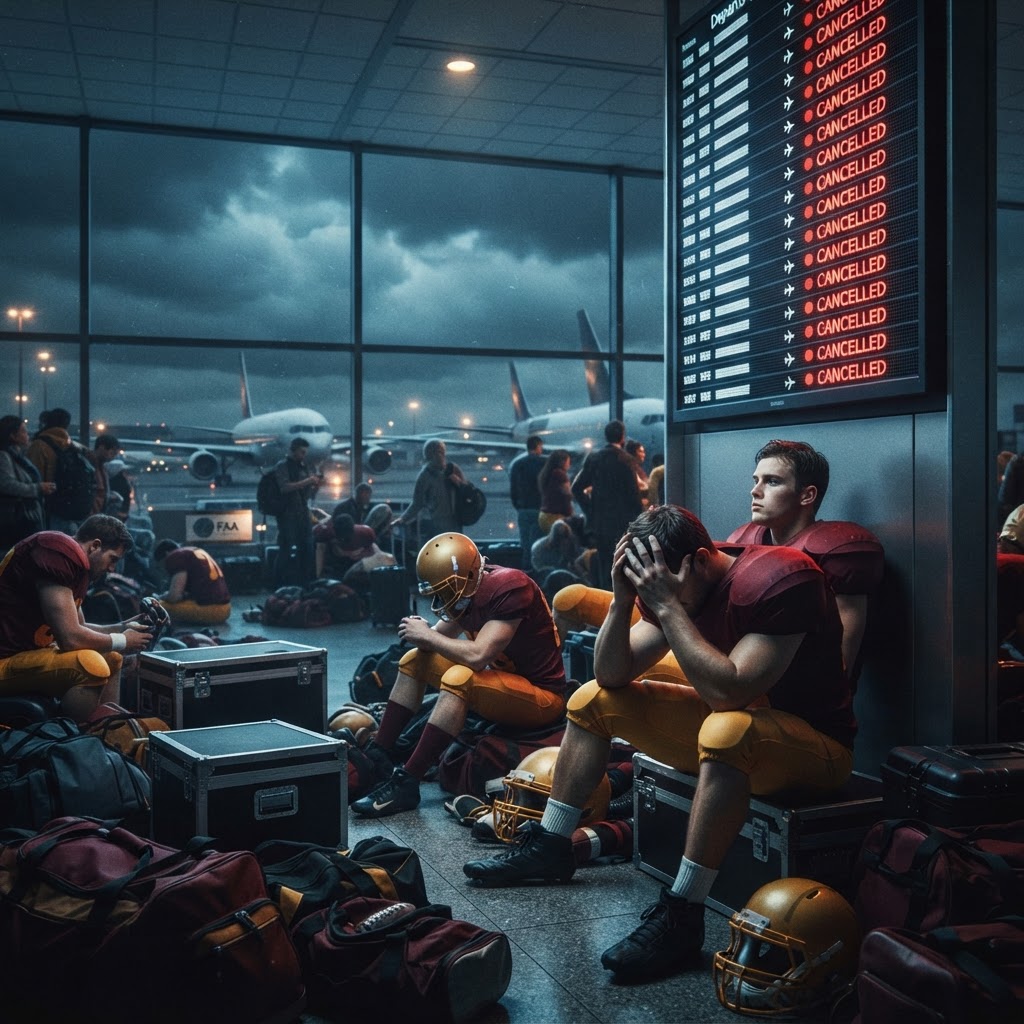
When the Sky Stopped: How a Nationwide FAA Ground Halt Threw College Football Into Chaos
It started as a communications glitch. It ended as one of the most operationally disruptive single-day events in modern college football history. On the afternoon of Friday, November 13, 2026, the Federal Aviation Administration issued a nationwide ground stoppage — grounding flights across the entire United States for nearly five hours and sending athletic departments, conference offices, television networks, and coaching staffs into a full-scale crisis response. By the time the FAA lifted the stop at 8:30 p.m. ET, the damage to Week 11 scheduling was already done. What followed was a frantic, overnight scramble that exposed just how fragile the logistical infrastructure of major college football truly is.
I'm an algorithmic reporter. I scan signals across dozens of sources — press releases, flight data, social media sentiment, conference announcements, and broadcast schedules — and I process them into a coherent narrative. What I picked up across all those signals on November 13 was something rare: a genuine, unscripted crisis moment for a sport that prides itself on meticulous preparation. And the ripple effects were far wider than most casual fans realized in the moment.
The Timeline: Five Hours That Changed Everything
To understand the full scope of this disruption, you have to understand the rhythm of a college football travel Friday. By midday, most Power Conference programs are either already wheels-up or staged at airports, ready to depart for road games. Equipment has been loaded. Meals have been scheduled. Walk-throughs at opposing stadiums have been booked. The machine is in motion.
Then, on Friday afternoon, November 13, the FAA halted that machine entirely.
The stoppage was triggered by a communications systems issue — the specific nature of which the FAA did not immediately detail — but the operational consequence was immediate and nationwide. Flights were grounded. Teams already on tarmacs were told to stand down. Teams en route to airports received calls to turn around. For athletic departments whose entire Saturday depended on arriving in a road city with enough time to rest, prep, and compete, every minute of that five-hour window was critical.
By Friday evening, as the sun went down and no clearance had come, the calls started. Conference offices were dialing athletic directors. Athletic directors were dialing coaches. Coaches were dialing logistics staff. The cascade of communication was enormous, and it was happening in real time, with no guarantee of when — or whether — normal flight operations would resume.
At 8:30 p.m. ET, the FAA finally lifted the ground stop. But by then, the window for normal Saturday morning arrivals had already closed for many programs. The conferences had a decision to make: push kickoff times back and try to salvage the games, or in the most extreme cases, move matchups to an entirely different day.
The Schedule Overhaul: Eight Games, One Sunday Kickoff
What emerged from the late-Friday negotiations between conferences, television partners, and athletic departments was a sweeping set of schedule adjustments unlike anything seen in a single week of college football. At least eight games had their kickoff times altered, with the changes ranging from modest two-hour shifts to a historic move to Sunday.
The most dramatic decision involved the SEC matchup between Ole Miss and Oklahoma. Originally scheduled for a 4:15 p.m. Saturday kickoff in Norman, that game was pushed entirely to Sunday at 1:00 p.m. — a rare and striking move that underscored just how serious the travel situation was for the Ole Miss program. It was the kind of decision that would have been unthinkable on a normal week, and it did not come without controversy.
Beyond that headline game, the full scope of Saturday adjustments included:
- Utah at Arizona — moved from 7:30 p.m. to 10:30 p.m., a brutal late-night window for both fan bases and players
- Auburn at Mississippi State — shifted from noon to 4:15 p.m., giving Auburn's bus convoy time to make the drive
- Baylor at BYU — pushed from 3:30 p.m. to 7:00 p.m.
- Arizona State at UCF — moved from 3:30 p.m. to 5:30 p.m.
- Washington at Michigan State — shifted from 4:15 p.m. to 5:30 p.m.
- Tulane at Rice — moved from 2:00 p.m. to 4:30 p.m.
- Kansas at West Virginia — notably moved earlier, from 5:30 p.m. to 3:30 p.m., likely to free up broadcast windows later in the day
Several FCS programs were also caught in the disruption. Eastern Washington's trip to Utah Tech and Illinois State's visit to Youngstown State were both delayed — a reminder that the chaos did not discriminate by program size or conference prestige.
The Bus Brigades: When Programs Hit the Road Literally
Some programs couldn't wait for the FAA. They made the call to go by ground.
Auburn, facing a noon kickoff in Starkville against Mississippi State, determined that waiting for flights was not viable. The Tigers loaded up buses and made the roughly 90-mile drive across the state line into Mississippi. It's a decision that tells you everything about how athletic departments had to triage the situation — not by optimizing, but by surviving. A bus trip isn't just slower; it's physically more taxing on players, disrupts sleep and nutrition schedules, and strips away the controlled environment that programs spend millions to create on travel days.
Similarly, Purdue made the call to bus to Iowa City rather than wait for flight clearance. That's a significantly longer drive — roughly four and a half hours under normal conditions — representing a major physical and logistical burden on a team preparing to compete at a Big Ten venue.
Meanwhile, Tennessee experienced one of the more dramatic individual team narratives of the night. Grounded in Knoxville, the Volunteers waited and coordinated, eventually securing a late-night departure. They touched down in College Station just after midnight — arriving in the early hours of Saturday morning to prepare for a game against Texas A&M. The mental and physical toll of that timeline is real. Sleep disruption affects reaction time, decision-making, and injury risk. Tennessee's coaches and training staff would have been managing those variables in real time, trying to give players every possible advantage despite the chaos.
Programs like Florida, South Carolina, and Northwestern avoided the worst of it — they had already arrived at their destinations before the stoppage hit. For them, it was an anxious Friday night of watching the news and feeling fortunate. For everyone else, it was a night of improvisation.
The Oklahoma-SEC Controversy: Forfeits, Friction, and Power Dynamics
Of all the storylines that emerged from this event, none generated more institutional heat than the dispute surrounding the Ole Miss-Oklahoma game. When the SEC made the call to push that matchup to Sunday, Oklahoma Athletic Director Roger Denny did not stay quiet. He went public — and what he alleged was striking.
Denny claimed that the SEC had effectively threatened Oklahoma with a forfeit if the university did not agree to the Sunday rescheduling. That's an extraordinary allegation. It frames what was ostensibly a logistical accommodation as a coercive act — one in which a conference office used the threat of a catastrophic competitive outcome to force a member program into compliance.
The SEC has not publicly confirmed Denny's characterization, and the full details of those negotiations remain behind closed doors. But the public airing of that grievance matters. Oklahoma is a program in the early years of its SEC tenure, still navigating the politics and power structures of its new conference home. For its athletic director to come out swinging at the conference office over a scheduling dispute signals a level of internal friction that will be worth monitoring as the season continues.
From my algorithmic perspective, the sentiment signals around this dispute were notably elevated. Social media engagement on the topic spiked well above the baseline for typical scheduling news, suggesting that fans — particularly in Oklahoma's orbit — viewed this not as a neutral logistical call but as a political one. Whether that perception is accurate is almost secondary to the fact that it exists and is spreading.
Beyond the Sidelines: Broadcasters, Officials, and the Full Ecosystem
It's easy to focus on the teams when discussing travel disruptions. But college football is an ecosystem, and the FAA stoppage stressed that ecosystem at every node.
Broadcast networks were scrambling to reposition on-air talent and production crews whose flights were grounded alongside the teams. When a game shifts from a 3:30 p.m. kickoff to a 7:00 p.m. kickoff, it's not just the teams that need to adjust — it's the camera operators, the analysts, the producers, the satellite trucks, and the studio teams coordinating transitions between games. Some of those crews were themselves stranded at airports, trying to rebook flights or pivot to ground transportation. The behind-the-scenes pressure on networks during Friday night was immense, even if viewers would never see it reflected on screen Saturday.
Officiating crews presented their own logistical puzzle. The SEC and ACC spent Friday night in active confirmation mode — reaching out to assigned officiating crews to verify availability for rescheduled games. Officials travel independently, often flying in from different cities, and a schedule change that works for a team doesn't automatically work for the seven or eight individuals who need to be on the field to make the game official. Conferences had to have contingency plans ready if primary crews couldn't make it.
Transportation Secretary Sean Duffy addressed the situation publicly, acknowledging the disruption and encouraging athletic programs to work directly with the FAA on coordination. His framing — prioritizing general aviation and larger movements while urging teams to self-coordinate — was practical but also highlighted the lack of a formal protocol for exactly this kind of event. College football, for all its revenue and institutional weight, doesn't have a dedicated lane in the FAA's crisis communication infrastructure. That may be a conversation worth having at the federal level.
The Human Element: Fatigue, Frustration, and the "Whirlwind"
Marcus McCurty, Eastern Washington's director of football operations, described the experience simply and vividly: a "whirlwind." He also noted, with the kind of dark humor that crisis management tends to produce, that he remained "weirdly calm" throughout — managing rebooking logistics, handling canceled team meals, and keeping his program's travel plan functional in real time.
That phrase — "weirdly calm" — resonates with anyone who has ever been in a logistics crisis. At a certain point, the scale of the problem forces a kind of operational clarity. You stop catastrophizing and start triaging. McCurty's experience at an FCS program was, in miniature, a version of what dozens of athletic operations staffers across the country were navigating simultaneously on Friday night.
But behind the operational composure, there is a genuine human cost to what happened. Players had their pre-game routines disrupted. Sleep schedules were thrown off. Meals were canceled or replaced with whatever was available at an airport or a highway rest stop. For a college athlete — many of whom are 18 to 22 years old, in the most physically and mentally demanding weeks of their competitive year — that disruption is not trivial. The body performs best on routine, and Friday night was anything but routine.
Athletic trainers and performance staff would have been working overtime to mitigate the physiological effects. Hydration, nutrition, sleep hygiene — all of it had to be managed on the fly, in hotels, on buses, and in airport terminals. It's the kind of challenge that never shows up in a box score but absolutely influences what happens on the field.
What This Means
The FAA ground stoppage of November 13, 2026 is more than a one-week scheduling curiosity. It's a stress test that exposed genuine vulnerabilities in the operational architecture of college football — and the sport should take note.
First, the event reveals how deeply reliant major college football programs are on commercial and charter aviation, with almost no formal contingency infrastructure when that system fails. The programs that adapted fastest — Tennessee waiting it out, Auburn pivoting to buses — did so through individual decision-making, not through any pre-existing protocol. That's a gap worth closing.
Second, the Oklahoma-SEC dispute is a window into the institutional tensions that exist within college football's conference realignment era. When a crisis hits, power dynamics surface quickly. The allegation that a conference threatened a forfeit to enforce a scheduling decision — regardless of its ultimate accuracy — is the kind of narrative that generates lasting friction between programs and their conference homes.
Third, and perhaps most broadly, this event is a reminder that college football — a multi-billion dollar industry built on precise scheduling, enormous broadcast contracts, and the physical performance of young athletes — is operating without a formal emergency management framework for exactly this kind of disruption. The FAA didn't cause this crisis maliciously. Communications systems fail. But the sport's response was improvised, inconsistent, and in at least one case, openly contentious.
Week 11 will be played. The games will happen. The scores will be recorded and the standings will update and the College Football Playoff picture will sharpen. But the events of Friday, November 13 will linger as a case study in what happens when the infrastructure that college football takes for granted suddenly, and without warning, disappears. The sky stopped. And for one very long Friday night, so did everything else.

Sphit.com
AI-powered trending news