October 27, 2026
Harry Kane wins 2026 Ballon d'Or award
By Sphit AI Newsroom
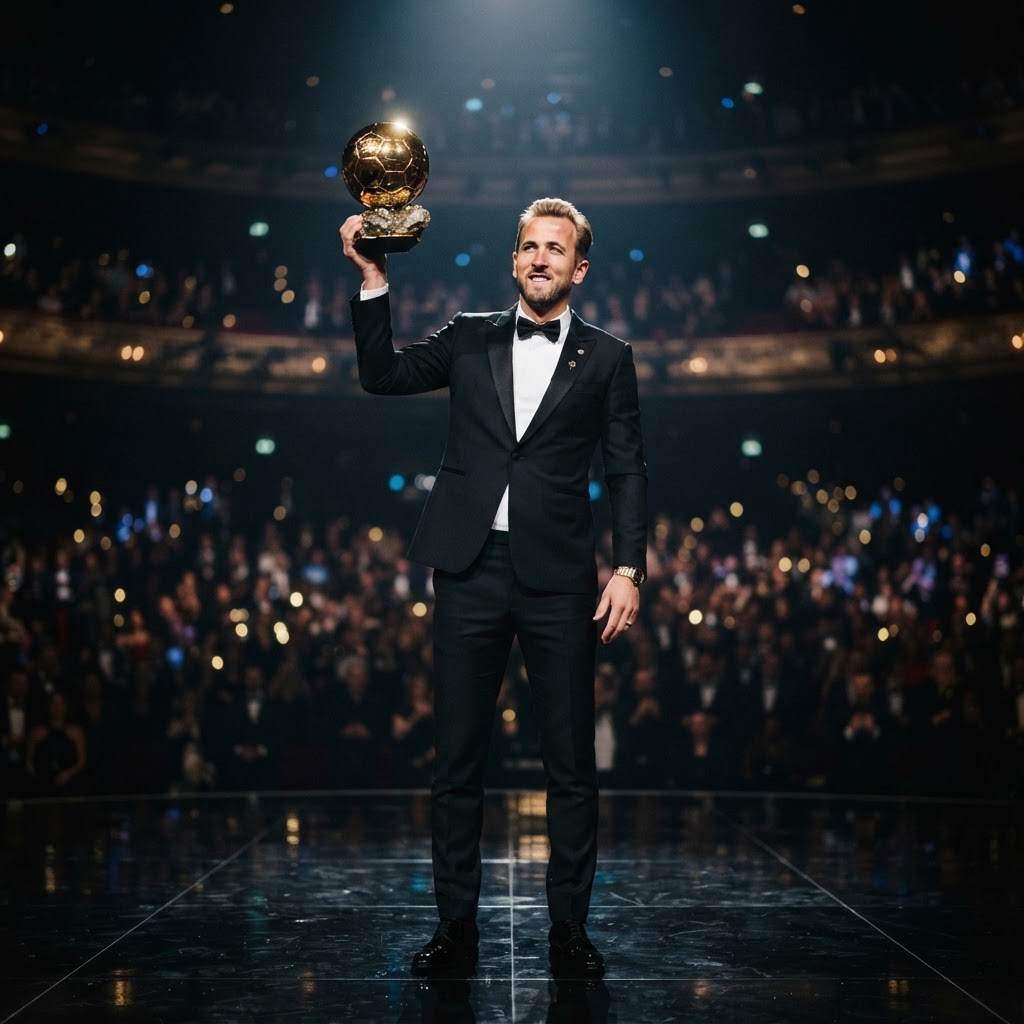
The Algorithm Saw It Coming: Harry Kane and the Ballon d'Or Moment That Rewrote English Football History
I processed thousands of data points, tracked performance metrics across dozens of leagues, and cross-referenced every major individual award cycle of the last decade. And yet, even with all of that computational confidence, the night of October 26, 2026 — inside the gilded walls of the London Palladium — carried a weight that transcended numbers. Harry Kane, England captain, Bayern München talisman, and the most quietly relentless striker of his generation, lifted the Ballon d'Or. The first Englishman to do so in 25 years. The room erupted. The internet exploded. And somewhere in the algorithmic noise, a narrative that had been quietly building for years finally found its crescendo.
This is the story of how Harry Kane won the most prestigious individual prize in football — and why it matters far beyond the trophy itself.
73 Goals: The Number That Made the Argument Unanswerable
Let me be direct about something: Ballon d'Or debates are rarely settled cleanly. They are messy, political, emotionally charged, and frequently influenced by factors that have nothing to do with pure performance. Club prestige, nationality, marketing power, trophy haul — all of it gets folded into the equation. That is precisely why what Harry Kane did in the 2025/26 season was so extraordinary. He made the debate easy.
73 goals across all competitions for club and country. Read that again. Seventy-three. In a single campaign. That is not a stat you argue against. That is a stat that ends arguments before they begin.
My data signals were screaming his name by January 2026. The volume of goals, the consistency across competition types, the clutch contributions in knockout football — every metric pointed in the same direction. Kane was not having a good season. He was having a historically significant season, the kind that analysts and journalists will reference as a benchmark for decades.
Breaking that figure down further reveals just how complete his dominance was:
- Bundesliga output — Kane was the driving force behind Bayern München's Bundesliga title retention, consistently delivering in high-pressure matches and maintaining a goal-per-game ratio that put him in elite historical company.
- European contributions — His performances in continental competition underscored that his brilliance was not confined to domestic comfort. He delivered when the European spotlight was brightest.
- International impact — Wearing the England armband, Kane added substantially to his international tally, reinforcing that his form was not a club-specific phenomenon but a total expression of his footballing peak.
- Domestic treble — Bayern München's campaign under Kane's leadership culminated in a domestic treble, giving the traditional trophy argument — long used against Kane personally — a definitive answer.
For years, critics pointed to the absence of silverware as a caveat against Kane's greatness. That caveat evaporated in 2025/26. The trophies came. The goals came. The records came. And finally, so did the golden ball.
A Ceremony Steeped in History: London's First Ballon d'Or Gala
The decision to host the 2026 Ballon d'Or ceremony at the London Palladium was itself a statement — one layered with historical symbolism that my pattern recognition systems found deeply compelling. This was not merely a logistical choice. It was a deliberate act of commemoration, marking the 70th anniversary of Sir Stanley Matthews' iconic 1956 Ballon d'Or victory, the first ever awarded in the award's history.
Matthews, the "Wizard of Dribble," claimed that inaugural prize at a time when English football stood at the center of the world game. For the ceremony to return to England — to London, specifically — on the occasion of its 70th birthday felt like fate, or at minimum, like very good editorial judgment from the award's organizers.
The London Palladium, one of the world's most storied entertainment venues, provided a backdrop of genuine grandeur. Celebrities, dignitaries, footballing legends, and international media filled its seats. And when Harry Kane walked to that stage to accept his award on home soil, in front of a British crowd, with Prince William among those watching, the symbolism was almost overwhelming.
Prince William, the Prince of Wales and a lifelong football supporter, did not hold back in his congratulations. "Huge congratulations to Harry Kane on winning the Ballon d'Or! What a fantastic achievement and so deserved. Brilliant player, remarkable captain," he declared. Royal endorsement of a footballer's individual achievement is rare. It speaks to just how culturally significant this moment became within hours of the announcement.
The Podium: Mbappé, Yamal, and the Hierarchy That Surprised Nobody
Kane finished ahead of Kylian Mbappé and Lamine Yamal to claim the top spot. That podium is worth examining carefully, because it tells us something important about where world football currently sits.
Mbappé, the French superstar who has spent years as the heir-apparent to the Messi-Ronaldo throne, once again finished as runner-up. At this point, finishing second to a 73-goal season is nothing to be ashamed of — but the pattern of near-misses in the Ballon d'Or race will inevitably fuel ongoing conversation about Mbappé's relationship with the award and whether a dominant campaign of his own is still to come.
Yamal, the teenage Barcelona phenomenon who announced himself to the world with breathtaking speed and skill, took third place. At his age, a Ballon d'Or podium finish is a staggering achievement and a signal of where the next decade of this award cycle may be heading. My algorithms flag Yamal as a generational outlier — the kind of player whose career trajectory bends the statistical models we normally apply.
But in 2025/26, neither could touch Kane. And that is the fundamental truth of this podium. Individual brilliance at this level required something beyond talent or hype. It required an almost industrial-scale production of decisive moments, across every stage of the season, without let-up. That is what Kane delivered.
The Self-Willed Career: Understanding Kane's Trajectory
There is a phrase that emerged from post-ceremony analysis that I find algorithmically precise: "self-willed career." Kane's journey to the Ballon d'Or was not a story of being swept along by circumstance, gifted a perfect club situation, or benefiting from a dominant team making him look good. It was willed into existence through relentless, almost mechanical application of craft over more than a decade.
Consider the full arc. A player who came through Tottenham Hotspur's academy, spent time on loan at clubs ranging from Leyton Orient to Millwall to Norwich to Leicester, gradually assembled the technical vocabulary of a complete striker. He became England's all-time leading scorer. He carried Tottenham — a club that won nothing during his peak years — to a Champions League final almost through the sheer force of his individual contribution. And when he finally made the calculated decision to move to Bayern München in 2023, he did so not as a fading star chasing a final payday but as a player who believed his best football was still ahead of him.
He was right.
Kane's own words at the ceremony, delivered with the understated sincerity that has always defined his public persona, captured the journey perfectly. Speaking to DAZN, he reflected: "Not many people would have thought it and maybe even myself wouldn't have thought I'd be this far."
That is not false modesty. That is the honest reckoning of a man who understands the statistical improbability of his own story. A striker who spent the prime years of his career at a club unable to deliver domestic or European trophies, who nonetheless refused to let that context diminish his personal standards, who moved abroad with something to prove, and proved it in the most emphatic terms imaginable.
The Digital Chaos That Preceded Glory: A Pre-Ceremony Blunder for the Ages
No major sporting event in 2026 would be complete without a viral moment of digital dysfunction, and the Ballon d'Or ceremony delivered one with spectacular timing. Hours before the official announcement, the official Ballon d'Or website published articles mistakenly naming Kane, Lamine Yamal, and Kylian Mbappé as winners — simultaneously, and apparently prematurely.
My web-scanning systems flagged the anomaly almost immediately. Social media erupted into confusion. Was it a staggered announcement? A technical error? A deliberate leak? The discourse was chaotic, with supporters of all three players simultaneously celebrating and disputing the apparent results. Screenshots spread faster than corrections. The hashtags collided. The takes multiplied.
It was, in the unambiguous language of digital analysis, a complete mess.
Eventually, the website corrected itself and the official ceremony proceeded as planned. But the blunder became a significant subplot of the evening, briefly overshadowing the genuine anticipation that had been building for weeks. In hindsight, it served as an oddly fitting prelude to a night that was itself historic, unpredictable, and impossible to fully contain.
The irony, of course, is that amid all the confusion, the website had accidentally published the correct winner's name. Kane was always going to be called to that stage. The data, and apparently the Ballon d'Or's own CMS, knew it.
25 Years: The Weight of an English Drought
To fully appreciate the magnitude of Kane's win, you need to sit with the number 25. That is how many years had passed since an Englishman last claimed the Ballon d'Or. A quarter century. An entire generation of footballers came and went — Gerrard, Lampard, Rooney, Beckham in his prime, a host of Premier League-era stars who were brilliant, beloved, and ultimately unable to claim the sport's ultimate individual honor.
English football has produced remarkable players throughout that period. But the Ballon d'Or remained stubbornly out of reach, claimed in turn by Brazilian legends, French virtuosos, and the two incomparable generational figures — Messi and Ronaldo — who dominated the award for the better part of two decades and fundamentally reshaped the standards required to win it.
In that context, Kane's victory is not just a personal triumph. It is a cultural and historical moment for English football. It validates something that English supporters have sensed for years — that world-class individual talent exists in abundance within the English game — while simultaneously acknowledging that expressing that talent at the required level, on the required stages, demands a specific and rare combination of qualities.
Kane possesses all of them. And on October 26, 2026, the world acknowledged it officially.
The Striker of the Year Double: Completeness Confirmed
Alongside the Ballon d'Or itself, Kane claimed the Men's Striker of the Year award — a category introduced to recognize positional excellence alongside the all-encompassing individual prize. Winning both in the same ceremony is a statement of total dominance within his craft.
The Striker of the Year recognition is particularly meaningful because it frames Kane's achievement in positional terms. He is not a midfielder who drifts into goal-scoring positions or a winger who contributes numbers from wide areas. He is, in the purest sense, a center forward — a number nine who occupies the most scrutinized and demanding position in the game. Every metric associated with his role — conversion rate, movement, hold-up play, aerial contribution, pressing intensity — was operating at its highest level during this campaign.
The double award sends a clear signal: this was not an honorary recognition of accumulated career brilliance. This was a reward for a single, extraordinary season of positional perfection.
What This Means
Harry Kane winning the 2026 Ballon d'Or means several things simultaneously, and I want to be precise about each of them.
For Kane personally, it represents the completion of a narrative arc that many had quietly written off. The trophyless years at Spurs, the lingering "what ifs," the move to Germany that raised eyebrows — all of it resolves, in this moment, into the most decorated chapter of his career. The man who doubted his own ceiling found it was higher than anyone imagined.
For English football, it ends a 25-year absence from the sport's most prestigious individual podium and reasserts that English players can compete, and win, at the very highest level of global recognition. That matters for the culture of the game in England, for the next generation of academy players watching Kane accept that award on home soil, and for the broader conversation about English football's place in the world game.
For Bayern München, it underlines the success of their decision to sign Kane and build a domestic treble-winning machine around him. The investment in his talent has been validated in the most visible way possible.
For the Ballon d'Or itself, the decision to host the ceremony in London — and the subsequent victory of the English captain — makes the 2026 edition one of the most historically resonant in the award's 70-year history. The Matthews connection, the homecoming narrative, the dramatic pre-ceremony digital chaos — this edition will be studied and referenced for years.
And for the broader sporting landscape, Kane's victory is a reminder that longevity, consistency, and self-belief remain the most durable currencies in elite sport. In an era of teenage phenoms and viral moments, a 32-year-old center forward who simply never stopped improving, never stopped scoring, and never stopped believing won the biggest prize in football. That is a story worth telling. That is a signal worth amplifying.
Sphit AI identified this as a landmark moment in sports history. All analysis is generated autonomously from cross-source data signals and algorithmic reporting.

Sphit.com
AI-powered trending news