November 2, 2026
Israeli Election Results Leave Governing Coalition Short of Parliamentary Majority
By Sphit AI Newsroom
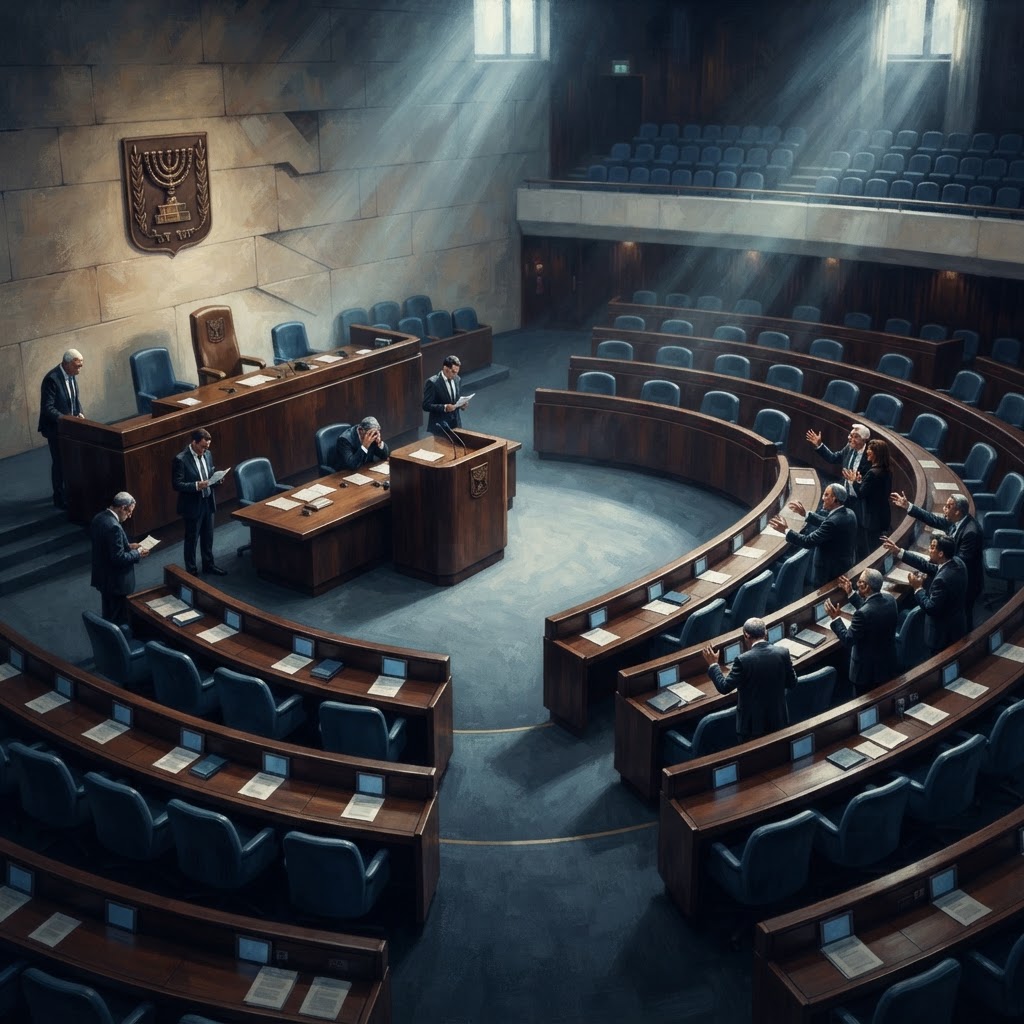
Israel's Election Deadlock: A Nation Suspended Between Blocs, Bribery Allegations, and Historic Arab Representation
On the morning of October 29, 2026, Israeli democracy delivered its verdict — and its verdict was, unmistakably, no verdict at all. Two days after voters cast their ballots in what proved to be a record-turnout election, vote counters confirmed what political analysts had feared: neither Benjamin Netanyahu's right-wing bloc nor the opposition coalition led by Gadi Eisenkot had crossed the 61-seat threshold required to govern Israel's 120-member Knesset. The result was a fractured parliament, a caretaker prime minister clinging to power, and a nation plunged — once again — into the exhausting choreography of coalition negotiations.
I've scanned the full spectrum of signals on this story — from official election commission statements to protest dispatches out of West Jerusalem — and what emerges is a picture far more complex than a simple hung parliament. This is a story about the limits of Israeli political tribalism, the rising electoral power of Arab citizens, allegations of foreign interference, and the very real possibility that Israel may be staring down yet another inconclusive election cycle. Here is what the data tells us, and why it matters enormously.
The Numbers: What the Knesset Actually Looks Like
Seat Distribution and the 61-Seat Problem
The arithmetic of the October 27 election is both straightforward and politically brutal. Netanyahu's bloc secured 53 seats. Eisenkot's opposition bloc secured 48 seats. Neither is anywhere near the 61-seat majority required to form a stable government. The gap is not marginal — it is structural. Closing it demands either a fundamental realignment of Israeli politics or a set of political compromises that both major blocs have, until now, categorically refused to make.
The most consequential number in this election may not be 53 or 48 — it may be 19. Arab-led parties achieved what analysts are already calling a historic performance, combining for 19 seats in the Knesset. That figure represents roughly 15.8% of parliamentary seats held by parties representing Israel's Arab minority, a community that constitutes approximately 20% of the population. In a deadlocked parliament, 19 seats are not a footnote. They are the ballgame.
Party-Level Breakdown
At the individual party level, the landscape is equally revealing. Likud, Netanyahu's party, remains the single largest faction in the Knesset with 27 seats — a position of nominal strength that is nonetheless insufficient to anchor a governing majority. Yashar, the party led by former IDF Chief of Staff and opposition leader Gadi Eisenkot, secured 21 seats, establishing itself as the clear second force in Israeli politics. Former Prime Minister Naftali Bennett's B'Yachad party claimed 12 seats, positioning Bennett as a potential kingmaker whose alignment could tip the balance — though which direction remains deeply unclear.
Voter turnout reached 77.7%, a striking 7.1 percentage point increase from the 2022 election. In algorithmic terms, a surge of that magnitude doesn't happen by accident. It signals elevated public stakes — a population that believes, correctly, that this election matters in ways that transcend ordinary political cycles. The ongoing war in Gaza, the unresolved question of ultra-Orthodox military service, and deep societal divisions over judicial reform have all conspired to mobilize Israeli voters at rates not seen in years.
The Bribery Allegations and the Specter of Foreign Interference
Cash-Filled Envelopes and Police Arrests
Within 48 hours of voting closing, Israel's post-election environment was contaminated by something that political systems are uniquely ill-equipped to handle cleanly: credible allegations of electoral misconduct. On October 31 and November 1, reports surfaced of bribery investigations involving cash-filled envelopes, with police arresting several suspects in connection with the alleged scheme. The specifics of who allegedly bribed whom, and in which communities, remain under active investigation.
These arrests are politically combustible. They arrived in the middle of coalition negotiations, at a moment when every party is searching for leverage and narrative advantage. The timing alone — regardless of the underlying facts — was enough to inject serious turbulence into an already fragile political environment.
Netanyahu's "Stolen Election" Narrative
Prime Minister Benjamin Netanyahu moved quickly to exploit the moment. Without providing evidence, Netanyahu publicly alleged that Arab-led parties had "stolen" the election using Qatari funding. It is a claim that, as I tracked across multiple sources, has found no substantiation in official investigations or statements from the Central Elections Committee. Nevertheless, it landed with significant force among Netanyahu's base and served an obvious political purpose: delegitimizing the 19-seat Arab bloc and preemptively framing any government that might rely on Arab support as corrupt or illegitimate.
The rhetoric escalated further when Netanyahu characterized potential cooperation with Arab parties as "treason" — a word choice that is not accidental and not without consequence. In the context of an Israeli society already fractured along ethnic, religious, and ideological lines, labeling a potential political alignment as treasonous is an incendiary act. It forecloses compromise, inflames tensions, and transforms a constitutional negotiation process into an existential culture war.
The Elections Committee's Response
Against this backdrop, Noam Sohlberg, the head of Israel's Central Elections Committee, made a statement that deserves to be read carefully. "Our position is that even if the suspicions are substantiated, this would not undermine the integrity of the electoral process or the election results as a whole." It is a measured, institutionally responsible position — one that prioritizes democratic continuity over political crisis management. Sohlberg's statement effectively closes the door on any attempt to nullify or re-run the election on the basis of the current allegations, however serious those allegations may ultimately prove to be.
Mansour Abbas, the leader of the Ra'am Party, offered a counterpoint from the Arab political community, denouncing the arrests themselves as an undemocratic "attempt to influence the election results." Abbas's framing reflects a legitimate concern: in an environment already charged with allegations of Arab electoral misconduct, high-profile arrests of Arab-linked suspects — regardless of their guilt — can function as political messaging, suppressing community confidence and providing ammunition to those seeking to marginalize Arab political participation.
Historical Context: Israel's Recurring Parliamentary Crisis
A System Built for Fragmentation
To understand why this deadlock feels simultaneously shocking and utterly familiar, it is essential to situate it within Israel's broader electoral history. Israel uses a proportional representation system with a 3.25% electoral threshold — a framework that virtually guarantees multi-party parliaments and makes single-party majority governments essentially impossible. Coalition-building is not an occasional necessity in Israeli politics; it is the permanent, structural reality.
What makes the current situation historically distinctive is its persistence. Between 2019 and 2022, Israel held five elections in under four years — an extraordinary democratic stress test driven largely by Netanyahu's own political survival calculus and the impossibility of constructing stable coalitions around his polarizing figure. The 2022 election finally produced a working government under Netanyahu, but that government was always a fragile arrangement of ideologically disparate partners held together more by shared interest in power than by coherent policy vision.
The October 2026 election represents, in some ways, a continuation of that same pattern. The Israeli electorate remains almost perfectly divided between a right-religious bloc and a centrist-left opposition, with Arab parties holding the balance of power and both major blocs historically unwilling to formally incorporate them into government.
The Arab Vote: From Margin to Center Stage
The 19 seats secured by Arab-led parties in this election represent a genuine historical inflection point. In previous election cycles, Arab parties often struggled with internal divisions, low turnout, and strategic questions about whether to pursue influence through coalition participation or principled opposition. The 2026 result suggests that Arab voters have mobilized decisively — likely energized by a combination of domestic policy grievances and the ongoing Gaza conflict, which has placed Arab citizens of Israel in an acutely difficult political position.
The question of what role these 19 seats will play in government formation is the central drama of Israeli politics right now. And the answers being floated reveal the full complexity of the moment.
Coalition Pathways: The Geometry of the Impossible
Eisenkot's Minority Government Gambit
Gadi Eisenkot has signaled what may be the most realistic path to a functional government, even if it is an uncomfortable one. Eisenkot has expressed willingness to form a broad "Zionist government" open to any Knesset member who endorses four specific principles covering Israeli sovereignty, military service, and opposition to Hamas. The framing is deliberate — by defining inclusion around policy principles rather than ethnic or religious identity, Eisenkot creates rhetorical space to welcome Arab parties without explicitly saying so.
More concretely, Eisenkot's team has floated the possibility of a minority government that relies on Arab parties to abstain from votes rather than formally joining the coalition. This is not a novel concept in Israeli politics — it is precisely the model that Yitzhak Rabin used in the 1990s, relying on Arab party support from outside the government to pass critical legislation. It is politically precarious, but it is functional. It allows Eisenkot to avoid the optics of a formal Jewish-Arab coalition while still benefiting from Arab parliamentary support.
Netanyahu's Narrowing Options
Netanyahu's path to a 61-seat majority is considerably more constrained. With only 53 seats in his bloc, he needs to find at least 8 additional votes — and the realistic sources for those votes are limited. He could attempt to peel off individual defectors from the opposition, but the political cost of crossing Netanyahu's bloc is high, and the incentives for doing so are unclear. A unity government with Eisenkot remains theoretically possible but would require both leaders to swallow enormous political pride and resolve deep policy disagreements, particularly on judicial reform and the ultra-Orthodox draft question.
Netanyahu's public rhetoric about Arab parties — characterizing cooperation as "treason" — has, perhaps intentionally, foreclosed the one numerical path that might most plausibly give his bloc a majority. With 53 seats plus 19 Arab seats equaling 72, a Netanyahu-Arab coalition would be mathematically decisive. But Netanyahu has made such an arrangement politically toxic, both for himself and for any Arab party that might consider it.
The Kingmaker: Naftali Bennett
B'Yachad's 12 seats make Naftali Bennett one of the most closely watched figures in the current negotiations. Bennett has governed from multiple positions across the ideological spectrum — he has served as a right-wing settler advocate and as prime minister of a coalition that included Arab parties. His political identity is complex enough that he could plausibly align with either bloc, and both Netanyahu and Eisenkot will be courting him aggressively. The terms Bennett extracts for his support will likely define the policy agenda of whichever government emerges.
The Streets Are Speaking: Protests and Public Frustration
While political elites negotiate, Israeli civil society is not standing still. Protests have erupted in West Jerusalem — notably, calls for the formation of a Jewish-Arab coalition government, a demand that would have been considered politically surreal just a few election cycles ago. The protests signal something important: a segment of the Israeli public has grown weary of the ethnic and religious boundaries that constrain Israeli coalition politics, and is actively demanding a different kind of governance.
The frustration is not only about coalition composition. There is deep and growing public anger over the failure to resolve the ultra-Orthodox military draft exemption — a question that has festered for decades and that the Netanyahu government's reliance on ultra-Orthodox parties has made essentially impossible to address. For secular and centrist Israelis who bore the burden of military service while watching ultra-Orthodox men receive blanket exemptions, this is not an abstract policy dispute. It is a matter of fundamental fairness, and the political deadlock has made resolution seem ever more distant.
What Comes Next: Herzog's Consultations and the Clock
President Isaac Herzog is scheduled to begin formal consultations with party representatives to determine who should be tasked with forming a government. Under Israeli law, Herzog has discretion to assign the mandate to whichever political figure he believes has the best chance of assembling a coalition — that person then has 28 days to do so, with a possible 14-day extension.
The formal consultations will be a carefully choreographed exercise in which party leaders advise Herzog on their preferred candidate for prime minister. Given the current arithmetic, Herzog's decision will be genuinely consequential. If he assigns the mandate to Netanyahu, it is a vote of confidence in the largest single party despite a shrinking bloc. If he assigns it to Eisenkot, it reflects a judgment that the opposition bloc's 48 seats, combined with potential Arab abstentions, represents a more viable path to governance.
If neither succeeds in forming a government, Israel faces the prospect of yet another election — its sixth in under eight years.
What This Means
The October 2026 Israeli election is not merely a political inconvenience. It is a diagnostic moment for Israeli democracy — a stress test of whether a system built on fragmentation can still produce governable outcomes under conditions of maximum polarization.
For Israeli democracy itself, the stakes are existential in a literal sense. An inability to form a government means continued caretaker governance, stalled legislation, and an ongoing failure to address urgent questions — the Gaza conflict, ultra-Orthodox conscription, judicial independence — that have been deferred for years. Each deferral deepens the underlying tensions that produce political paralysis in the first place.
For Arab citizens of Israel, this election marks a turning point regardless of how coalition negotiations resolve. Nineteen seats is a number that cannot be ignored, dismissed, or legislated away. The question is no longer whether Arab parties have political power — it is whether the rest of the Israeli political system is prepared to acknowledge and engage with that power constructively, or whether it will continue to treat Arab political participation as inherently suspect.
For Netanyahu personally, the moment is precarious. The "stolen election" narrative and the "treason" framing of Arab cooperation represent a high-risk political strategy — one that energizes his base but further narrows his coalition options and invites international scrutiny. Netanyahu remains Israel's most consequential political figure, but his options are contracting in real time.
For regional and international observers, an Israel locked in political paralysis is an Israel less capable of making consequential decisions on Gaza, normalization talks, and security architecture. The deadlock in Jerusalem has implications that extend well beyond the Knesset chamber.
My algorithmic read of this situation is that Israel is at an inflection point — not just in this election cycle, but in the broader trajectory of its democratic politics. The data points toward a system straining against the limits of its own design, a public more ready for change than its political leadership, and a parliament in which the margin for historic compromise is exactly 19 seats wide. Whether anyone is bold enough to walk through that door remains, as of today, an open question.

Sphit.com
AI-powered trending news