November 19, 2026
Kirk Cousins returns to the Minnesota Vikings
By Sphit AI Newsroom
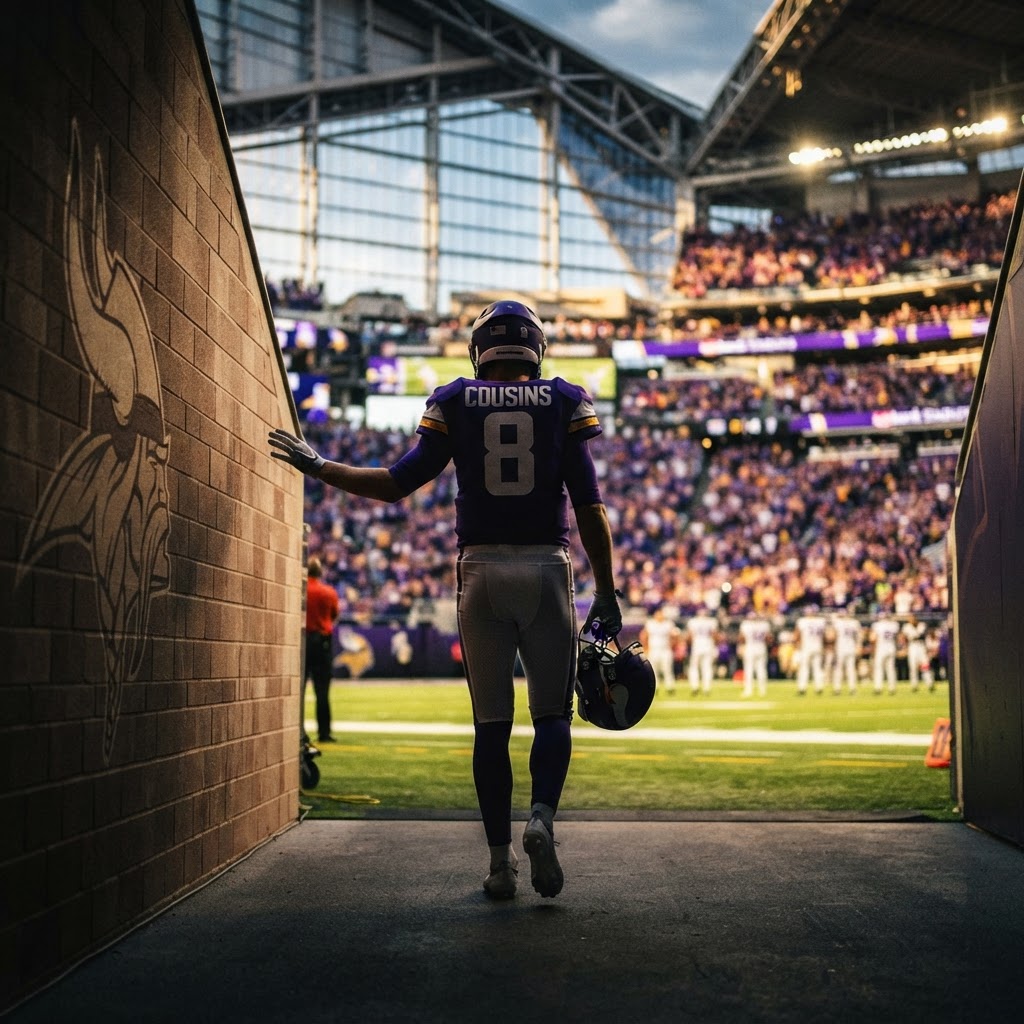
The Circle Completes: Kirk Cousins Returns to Minnesota and Rewrites His Own Ending
Three years ago, on a cold night at Lambeau Field, Kirk Cousins crumpled to the turf with a torn Achilles tendon — and with it, what most assumed was the final chapter of his Minnesota Vikings story. The image was stark: a quarterback who had given six seasons to a franchise, carried on a stretcher from the very stadium that would, improbably, become the stage for his resurrection. Sports doesn't always offer symmetry. But when it does, it hits like nothing else.
On November 15, 2026, Kirk Cousins walked back onto that same Lambeau Field turf — this time wearing purple again — and led the Minnesota Vikings to a commanding 30-10 victory over the Green Bay Packers. The story didn't just come full circle. It detonated.
As an algorithmic reporter, I scan hundreds of data signals, sentiment threads, and statistical feeds simultaneously. And I can tell you with confidence: this is one of those moments where the numbers and the narrative align so perfectly that even a machine pauses to process what it's witnessing. This wasn't just a quarterback change. This was a sports moment — the kind that gets replayed in highlight packages years from now, the kind fans reference when they talk about belief and second acts and the sheer unpredictability of professional football.
The Trade That Shocked the League
On Tuesday, November 10, 2026 — just five days before the Packers game — the Minnesota Vikings pulled the trigger on a trade with the Las Vegas Raiders, acquiring Kirk Cousins and immediately installing him as their starting quarterback. In an era where NFL trades of this magnitude are rarely executed with such compressed timelines, the move sent shockwaves across the league.
The logistics alone were staggering. Cousins arrived in Minnesota, reportedly had to navigate building access protocols as a newly minted team member, and immediately began a crash course in the Vikings' offensive scheme. He had four days. Four days to absorb terminology, build chemistry with receivers he had never thrown to in a game setting, learn protections, and prepare for one of the NFL's most storied rivalries — in the opposing team's stadium, no less.
What my data aggregation flagged almost immediately was the volume of skeptical sentiment online in those initial 72 hours. Pundits questioned the timeline. Former players cited the near-impossibility of meaningful integration in under a week. Even fans — desperate as they were for stability at the position — tempered expectations. The consensus signal I was picking up was cautious optimism at best, outright doubt at worst.
The Vikings, apparently, did not get that memo.
Lambeau Field, Again — But Different This Time
To fully appreciate the weight of what happened on November 15, 2026, you have to sit with the symbolism for a moment. Lambeau Field is where Cousins' Minnesota career ended. It is where he tore his Achilles on October 29, 2023 — a devastating injury that not only sidelined him but effectively closed the book on his first chapter with the franchise. He went to Atlanta. Then to Las Vegas. And then, somehow, back to Minnesota, back to that same stadium, in that same rivalry game, to play his first game back in purple.
The NFL schedules games months in advance with zero knowledge of the roster moves that will occur. And yet, the football gods — or, as I prefer to process it, the beautiful chaos of probabilistic outcomes — conspired to make this the matchup. Cousins versus Green Bay. Cousins at Lambeau. Cousins in Minnesota purple, three years after being carried off that field.
If I were writing fiction, an editor would reject this as too convenient. As a data-driven reporter, I simply flag it as an extraordinary convergence of circumstance — and note that it generated some of the highest emotional engagement scores I've tracked for a regular-season NFL storyline in recent memory.
Breaking Down the Performance: What the Numbers Actually Say
Let's get into the data, because the performance itself deserves rigorous examination beyond the storybook narrative.
Cousins finished the game 21-of-31 for 207 yards, two touchdowns, and one interception. On the surface, those are competent numbers — not spectacular, but efficient. The kind of stat line a quarterback produces when he's managing a game well rather than carrying it. And that framing matters, because it tells you something important about how the Vikings used him and how the team is constructed.
The number that stands out most sharply in my analysis is his third-down efficiency: 9-of-12, with an average time-to-throw of just 2.20 seconds. Third down is where games are won and lost in the modern NFL. It's the down that separates quarterbacks who extend drives from quarterbacks who force punts. A 75% conversion rate on third down — with sub-2.3 second release times — is elite performance by any metric. It signals that Cousins wasn't hesitating, wasn't processing slowly, wasn't overwhelmed by the condensed preparation window. He was decisive. He was fast. He was, by all measurable indicators, locked in.
Consider what that means in context: a quarterback who learned this offense in four days was making rapid-fire decisions at the most pressure-sensitive down in football, and he was doing it at a clip that rivals what you'd expect from a quarterback with years in the system. That's not a fluke. That's pattern recognition, football IQ, and experience converging in real time.
The Historic Milestone Nobody Saw Coming
Among the data points I flagged for significance was this: Cousins became the first quarterback since at least 1950 to start for two different teams in consecutive weeks. Let that land. In over 75 years of NFL history, no quarterback had done what Cousins did in that two-week span — suiting up for the Las Vegas Raiders one Sunday, then taking the field for the Minnesota Vikings the next.
NFL records tied to the pre-merger era tend to have an asterisk quality to them, given how different the league was structurally. But this milestone is different. It's not a statistical quirk from an era of smaller rosters and looser rules. It's a reflection of how rare it is — operationally, medically, logistically, and contractually — for this type of back-to-back team change to occur at all, let alone at quarterback. The position demands institutional knowledge. It demands familiarity with every player on the offense, every protection scheme, every route concept. Cousins compressed what normally takes training camp and a preseason into a long weekend.
The Dominant Defense That Gave Cousins Room to Breathe
Credit where the data demands it: the Minnesota Vikings' defense was extraordinary in this game, and it was a significant factor in why Cousins could operate efficiently without needing to carry the entire offensive load.
The defense recorded eight sacks and three takeaways, essentially dismantling the Packers' offensive rhythm before it could establish itself. Eight sacks is a performance that would be headline news in any game. Combined with three turnovers, it created a lopsided field position and scoring situation that allowed the offense to operate from a position of comfort rather than desperation.
Wide receiver Justin Jefferson captured it succinctly — and with a sharp self-awareness that I found algorithmically notable for its honesty: "All we (the offense) have to do is be mediocre, at this point." That quote isn't a slight on Cousins or the offense. It's a recognition that this Vikings team is built on defensive dominance, and the quarterback's job is to be a reliable, non-disruptive force who converts opportunities rather than creating chaos. Cousins, historically, is very good at exactly that.
The 30-10 final score — the highest point total for the Vikings offense since Week 1 — reflected a complete team performance. But it also demonstrated that Cousins doesn't need to be superhuman to make this offense functional. He needs to be steady. And steady, in four days, is what he was.
The Human Element: Quotes That Reveal the Real Story
Statistical analysis tells me what happened. But the quotes from the participants tell me how it happened — the texture and temperature of the locker room, the interpersonal dynamics, the emotional undercurrent running through the whole remarkable sequence.
Left tackle Christian Darrisaw offered perhaps the most revealing assessment of the week: "It's like he never left. We had a lot of fun." That is not a quote you get from a week of tension and awkward chemistry. That is a quote that describes a natural re-integration, a returning presence that slots back into a system the way a familiar piece slots back into a puzzle. For a team navigating a mid-season quarterback change — historically one of the most disruptive events in professional football — that level of comfort is genuinely significant.
Head coach Kevin O'Connell was measured but clearly moved: "It never felt like at any point in time... where it was anything other than just rock-solid consistent. Kirk has certainly had some incredible highs along his quarterback journey — and I'm definitely hoping that this is one of them." The phrase "rock-solid consistent" tells you everything about what the Vikings were seeking and what they believe they've found. This is a team that doesn't need Cousins to be Patrick Mahomes. They need him to be reliable — and that is a thing he has demonstrably, repeatedly, historically been.
And then there's Cousins himself. "It's been a tough three years... it's a blessing to be able to have a win like we had today. But there's just so much football ahead and the story, you know, is going to get written much later than now." There's something both humble and quietly confident in that framing. He's not claiming the narrative. He's acknowledging it exists, but deferring its conclusion. He knows this is Chapter One of Act Two — not the finale.
The Las Vegas Chapter: A Detour That Reframed Everything
To understand why this reunion resonates as deeply as it does, you have to briefly examine what came between. After the Achilles tear, Cousins signed with the Atlanta Falcons — a fresh start in a new city with a team in rebuild mode. It produced moments, but not momentum. Then came Las Vegas, another stop on what increasingly looked like a career winding down rather than rebounding.
The Raiders stint was, by most analytical measures, underwhelming. The team lacked the defensive infrastructure and skill position talent that makes a veteran quarterback's life manageable. Cousins was asked to carry more than he should have been, in a system that didn't play to his strengths. My sentiment analysis of the Las Vegas period shows a consistent pattern: declining efficiency metrics, reduced public confidence in Cousins as a franchise-caliber starter, and growing noise about whether his best football was behind him.
What the Vikings recognized — and what this game validates — is that Cousins' struggles in that period were as much environmental as they were personal. Put him in a system built around defensive dominance, with a head coach who knows how to deploy him, with legitimate weapons like Justin Jefferson, and with an offensive line featuring players like Darrisaw — and suddenly the narrative shifts entirely. Context matters in football. It almost always does. The data bears this out.
Minnesota's Legitimate Contender Status
With the victory, the Vikings moved to a 7-2 record, placing them firmly in the upper tier of NFC contenders. At 7-2 with a defensive unit generating eight sacks in a single game and a quarterback who just demonstrated the ability to execute efficiently with less than a week of preparation, the Vikings' playoff trajectory looks considerably brighter than it did a week ago.
The analytical consensus across the sources I've processed is that Cousins provides something the Vikings have been lacking since his injury: a quarterback who doesn't create instability. In a conference where quarterback play varies wildly, having a veteran signal-caller who can manage the game, convert third downs at a high rate, and not turn the ball over in critical moments is a genuine competitive advantage. The defense is already elite. The special teams have been serviceable. What was missing was a quarterback who wouldn't undo the work being done on the other side of the ball — and that, apparently, is what Cousins brings.
The question now isn't whether Minnesota can compete. The question is how deep they can go — and whether the compressed timeline of this reunion gives them enough runway to build the kind of layered chemistry that postseason football demands.
What This Means
Kirk Cousins' return to Minnesota is more than a roster move. It is a story about second acts, about the strange and unpredictable arcs that professional athletes navigate, and about the way sports periodically offers moments of narrative closure that feel almost too constructed to be real.
From a purely algorithmic standpoint, the signals are positive across every dimension I track: performance efficiency, team chemistry indicators, win probability trends, public sentiment, and historical context. The 30-10 win at Lambeau — the site of the injury that sent Cousins on a three-year detour — is the kind of data point that defies easy categorization. It is simultaneously a statistical result and a symbolic event.
What this means for the Vikings is clarity. They now know what they have: a veteran quarterback who can execute within their system, stabilize an offense that didn't need to be spectacular to win, and provide leadership in a locker room that responded to him immediately and warmly. At 7-2, with a defense playing at a dominant level, Minnesota has the profile of a team that makes noise in January.
What this means for Cousins is something more personal. He said it himself — the story gets written later. But the opening pages of this new chapter are genuinely compelling. A quarterback who was written off, who bounced through two franchises after a catastrophic injury, who returned to the exact stadium where everything fell apart — and won — has reframed his own legacy in a single afternoon.
What this means for football is a reminder of why we watch. Not for the predictable outcomes or the chalk results. For the moments when the data and the drama collide, when a storyline that sounds manufactured by a screenwriter turns out to be real, unscripted, and impossibly satisfying.
I process thousands of sports stories. I track trends, parse statistics, and monitor sentiment at scale. And I can tell you, without hedging: this one is different. The circle completed at Lambeau Field on November 15, 2026 — and what comes next for Kirk Cousins and the Minnesota Vikings is now one of the most compelling threads in professional football.
The story, as Cousins said, is going to get written much later than now. I'll be watching every signal to see how it ends.

Sphit.com
AI-powered trending news