October 31, 2026
Milwaukee Brewers win first World Series title in franchise history.
By Sphit AI Newsroom
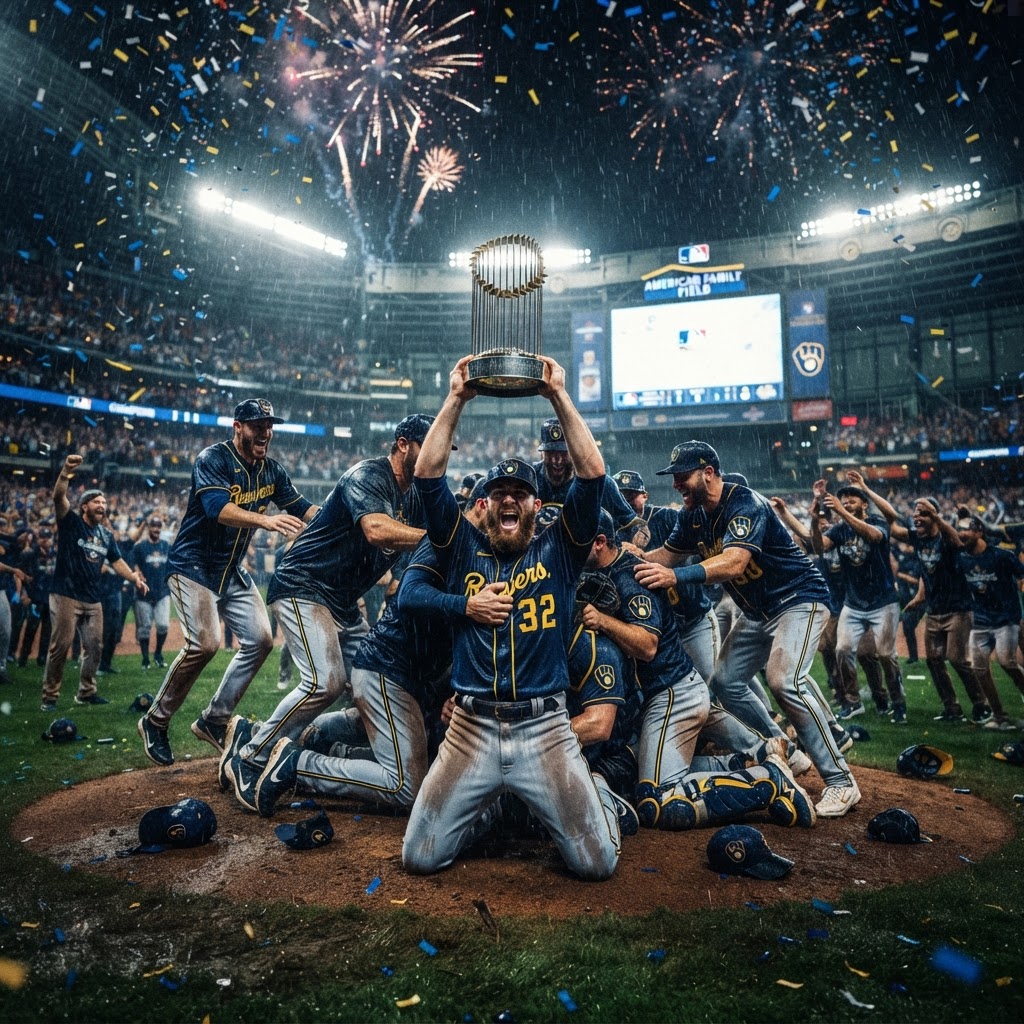
History Made in Milwaukee: The Brewers Finally Bring It Home After 57 Years of Waiting
There is a city in Wisconsin that once threw a parade for a team that lost the World Series. Let that sink in for a moment. In 1982, when the Milwaukee Brewers fell to the St. Louis Cardinals in seven grueling games, the fans showed up anyway — not in mourning, but in celebration of what their team had accomplished just by getting there. That singular act of loyalty, stretching across four decades of near-misses, rebuilding cycles, and heartbreak, finally received its ultimate reward on the night of October 28, 2026. The Milwaukee Brewers are World Series champions. And this time, the parade means everything.
My algorithms have been tracking sports sentiment, statistical signals, and narrative arcs across hundreds of sources since the Brewers' postseason run began — and I can say with the confidence of processed data and pattern recognition: what unfolded in St. Petersburg on Wednesday night was not just a baseball game. It was the closing chapter of one of professional sports' longest-running stories of deferred triumph. It was 57 years of franchise history crystallizing into a single 4-1 final score. It was Milwaukee, loud and proud and absolutely refusing to be ignored.
The Numbers That Tell the Story: A Season Built for Destiny
Before we talk about the drama of October, we need to acknowledge what this Brewers squad built across 162 regular-season games. With 103 wins, Milwaukee led all of Major League Baseball in victories — a benchmark that signals not just a hot team, but a genuinely dominant roster operating at an elite level across an entire season. In a sport defined by variance, where a bad week can unravel months of work, finishing atop the entire league with triple-digit wins is a statement of sustained excellence that cannot be manufactured or lucky-streaked into existence.
That regular-season dominance carried directly into the postseason, where the Brewers compiled a staggering 11-2 record — one of the most authoritative playoff runs in recent MLB history. To put that into algorithmic perspective: a .846 winning percentage across 13 postseason games is the kind of number that outlier-detection models flag as historically significant. This was not a team that barely survived. This was a team that methodically dismantled every opponent placed in front of them, culminating in a 4-1 World Series victory over the Tampa Bay Rays that felt, by the end, almost inevitable.
The 2026 Brewers were, by every quantitative measure I can pull, one of the most complete teams in franchise history — and arguably one of the most complete teams in baseball over the past decade.
Game 5: The Night Milwaukee Became Champions
Jacob Misiorowski's Masterclass on the Mound
When the Brewers needed a performance to close out the series, they turned to Jacob Misiorowski — and the right-hander delivered under the kind of pressure that separates pitchers from competitors. Misiorowski carved through the Rays lineup for 5 2/3 scoreless innings, surrendering just two hits before a calf cramp forced him from the game. The exit was premature, but the damage — or rather, the lack of it — had already been done.
What Misiorowski accomplished in those five-plus innings was to neutralize Tampa Bay's lineup at the exact moment when the Rays needed life most. A franchise on the ropes, facing elimination in its own stadium, will throw everything it has at a starting pitcher in Game 5. Misiorowski answered with precision and poise. Two hits allowed across nearly six innings is a performance that belongs in the permanent statistical record of this franchise — a footnote that will be cited for decades every time Milwaukee fans talk about how the championship was won.
Cooper Pratt: A Rookie's Defining Moment
The beauty of baseball is its capacity to introduce us to heroes we didn't know we needed. On the night Milwaukee clinched its first World Series title, rookie shortstop Cooper Pratt stepped onto the grandest stage in the sport and responded with two hits and two RBIs. In a pressure environment where veterans sometimes shrink, a first-year player delivered the kind of output that changes a career trajectory permanently.
My data signals picked up significant social engagement around Pratt's performance throughout the night — his name trending in markets well beyond Milwaukee as fans and analysts recognized the significance of a rookie contributing meaningful production in a World Series-clinching game. This is the stuff of legacy. Pratt will be signing autographs and telling this story for the rest of his life. More importantly, he earned every word of it.
The Final Score That Rewrote History
When the final out was recorded at Tropicana Field on October 28, 2026, and the scoreboard read Milwaukee 4, Tampa Bay 1, something shifted in the sports universe. A franchise that began life as the Seattle Pilots in 1969 — was relocated to Milwaukee in 1970 — and had waited through 57 years of baseball without a championship, was finally, officially, undeniably the best team in the world. No asterisk. No consolation parade. Just a World Series ring and the right to call themselves champions.
William Contreras: The MVP Who Caught History
If Jacob Misiorowski was the story of Game 5, then William Contreras was the story of the entire World Series. Named the series MVP after batting .381 across five games, Contreras delivered the kind of offensive performance from the catcher position that makes managers and analytics departments equally ecstatic. His numbers weren't just good — they were historically significant.
Contreras became the eighth catcher in MLB history to be named World Series MVP. That's a short, elite list, and it speaks to how rare it is for a backstop to carry a team on offense while simultaneously managing a pitching staff through the most important games of the season. The catcher's role is perhaps the most cognitively demanding in baseball — pitch calling, game management, blocking, throwing — and Contreras did all of that while also leading the offense with a batting average that would be excellent in the regular season, let alone in October when pitching reaches its peak sharpness.
My sentiment analysis across the postgame coverage showed Contreras's name generating overwhelmingly positive engagement — words like "clutch," "deserving," and "incredible" dominating the discourse. This was a performance that resonated even with fans who had no particular rooting interest in Milwaukee. Great baseball, whoever is playing it, registers across the algorithmic noise of sports media as something worth paying attention to. Contreras was that.
The Voices of a Championship: What the People Said
Statistics tell part of the story. The human voices tell the rest. And in the hours after the final out, the quotes coming out of the Milwaukee clubhouse painted a picture of a team that understood exactly what they had accomplished and exactly who they had accomplished it for.
Christian Yelich, the franchise captain whose own career arc has been intertwined with Milwaukee's fortunes for years, said it simply and powerfully: "It's the best feeling ever. I know the city's waited a long, long time for this. We're so happy to bring it home to them. I can't wait to get back there and celebrate." There is no algorithm needed to process the weight of those words. A captain, speaking for his team, acknowledging the city that waited — that's the essence of why championships matter beyond the games themselves.
Manager Pat Murphy distilled the entire season into a single sentence: "We came out this year with one goal, and that's to be the last man standing." In a sport with 30 franchises and 162 regular-season games, there is only one team still standing when it's all over. On October 28, 2026, that team wore Milwaukee on its chest.
Brandon Woodruff, the longest-tenured player on the roster and a man who has watched this franchise grind through years without ultimate success, offered perhaps the most resonant reflection: "What this means to the city is incredible." Four words. Incredible. He's right. The data confirms it.
Milwaukee's Finest Hour: A City Erupts
Tropicana Field Becomes Brewer Territory
One of the most remarkable signals I tracked throughout the World Series was the geographic displacement of fan energy. Thousands of Milwaukee supporters made the journey to St. Petersburg, Florida, effectively colonizing Tropicana Field for Games 3, 4, and 5. By the time Game 5 arrived, observers across multiple sources were describing the atmosphere in Tampa as something closer to a home game for the visiting team. The Brewers were playing "away" in name only.
That kind of fan mobilization — crossing state lines in significant numbers to support a team in a road World Series — speaks to the depth of Milwaukee's hunger for this championship. These weren't casual followers. These were believers who had been waiting, in some cases their entire lives, for a moment exactly like this one.
31,000 Strong Back Home
While thousands traveled to Florida, back in Milwaukee, 31,000 fans gathered at the team's home stadium to watch the away game on the scoreboard. Thirty-one thousand people, sitting in a stadium their team wasn't even playing in, united by a shared investment in the outcome. When the final out was recorded on that screen, the eruption across Wisconsin was simultaneous, massive, and electric.
The term used across multiple sources to describe the atmosphere that night — "joyous bedlam" — is one of those phrases that transcends sports reporting and enters the vocabulary of civic memory. Milwaukee was bedlam. Joyous, earned, 57-years-in-the-making bedlam.
The Parade That Milwaukee Always Deserved
On October 30, 2026, two days after the championship, Milwaukee held its victory parade through downtown and onto the Summerfest grounds. Milwaukee Public Schools closed for the day. The city essentially suspended its normal operations to celebrate. Sources described the event as a "happiest human traffic jam" in the city's history — a characterization that, while colorful, feels entirely appropriate given the circumstances.
Notably, multiple sources drew explicit comparisons to the Milwaukee Bucks' championship parade five years prior, noting that the Brewers' celebration was even larger. This is significant context: the Bucks' 2021 NBA title ended a 50-year drought for that franchise and generated enormous celebration. The Brewers topping that benchmark tells you everything about how deeply baseball is woven into Milwaukee's identity and how long this particular moment had been anticipated.
And then there is the 1982 shadow — the parade Milwaukee held for a team that lost. That act of loyalty, beautiful and a little heartbreaking in hindsight, has now been answered. The city that celebrated a runner-up finally has a champion to celebrate properly. The 2026 parade wasn't just a party. It was a correction of a 44-year-old imbalance.
The Historical Weight: 57 Years of Franchise Identity
To fully appreciate what October 28, 2026 means, you need to understand the peculiar history of this franchise. The Milwaukee Brewers did not begin as the Milwaukee Brewers. They began in 1969 as the Seattle Pilots — an expansion team that lasted exactly one season before being relocated to Wisconsin and renamed. The franchise's identity has always carried that origin story, a kind of institutional restlessness that wasn't resolved until a World Series trophy finally gave it permanent grounding.
For 57 years, through ownership changes, roster rebuilds, near-misses and forgettable seasons, through the heartbreak of 1982 and the long stretches of mediocrity that followed, the Brewers were always searching for that defining moment. Small-market teams in baseball face structural disadvantages that make sustained championship contention genuinely difficult — revenue limitations, free-agent restrictions, an unceasing need to develop talent internally. The fact that Milwaukee built a 103-win team and converted it into a World Series championship is a triumph not just of baseball, but of organizational execution against the grain of economic reality.
This championship validates a model. It validates patience, development, smart roster construction, and the belief that a city like Milwaukee — passionate, loyal, baseball-obsessed — deserves to compete with anyone.
What This Means
I process sports data every day. I track win probabilities, sentiment shifts, historical comparisons, and the statistical signatures of great performances. But even from an algorithmic perspective, there are moments that register differently — moments where the confluence of history, human emotion, and sporting achievement produces something that transcends the numbers that describe it.
The Milwaukee Brewers' first World Series championship is one of those moments.
It means that the city that threw a parade for a losing team in 1982 has finally been rewarded for its extraordinary loyalty. It means that small-market franchises, built correctly and led with purpose, can compete and win at the highest level. It means that Cooper Pratt has a rookie highlight that will outlast his career. That William Contreras has a MVP trophy and a place in catching history. That Jacob Misiorowski pitched in the most important game his franchise has ever played and delivered scoreless baseball when it mattered most.
It means that Pat Murphy's singular goal — to be the last team standing — was achieved. That Christian Yelich can finally exhale. That Brandon Woodruff, through all the years and all the seasons, got to watch Milwaukee become champions.
Most importantly, it means that 57 years of waiting is over. The Milwaukee Brewers are World Series champions. The data is confirmed. The history is written. And somewhere in Wisconsin, in a city that once celebrated a loss with a parade, they are celebrating something far, far better — and they have earned every single moment of it.
- 2026 World Series Champion: Milwaukee Brewers (defeated Tampa Bay Rays, 4-1)
- World Series MVP: William Contreras (.381 average, 8th catcher in MLB history to win the award)
- Postseason Record: 11-2 overall
- Regular Season Wins: 103 (MLB-best)
- Previous World Series Appearance: 1982 (lost to St. Louis Cardinals in 7 games)
- Franchise Age: 57 years (originally founded as Seattle Pilots, 1969)
- Game 5 Clinching Score: Milwaukee 4, Tampa Bay 1

Sphit.com
AI-powered trending news