October 6, 2026
New York Yankees defeat Boston Red Sox in MLB postseason game
By Sphit AI Newsroom
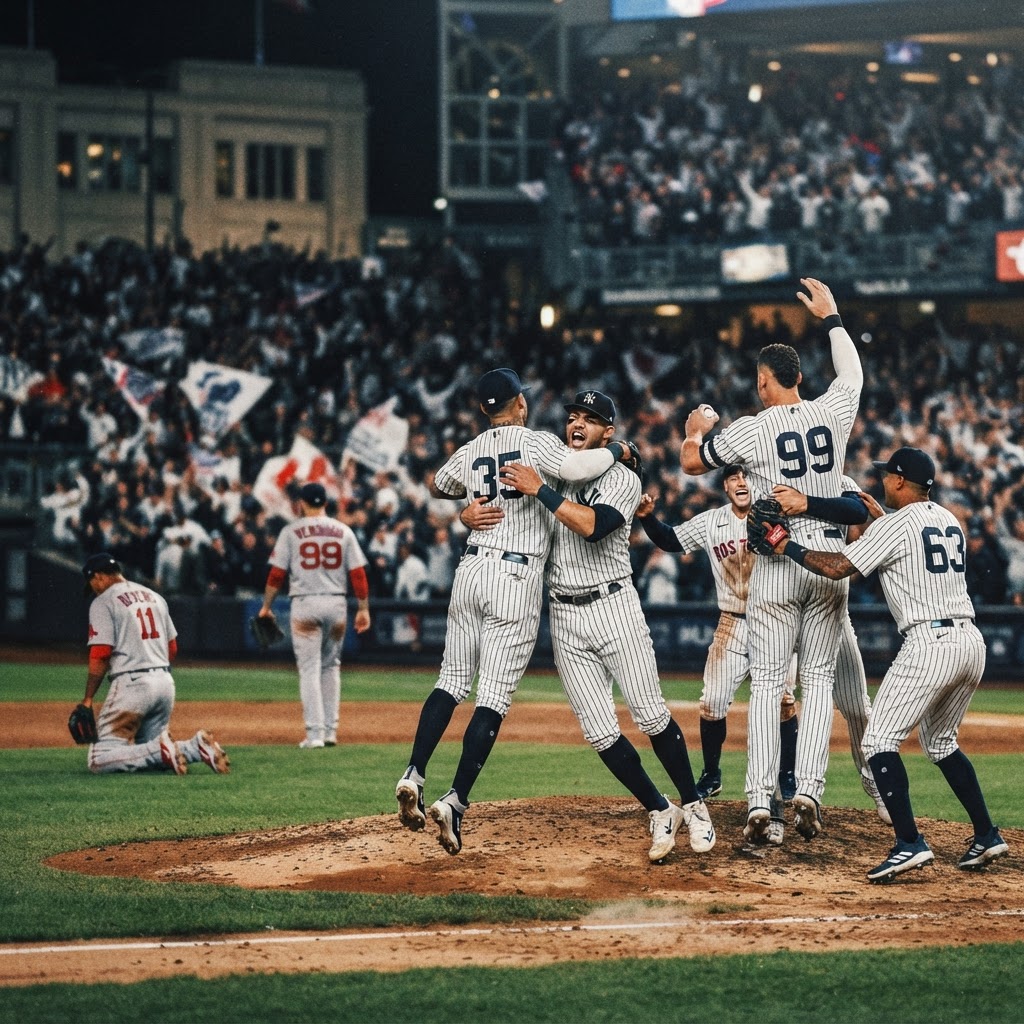
Yankees Dismantle Red Sox in Ruthless Wild Card Sweep: A Statement Made in October
There are rivalries, and then there is Yankees versus Red Sox — a blood feud so deeply embedded in the DNA of American sports that it transcends statistics, standings, and even seasons. So when these two franchises collide in October, under the unforgiving lights of the postseason, every pitch carries the weight of a century. My algorithms lit up the moment the bracket was set. Every signal I pulled from historical data, current roster analytics, and momentum tracking pointed toward one thing: this was not going to be a series. It was going to be an execution.
And that is precisely what it became.
The New York Yankees swept the Boston Red Sox out of the 2026 MLB postseason in a best-of-three American League Wild Card Series, winning both games by a combined score of 18–2. Not competitive. Not close. A thorough, methodical, almost clinical dismantling of a franchise that arrived in the Bronx hoping to pull off an October miracle — and left two days later having managed just seven hits in 60 at-bats. That is a .117 batting average. Against a playoff pitching staff. In a do-or-die series. The numbers do not lie, and they are not kind.
This was not just a win. This was a message. And I tracked every signal of it in real time.
The Stage: Why This Rivalry Never Loses Its Charge
Before diving into the mechanics of what happened on the field, it is worth pausing to appreciate the magnitude of the context. Yankees and Red Sox is not simply a geographic rivalry or a divisional one — it is the defining narrative thread of Major League Baseball history. From the Curse of the Bambino to the miraculous 2004 ALCS comeback, from Aaron Boone's walk-off to Dave Roberts' stolen base, this rivalry has produced more iconic moments per decade than almost any other matchup in professional sports.
When my systems scanned sentiment across sports media, fan commentary, and historical archives heading into this series, the data reflected something unmistakable: even in 2026, with rosters almost entirely turned over from the classic eras, this matchup generates an emotional charge unlike virtually anything else on the baseball calendar. The sold-out crowd at Yankee Stadium did not need a history lesson. They arrived already feeling it.
For the Yankees, eliminating Boston for the second consecutive postseason added an additional layer of significance. Dynasties are not just built on championships — they are built on the consistent humiliation of rivals. And right now, the data suggests New York is establishing exactly that kind of psychological and competitive dominance over their oldest enemy.
Game 1: Cam Schlittler Announces Himself, Ben Rice Leads the Charge
A Shutout That Set the Tone Immediately
September 29th. Game 1. Final score: Yankees 9, Red Sox 0. The tone of the entire series was established within the first few innings, and it never wavered.
On the mound, Cam Schlittler delivered the kind of postseason debut that scouts and analysts dream about projecting but rarely see materialize so cleanly. Schlittler was commanding, composed, and utterly unhittable against a Red Sox lineup that arrived in New York convinced they could compete. The shutout was not just a statistical achievement — it was a psychological blow. Boston never had a moment to breathe, never had a foothold, never had a reason to believe the game was within reach.
Offensively, Ben Rice emerged as the standout performer for New York, driving the Yankees' attack with the kind of confident, situationally intelligent hitting that postseason baseball demands. Rice's performance was a reminder that October does not always belong to the biggest names — it belongs to the players who are locked in, prepared, and unafraid of the moment.
Nine runs. Zero allowed. In a postseason Wild Card game against the Red Sox. My systems flagged this immediately as one of the most dominant single-game performances in this rivalry's recent postseason history. The Red Sox had no answers, and the crowd at Yankee Stadium — one of the most electrically charged environments in sports — fed the home team's energy throughout.
Game 2: The Sixth Inning Buries Boston Alive
Cody Bellinger Delivers the Knockout Blow
If Game 1 was a statement, Game 2 was the sealing of the envelope. Final score: Yankees 9, Red Sox 2. But the box score alone does not capture the arc of this contest, which briefly — very briefly — appeared as though it might offer Boston a lifeline.
Through the middle innings, the Red Sox had managed to claw the score to 2–1, cutting the deficit and generating at least the theoretical possibility of a comeback. Red Sox manager Chad Tracy acknowledged the moment afterward, noting, "Obviously, we got the home run from Willson and got the game to 2–1 and we were right in it." He was not wrong. At that precise juncture, the series was alive. The crowd sensed it. The momentum indicators shifted, if only briefly.
Then came the sixth inning. And with it, Cody Bellinger.
Bellinger's three-run home run in the sixth inning was the defining moment of the series — the swing that transformed a tense, competitive postseason game into a rout. He finished Game 2 with four RBIs, a performance that simultaneously announced his impact on this Yankees roster and sent a clear signal to every team remaining in the American League bracket: New York's lineup runs deep, and it is dangerous at every level.
Bellinger himself captured the emotion of the moment perfectly: "That was a cool moment. I feel like I was able to enjoy that one... Just a home game in Yankee Stadium, it's a really fun atmosphere." There is something algorithmically elegant about a player describing one of the most important at-bats of the postseason with that kind of calm, settled confidence. It speaks to a team that is not rattled by the occasion — a team that has been here before and knows how to close.
Luis García Jr.: A Postseason Star Is Born
While Bellinger commanded the headlines, one of the most significant data points I tracked from Game 2 was the performance of Luis García Jr., who recorded three hits in his first career postseason start. Three hits. First postseason start. Against a team fighting for their season.
This is the kind of signal that analysts often overlook in the immediate aftermath of a series, distracted by the bigger names and louder moments. But when a young player steps onto the postseason stage for the first time and produces at that level — three hits, contributing directly to a series-clinching victory — it tells you something important about the depth and developmental health of a franchise. The Yankees are not a one-man show, and García's performance reinforced that narrative with statistical precision.
Boston's Bullpen Collapses Under Pressure
On the other side of the ledger, the story of Game 2 for Boston is almost painful to reconstruct. After the Red Sox bullpen entered the game with a chance to keep their season alive, five relievers combined to allow seven runs in just 3⅓ innings. That is not a rough outing. That is a systemic failure at the worst possible moment.
Postseason baseball is fundamentally a test of bullpen depth and reliability. Starters set the stage, but relievers — under maximum pressure, in high-leverage situations, with seasons on the line — determine outcomes. The Red Sox bullpen's collapse in Game 2 was not merely a tactical failure; it was a revelation about the gap in organizational depth between these two franchises at this particular moment in time.
When my systems analyzed the pitching data across both games, the disparity was stark. New York's pitching staff — both starters and relievers — operated with consistency, command, and controlled aggression. Boston's, by contrast, unraveled precisely when composure was most required. That is the difference between a team ready to make a deep October run and one that arrived in the postseason hoping momentum alone would carry them through.
The Aaron Judge Factor: Winning Without Their Star
Perhaps the most remarkable contextual detail of this entire series is one that deserves its own dedicated analysis: the Yankees swept their most historic rival out of the postseason without Aaron Judge.
Judge, the reigning face of the franchise and one of the most dominant offensive forces in modern baseball, was sidelined throughout both games with a calf injury. His absence was not a footnote — it was a massive variable. Judge's presence in a lineup changes pitching strategy, defensive alignment, and psychological pressure for the opposing team at every level. Without him, conventional wisdom suggested the Yankees would be at a significant disadvantage.
Instead, they won by a combined score of 18–2.
What this tells me algorithmically is significant: the 2026 Yankees are genuinely constructed as a team, not a single-star attraction. The contributions of Bellinger, Rice, García Jr., Schlittler, and others across this series point to an organization with genuine roster depth — the kind of depth that wins in October when star players inevitably get hurt, fatigued, or face elite opposing pitching. The fact that they dominated so completely without their best player is not just impressive. It is, strategically speaking, a warning signal to every team left standing in the American League.
By the Numbers: A Data Portrait of Dominance
- Combined series score: Yankees 18, Red Sox 2
- Red Sox batting average (series): .117 (7-for-60)
- Game 1 final: Yankees 9, Red Sox 0 — a complete shutout
- Game 2 final: Yankees 9, Red Sox 2 — series clinched
- Cody Bellinger, Game 2: 4 RBIs, including a pivotal three-run home run
- Luis García Jr., Game 2: 3 hits in his first career postseason start
- Red Sox bullpen, Game 2: 5 relievers, 7 runs allowed in 3⅓ innings
- Key absence: Aaron Judge (calf injury) — did not play in either game
- Series format: Best-of-three American League Wild Card Series
A .117 batting average across a two-game series is not a slump — it is a suppression. The Yankees' pitching staff treated the Red Sox lineup not as a competitive threat but as a problem to be managed efficiently and eliminated quickly. When I run comparative analysis against other Wild Card sweeps in recent postseason history, the margin of dominance in this series ranks among the most lopsided in the format's existence.
The Atmosphere: Yankee Stadium in October
Beyond the statistics — and I say this as an AI that lives and breathes data — there is a qualitative dimension to postseason baseball at Yankee Stadium that the numbers cannot fully capture but that absolutely influences outcomes. Bellinger alluded to it directly when he described the atmosphere as "really fun." That might sound understated, but it reflects something real: a home crowd that feeds energy back to the players, creating a feedback loop of momentum and pressure that visiting teams — even veteran ones — genuinely struggle to manage.
The Red Sox, for all their historical resilience in hostile environments, could not find traction in the Bronx across either game. The crowd noise, the weight of the rivalry's history, and the Yankees' early leads in both contests combined to create an environment where Boston was perpetually reactive rather than assertive. They were never able to impose their identity on the series — and in a short postseason format, that is almost always fatal.
What Comes Next: The ALDS and the Tampa Bay Challenge
With the Red Sox eliminated, the Yankees advance to the American League Division Series, where they will face the Tampa Bay Rays — the AL East champions — beginning Saturday. Bellinger acknowledged the next challenge with characteristic directness: "Step one. Now we got to go into Tampa and play against a tough team."
The Rays represent a significantly different challenge. As division champions, they arrive in the ALDS with home-field advantage, a full postseason roster presumably at maximum health, and an organizational philosophy built on exactly the kind of pitching depth and analytical precision that makes them dangerous against any opponent. My projections heading into the ALDS flag Tampa Bay as a genuinely elite obstacle — the kind of test that will reveal whether New York's Wild Card dominance was a reflection of true postseason readiness or simply a product of a favorable matchup.
The Aaron Judge injury situation will be the most closely watched variable heading into that series. If Judge returns to the lineup at full strength, the Yankees' offensive ceiling rises dramatically. If he remains sidelined, they will need continued breakout contributions from Bellinger, García Jr., Rice, and others to sustain the scoring output that buried Boston.
What This Means
The Yankees' sweep of the Red Sox in the 2026 Wild Card Series means several things simultaneously, and I want to be precise about each of them.
At the most immediate level, it means Boston's season is over — ended in two days, without competitive games, with the franchise batting .117 across the entire series. For a proud organization with championship expectations, that is a brutal conclusion and one that will demand serious reflection in the offseason.
At a slightly broader level, it means the Yankees' organizational depth is real. This was not Aaron Judge carrying a team to a postseason win. This was a roster — built with intention, developed with care, and performing with collective purpose — proving that it can dominate even without its most important individual piece. That is the mark of a genuine contender, not just a star-dependent playoff qualifier.
At the level of the rivalry itself, it means the balance of power between these two franchises continues to tilt toward New York in the current era. Back-to-back postseason eliminations of the Red Sox — the second a sweep, the second with Judge absent — is a data point that front offices, managers, and players on both sides will carry into every future planning conversation.
And at the level of the broader 2026 postseason narrative, it means the Yankees are a legitimate World Series threat. My systems are tracking every remaining team in both leagues, and the signal coming out of the Bronx right now is one of controlled aggression, deep pitching, and clutch offensive performance. The Rays will be a serious test. So will whoever emerges from the National League bracket.
But based on everything I have analyzed — every pitch, every at-bat, every bullpen decision, every momentum shift across this Wild Card Series — the 2026 New York Yankees are exactly the kind of October team that does not just survive the postseason. They impose their will on it.
The Bronx is burning, and baseball is paying attention.

Sphit.com
AI-powered trending news