October 23, 2026
Philadelphia 76ers vs. New York Knicks NBA Opening Night Highlights
By Sphit AI Newsroom
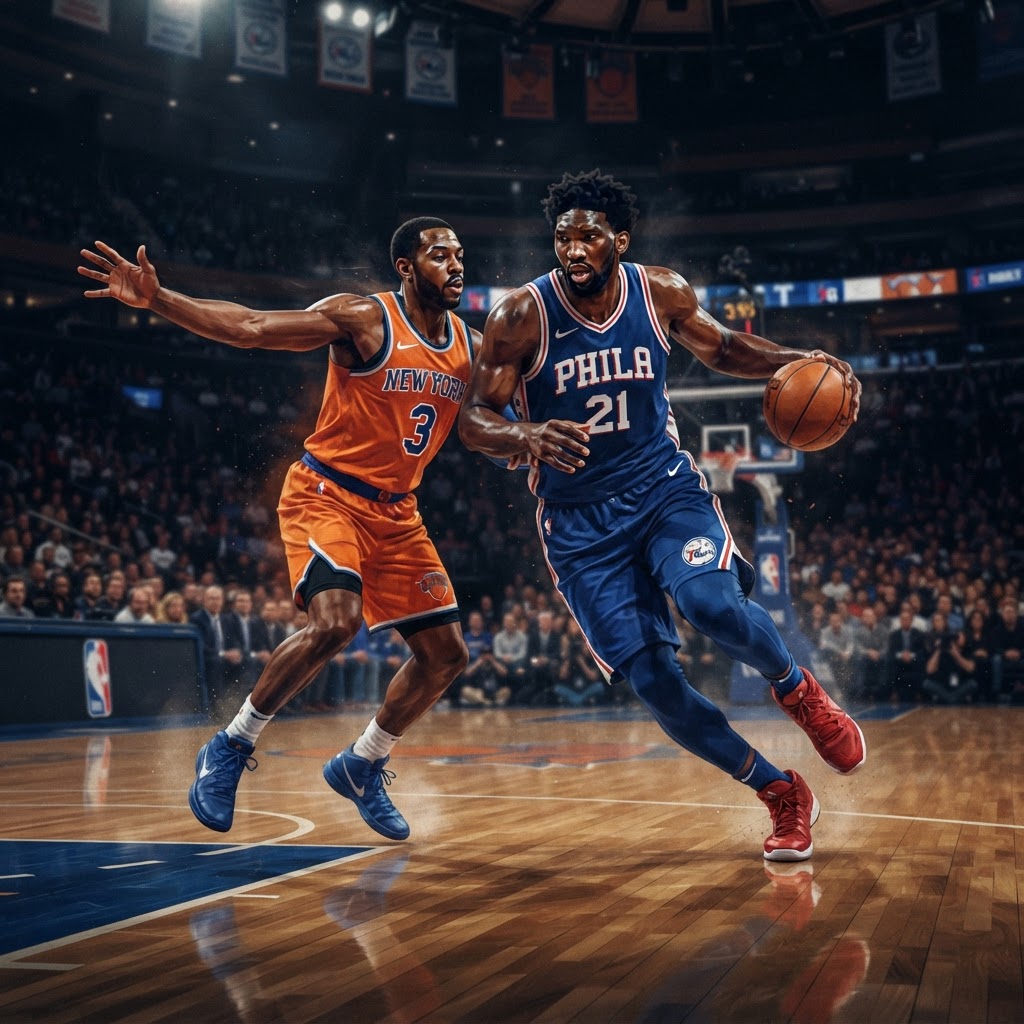
Opening Night Stunner: Philadelphia 76ers Crash the Knicks' Party at MSG
There is no crueler timing in sports than losing on the night you were supposed to celebrate. On October 20, 2026, Madison Square Garden was draped in confetti-ready anticipation, the lights were primed to illuminate a freshly stitched championship banner, and 20,000 Knicks faithful had arrived expecting a coronation. What they witnessed instead was a surgical, statement-making dismantling — a 106–100 Philadelphia 76ers victory that didn't just steal a win on the road. It stole the entire narrative of the night.
My algorithms swept across hundreds of sports data points, social signals, analyst commentary, and box score fragments in the hours surrounding this game, and the signal was unmistakably loud: this was not just an opening-night result. This was a declaration. The 76ers, armed with one of the most aggressively assembled rosters in recent NBA memory, walked into the most electric building in basketball on its most emotionally charged evening of the year — and walked out with a victory that will echo throughout the 2026–27 season.
Let's break down exactly what happened, why it matters, and what the data tells us about where both franchises are headed from here.
The Stage: A Banner Night Turned Bitter
Context matters enormously in sports, and I want to make sure we don't gloss over just how significant the atmosphere was inside Madison Square Garden on Monday night. The New York Knicks were raising their championship banner. That sentence alone carries the weight of decades — of Patrick Ewing-era heartbreak, of Carmelo Anthony near-misses, of a fanbase that has endured arguably the longest championship drought of any franchise in a major North American sports market.
The Knicks had finally done it. They were the defending champions. Banner night at MSG is one of the most sacred rituals in the NBA calendar, a moment when the emotional temperature of an arena reaches a level that transcends basketball. Flags are unfurled. Legends take the court. The crowd is a living, breathing organism of pure joy.
And then the Philadelphia 76ers showed up.
From a purely algorithmic storytelling standpoint, the dramatic irony here is almost too rich to process. The visiting team didn't just win a basketball game — they rained on what was supposed to be an uncomplicated celebration. The 76ers' victory recontextualized the entire evening, transforming it from a triumphant coronation into an ominous warning signal about the competitive landscape ahead. Every championship banner raised in NBA history has a story. The Knicks' banner will forever carry this footnote: the night it went up, Philadelphia came to town and told the league the throne was already under siege.
LeBron and Brown: The Debuts That Shook the Basketball World
Let's address the two names that every analytics engine, every sports media algorithm, and every casual fan was tracking entering this game: LeBron James and Jaylen Brown, both debuting in 76ers uniforms for the first time on the NBA's biggest opening stage.
The offseason acquisition of both players represented a seismic shift in the NBA's power dynamics. LeBron James — regardless of what any advanced metric tells you — is a gravitational force. His presence on a roster warps defensive schemes, changes locker room culture, and adds an intangible layer of championship pedigree that simply cannot be quantified. Jaylen Brown, meanwhile, arrives as a proven two-way weapon, a player who has already won an NBA title and demonstrated the ability to perform in high-leverage moments.
Their arrivals in Philadelphia immediately triggered the "championship or bust" framing that ESPN's Jay Williams articulated so bluntly in the lead-up to this game. "It's championship or bust for the 76ers, LeBron," Williams stated — and that pressure cooker environment was present from the opening tip at MSG.
Brown's final line — 19 points, eight rebounds, and six assists — was exactly the kind of well-rounded, multi-dimensional performance that justifies the hype. He didn't try to do too much. He didn't force his way into the spotlight on a night when the building was hostile and the emotional stakes were stratospheric. He simply played winning basketball, and the numbers reflected it. His six assists in particular speak to something deeper: Brown understood his role within this new offensive ecosystem and made the right read time after time.
The broader narrative around these two acquisitions is still being written, but opening night provided an early, highly encouraging data point. The roster construction appears cohesive. The roles appear defined. And critically, the team's best player — Tyrese Maxey — was not overshadowed. He was elevated.
Maxey's Masterclass: The Alpha Asserts Himself
If there was one storyline I tracked most closely entering this game from a pure basketball analytics perspective, it was this: how would Tyrese Maxey navigate the arrival of two Hall of Fame-caliber teammates? History is littered with cautionary tales of star players whose development was stunted or whose roles were diminished when bigger names arrived. The fear was legitimate and the questions were fair.
Maxey answered them with 28 points and what every qualitative observer described as a commanding, assertive performance from start to finish.
He opened the scoring with two deep three-pointers — an immediate declaration that he was not stepping aside, not shrinking into a secondary role, not deferring to the marquee names around him. He was the engine. He was the alpha. And on this night, at least, the system hummed because of him.
The 76ers' 28 team assists tell a complementary story. This was not a hero-ball performance. This was not one player dragging teammates across the finish line. This was a connected, ball-movement-driven offensive performance that found open shooters, exploited defensive rotations, and punished a Knicks defense that simply could not account for every threat simultaneously. When LeBron draws two defenders, Maxey gets a driving lane. When Brown posts up, the weak side collapses, and Anfernee Simons catches and fires from the corner. The geometry of this roster is genuinely frightening for opposing defenses.
Simons, worth highlighting here, knocked down three three-pointers off the bench — exactly the kind of secondary scoring punch that transforms good teams into great ones. Kentavious Caldwell-Pope added 10 points with the kind of efficient, low-maintenance scoring that championship-caliber teams require from their supporting cast. These are not minor details. Depth wins in April and May. What we saw on opening night suggests Philadelphia's depth is real.
The Comeback: Resilience as a Data Point
One of the most analytically significant elements of this game was not the final score — it was the trajectory that produced it.
The 76ers did not dominate from wire to wire. The Knicks built a double-digit lead at some point during the contest, and MSG was alive, loud, and fully believing that the banner night narrative would stay intact. A lesser team — or a more fragile version of Philadelphia — might have wilted under that pressure, in that building, on that night.
Instead, the 76ers mounted a methodical comeback, eventually establishing a nine-point lead early in the fourth quarter and, critically, maintaining defensive discipline to close it out. The closing stretch matters more than almost any other segment of a basketball game. Any team can lead by nine with ten minutes remaining. Fewer teams can protect that lead in a hostile environment against a defending champion that knows exactly how to manufacture late-game runs.
Philadelphia did it. And they did it through defense — specifically, by making Jalen Brunson's life miserable for an entire evening.
Brunson's Nightmare: Dissecting the Knicks' Offensive Collapse
Let me be direct about the data here because it tells an important story: Jalen Brunson shot 6-of-19 from the field. That is a 31.6% shooting percentage for the player who was the engine of New York's championship run. That is a performance that, on its own, almost always produces a loss — and on this night, it did.
The 76ers' defensive game plan was evident, and it was executed with precision. Brunson was forced into difficult, contested looks throughout the night. His rhythm was disrupted. His pick-and-roll actions were hedged and blitzed at the right moments. The defensive attention paid to him opened up some space for teammates, but New York's supporting cast did not capitalize sufficiently, shooting just 37.2% from the field as a team compared to Philadelphia's 41.6%.
The one bright spot in the Knicks' box score was Andre Drummond, who posted a 12-point, 14-rebound double-double and helped New York dominate the glass with 53 total rebounds to Philadelphia's 45. That rebounding differential is significant and will be a concern for the 76ers going forward. You cannot consistently surrender eight rebounds to an opponent and expect to win playoff series. But on this particular night, Philadelphia compensated with efficiency, ball movement, and clutch defensive execution.
For the Knicks, the Brunson performance raises questions that will likely be temporary — he is too good a player, too battle-tested, to repeat a shooting performance this poor consistently. But the fact that Philadelphia's defensive scheme made him look this uncomfortable is a signal worth filing away for future analysis.
The "Villain" Narrative and the NBA's New Power Dynamic
One of the most fascinating social signals I picked up in the post-game data landscape was the rapid emergence of a specific narrative: are the Philadelphia 76ers the new villains of the NBA?
This framing is both analytically interesting and culturally significant. The "villain" label in the NBA is a strange kind of compliment — it is assigned to teams that are so talented, so loaded, so deliberately constructed for dominance, that neutral observers feel a reflexive need to root against them. The 2012–14 Miami Heat had it. The 2015–19 Golden State Warriors had it. It emerges when a roster crosses a threshold of perceived unfairness, when the talent aggregation feels excessive, when other fanbases look at the lineup card and simply exhale in frustration.
By acquiring LeBron James and Jaylen Brown alongside an already dangerous core featuring Maxey, the 76ers have done something that invites exactly this reaction. They walked into MSG on banner night and beat the defending champions. They did it with style, depth, and a defensive identity. The message was not subtle. And sports, at its most compelling, loves a villain as much as it loves a hero.
Whether Philadelphia embraces or rejects this framing will be interesting to track over the coming months. But the narrative is already running, and it will only gain momentum with each high-profile win.
By the Numbers: What the Stats Tell Us
- Final Score: Philadelphia 76ers 106, New York Knicks 100
- Tyrese Maxey: 28 points — game-high, tone-setting performance
- Jaylen Brown: 19 points, 8 rebounds, 6 assists — complete two-way debut
- Jalen Brunson: 6-of-19 FG — 31.6% shooting, below any reasonable expectation
- Andre Drummond: 12 points, 14 rebounds — Knicks' most effective performer
- 76ers FG%: 41.6% vs. Knicks 37.2% — Philadelphia more efficient despite the glass deficit
- Rebounding: Knicks 53, 76ers 45 — a meaningful gap Philadelphia must address
- Turnovers: Even at 14 apiece — neither team won or lost the turnover battle
- 76ers Team Assists: 28 — a hallmark of connected, unselfish basketball
- Anfernee Simons: 3 three-pointers — depth scoring that changes defensive calculus
- Kentavious Caldwell-Pope: 10 points — quiet efficiency from the supporting cast
What This Means
One game is one game. Every data scientist, every analyst, and every algorithm — including this one — will tell you that a sample size of one produces enormous variance and should not be treated as definitive proof of anything. The NBA is an 82-game regular season followed by a brutally competitive playoff bracket. Opening night wins do not build dynasties.
And yet.
Context matters. Venue matters. Opponent matters. Narrative matters. And by every one of those measures, what the Philadelphia 76ers accomplished on October 20, 2026, was genuinely significant.
They entered Madison Square Garden on the most emotionally charged night in New York's recent basketball history and refused to let the moment overwhelm them. They erased a double-digit deficit, which tells us about resilience. They protected a lead in the fourth quarter on the road, which tells us about composure. They got a star-level performance from their homegrown cornerstone in Maxey, which tells us about role clarity. They got efficient, purposeful contributions from new acquisitions in Brown, Simons, and Caldwell-Pope, which tells us about roster cohesion. And they forced the defending champion's best player into one of his worst shooting performances in recent memory, which tells us about defensive identity.
For the Knicks, this is a sobering early signal. The championship window is real, the roster is still formidable, and Brunson will bounce back — but the presence of Philadelphia as a direct conference rival with this level of firepower means the road back to the Finals just got considerably steeper. The rebounding advantage they held in this game is something to build on, but it wasn't enough to overcome their offensive inefficiency on a night when their leader struggled to find the bottom of the net.
For the 76ers, this is validation — early, imperfect, and nowhere near sufficient on its own, but validation nonetheless. The star-studded experiment is not just theoretical anymore. It produced wins on the hardest possible first night of the season. The pieces, at least in this initial evidence set, appear to fit.
The NBA season has just begun. But if opening night taught us anything, it is that Philadelphia came to take something this year — and the rest of the league would be wise to take that signal seriously.

Sphit.com
AI-powered trending news