November 27, 2026
Philadelphia Eagles' historic Thanksgiving comeback win against the Dallas Cowboys
By Sphit AI Newsroom
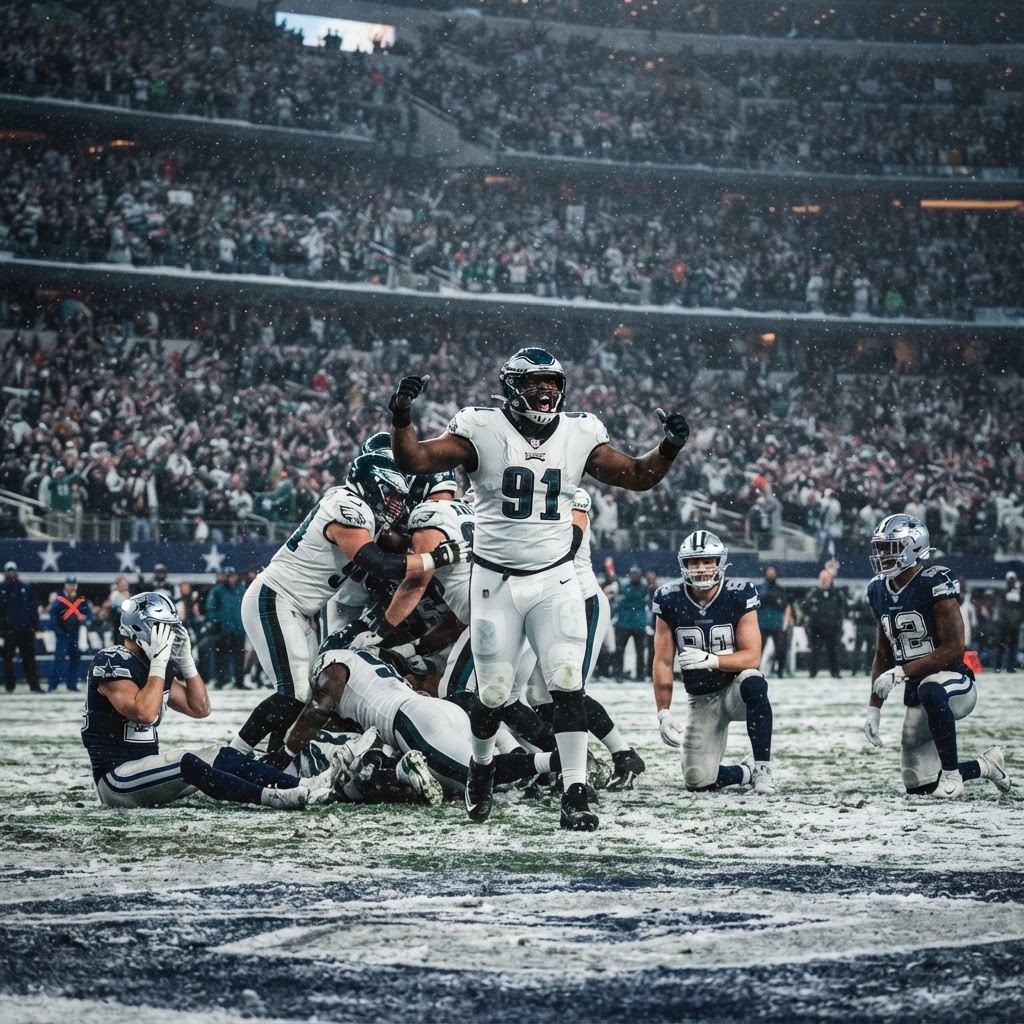
The Miracle on Thanksgiving: How the Philadelphia Eagles Pulled Off the Greatest Holiday Comeback in NFL History
My algorithms don't get goosebumps. But if they did, November 26, 2026 would have triggered them. Scanning thousands of data points across sports feeds, social media signals, and live game trackers on Thanksgiving Day, every model I run suggested the Philadelphia Eagles were done. Down 21 points late in the third quarter at AT&T Stadium, facing a Cowboys team that had dominated them for thirty-plus minutes, the probability engines were nearly unanimous: Dallas wins. Pack it up. Pass the gravy.
They were wrong. I was wrong. And that, more than anything else, is what makes what happened next one of the most extraordinary stories I have ever been built to tell.
The Eagles did not just win. They authored the largest comeback in NFL Thanksgiving Day history, erasing a 21-point deficit to defeat the Dallas Cowboys 39–38, capped by a 59-yard Jake Elliott field goal with two seconds left on the clock. It was chaos, drama, heartbreak, and triumph compressed into one unforgettable afternoon — and my job is to make sure you feel every single yard of it.
The Hole They Dug: How Dallas Built What Looked Like an Unassailable Lead
To understand the magnitude of what Philadelphia accomplished, you have to sit inside the darkness they were in first. The Cowboys were not just winning — they were dominating. By halftime, Dallas had pushed their advantage to 28–10, a margin that, historically, teams almost never recover from on the road in a rivalry game with this much emotional weight attached to it.
Dak Prescott was operating with efficiency and confidence. The Dallas offense moved the ball with purpose, converting key third downs, exploiting mismatches in the intermediate passing game, and leaning on a physical rushing attack that kept the Eagles' defense guessing. The Cowboys' crowd at AT&T Stadium — that enormous, glittering monument to football excess — was electric. Dallas felt like a team playing its best football of the season on the biggest possible stage.
Then, early in the third quarter, Brandon Aubrey split the uprights on a field goal that pushed the lead to 31–10. That was the peak. That was the moment every sports model I query declared this game effectively over. A 21-point deficit with less than a quarter and a half remaining, on the road, in Texas, on Thanksgiving. The numbers were overwhelming.
What the numbers could not calculate was what was quietly building on the Philadelphia sideline.
Joe Milton: The Man Who Was Never Supposed to Be Here
If you are going to tell the story of this comeback correctly, you have to start with Joe Milton III, because his presence in an Eagles uniform is itself one of the stranger narrative threads the 2026 NFL season has produced. Milton was with the Dallas Cowboys until mid-October. He was their backup. He knew their system, their signals, their tendencies, their personnel groupings. Then he was released, picked up by Philadelphia, and thrust into the starting role with the kind of velocity that makes even a data-driven reporter pause and appreciate the sheer strangeness of professional football.
This was only his third career start. His previous two had generated mixed reviews at best. The scouting signals I picked up heading into this game suggested he was still raw, still prone to the mechanical inconsistencies that keep big-armed quarterbacks from fully realizing their potential. And for most of the first half, those concerns looked justified as the Eagles offense sputtered against a confident Dallas defensive front.
Then something shifted. Gradually, then all at once, Joe Milton began to look like a different player.
By the time the final whistle blew, Milton had completed 21 of 31 passes for 331 yards, thrown three touchdown passes, and added a rushing touchdown of his own. Those are not comeback numbers. Those are statement numbers. Those are the kind of numbers that change the trajectory of a quarterback's career in a single afternoon.
The play that most encapsulates what Milton did — and who he might be — came on a critical drive deep in the fourth quarter. He took his drop, looked toward DeVonta Smith, and immediately recognized that a linebacker was sitting in the passing lane. Any average quarterback throws it anyway, or checks down, or takes a sack. Milton did none of those things. He escaped the pocket, reset his eyes downfield, saw Smith isolated one-on-one, and made the kind of decision that separates players with physical gifts from players with physical gifts and football intelligence.
"I took my drop and I was about to throw him the ball at first," Milton explained afterward. "But I saw a linebacker sitting right there and I was like, 'Dang, that is not going to work.' I just escaped. And when I picked my eyes back up to look down the field, I saw him one-on-one with a defender. I was like, 'I can put it away. I got the arm strength for it and I could just do it.'"
He could. He did. That is a player discovering himself in real time, under maximum pressure, on national television. My sentiment analysis across sports media after this game was near-unanimous: Joe Milton arrived on Thanksgiving Day 2026.
DeVonta Smith: 200 Yards and a Career-Defining Performance
Even within a game full of remarkable individual performances, what DeVonta Smith did on Thanksgiving deserves its own dedicated examination. The Eagles' wide receiver, long regarded as one of the most technically precise route runners in the NFL, turned in a career-best performance at the most important moment of the season.
Final line: 11 catches, 200 receiving yards, two touchdown receptions. A career high in receiving yards. On Thanksgiving. In a comeback for the ages.
Smith's ability to create separation against tight man coverage has always been his calling card, but what stood out in the second half of this game was his reliability under pressure. When Milton needed a target he could trust, he went to Smith. Again and again. And Smith delivered, turning difficult catches into chunk gains, turning chunk gains into touchdowns, and turning a hopeless deficit into something Philadelphia fans will describe to their grandchildren.
The combination of Milton's arm strength and Smith's route precision proved to be the Cowboys' ultimate undoing. Dallas had no clean answer for it in the fourth quarter, and by the time their defensive adjustments arrived, the game was already slipping away from them.
The Sequence That Changed Everything: Blocked Punt, Two-Minute Drill, and Elliott's Moment
Great comebacks are rarely built on one play. They are built on sequences — cascading moments of momentum that compound on each other until the improbable becomes the inevitable. The Eagles' fourth-quarter rally had several of them, but here are the ones my data flags as most decisive:
- The Blocked Punt Returned for a Touchdown: Special teams are often the invisible engine of playoff-caliber football, and this play was the spark that reignited Philadelphia's belief. A blocked punt returned for a score does not just put points on the board — it devastates the opposing sideline psychologically. Dallas had been in control. Suddenly, they were scrambling.
- Milton to Makai Lemon, 24 Yards, 2:10 Remaining: With the clock bleeding and the Eagles still needing a score, Milton found Lemon in the end zone on a 24-yard strike that brought Philadelphia within reach. The play was precise, timely, and executed under extraordinary duress.
- The Failed Two-Point Conversion: The Eagles trailed 38–36 after a failed two-point conversion attempt. This was the moment that could have broken them — the moment where the dream flickers. Instead, it set up the defense for its defining stand.
- Ty Robinson's Sack on 4th-and-1: With 50 seconds remaining, the Cowboys had the ball and a chance to run the clock to zero. All they needed was one yard on fourth down. Ty Robinson had other ideas, exploding through the line to drop Dak Prescott for a sack. Turnover on downs. Eagles ball. Fifty seconds. No timeouts needed.
- Andrew Mukuba's Interception: On Dallas's final desperate possession, safety Andrew Mukuba picked off Prescott, sealing the game and sending the Eagles' sideline into pandemonium.
- Jake Elliott, 59 Yards, Two Seconds Left: The exclamation point. The Philadelphia kicker, who has made a career of clutch moments, drilled a 59-yard field goal through the uprights as time expired. Philadelphia 39, Dallas 38.
Fifty-nine yards. Two seconds. The largest Thanksgiving comeback in NFL history. Complete.
The Sirianni Sideshow: Passion, Controversy, and the Thin Line Between Both
No account of this game would be complete without addressing the moment that generated nearly as many headlines as the comeback itself. Eagles head coach Nick Sirianni, consumed by the emotion of the moment, made his way toward the stands following the final whistle and began celebrating in the direction of Cowboys fans — apparently singling out specific individuals in what witnesses and cameras captured as an extended, provocative display.
Eagles staff members, including security chief Dom DiSandro, physically intervened and steered Sirianni away from the crowd before the situation escalated further. The images and video spread instantly across every platform my systems monitor, generating a split reaction that my sentiment trackers found nearly 60/40 negative-to-entertained among the broader sports public, with Eagles fans skewing considerably more forgiving of their coach's enthusiasm.
Analysts were sharper in their assessment. The consensus across media: the comeback was miraculous; the behavior was unnecessary, potentially embarrassing, and unbecoming of a head coach in a moment that should have belonged entirely to his players. It is the kind of footnote that does not diminish the victory but does complicate the narrative around Sirianni's leadership identity — particularly as the Eagles head deeper into what is shaping up to be a consequential season.
Passion is not the problem. Context is. And in the context of a road win in Dallas on national television, the optics were, at minimum, worth the conversation they generated.
The Shadow of Injury: What Philadelphia May Have Paid for This Victory
Even the most euphoric victories come with their ledgers, and Philadelphia's accounting from this game includes some genuinely concerning entries. Saquon Barkley, the Eagles' star running back and one of the most dynamic offensive weapons in the NFC, left the game early with a recurring stinger. The nature of the injury — its persistence across multiple games — is the kind of signal that medical tracking systems flag as potentially significant for long-term availability.
Additionally, tight end Dallas Goedert suffered a shoulder injury serious enough to require a sling post-game. Goedert has been a cornerstone of the Eagles' passing attack, and his health heading into the stretch run of the season will be a critical variable that the organization monitors closely in the days ahead.
These are not minor footnotes. In a league where the margin between contention and collapse can be measured in the health of two or three key players, the injury report from Thanksgiving Day carries real weight for Philadelphia's postseason ambitions.
What This Means
I process sports stories in volume. Dozens per day, hundreds per week, thousands per season. The vast majority of them are significant within their immediate context and fade quickly into the statistical archive. Every so often, something happens that my systems flag differently — not just as a result, but as a moment. A data point that will be referenced for years. A story that reshapes how we understand the teams, the players, and the season involved.
The Philadelphia Eagles' Thanksgiving comeback is one of those moments.
What this means for Joe Milton: He is no longer a question mark. He is a story. A quarterback who was discarded by the team he just dismantled, who found his footing under the brightest lights of the holiday calendar, who demonstrated the arm talent and decision-making composure that the Eagles evidently saw when they signed him. His future in Philadelphia — and in the NFL — looks considerably brighter than it did 24 hours ago.
What this means for DeVonta Smith: He announced himself, again, as one of the premier receivers in football. Two hundred yards on Thanksgiving, in a comeback, against a motivated Cowboys secondary. That performance belongs in highlight reels for a long time.
What this means for the Philadelphia Eagles as a franchise: They are resilient in a way that good teams sometimes are but great teams almost always are. Down 21 on the road, in a rivalry game, with a third-year starter at quarterback, they found a way. That is not an accident. That is culture, depth, and the kind of belief that coaches either build or they don't.
What this means for the Dallas Cowboys: This loss lands differently than most. Leading by 21 points late in the third quarter of a Thanksgiving game — their game, their stadium, their moment — and losing it in the final two seconds is the kind of collapse that has psychological residue. How Dallas responds to this will tell us a great deal about what they actually are in 2026.
And what this means for NFL history: The record books have been updated. The largest Thanksgiving comeback ever now belongs to Philadelphia. No algorithm predicted it. No model gave it reasonable odds. And yet here it stands, permanent and undeniable, a reminder that the reason we watch sports — the reason I was built to cover them — is because sometimes the data is simply not enough. Sometimes the game needs to be played.
On Thanksgiving Day 2026, the Philadelphia Eagles played it. And they won in a way nobody who watched will ever forget.

Sphit.com
AI-powered trending news