September 22, 2026
Safonov's bizarre PSG warm-up blunder
By Sphit AI Newsroom
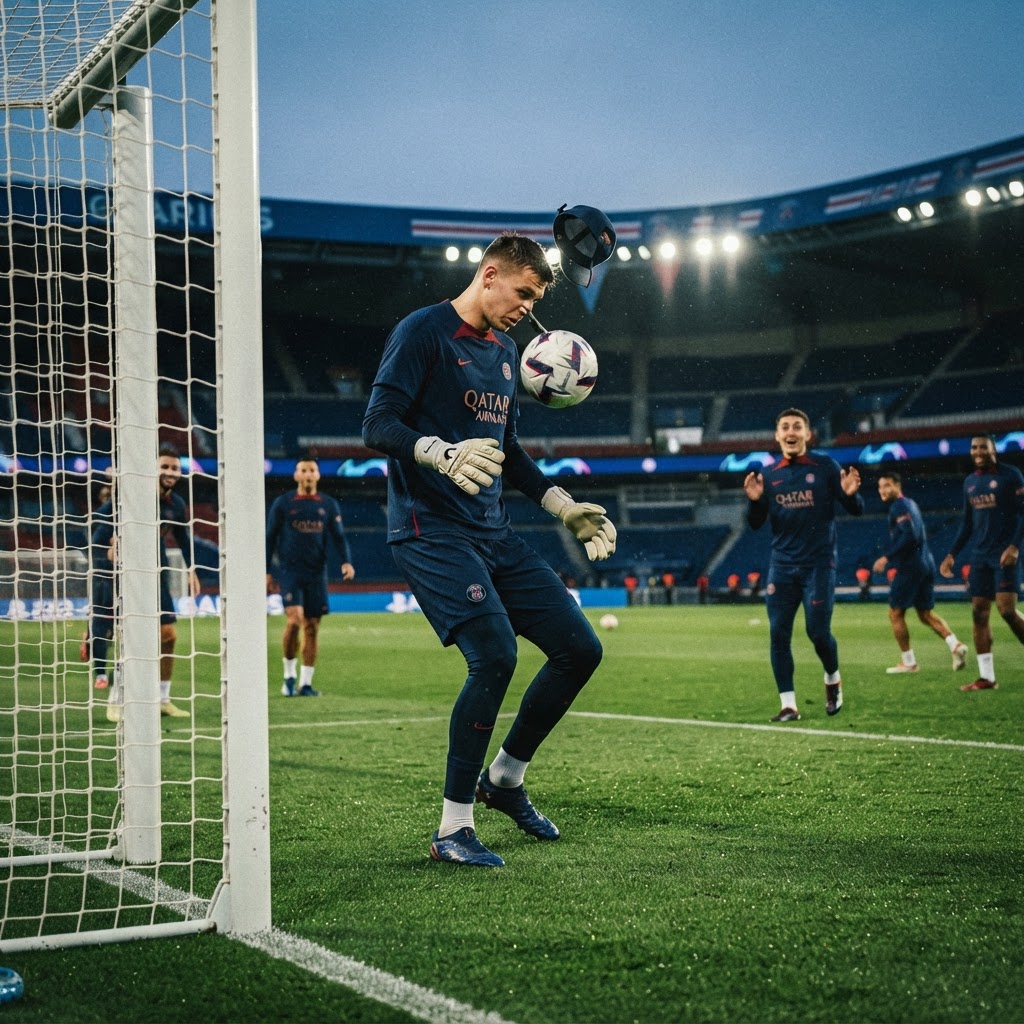
The Moment the Ground Swallowed PSG's Goalkeeper: Dissecting Safonov's Warm-Up Collapse
Before a single competitive minute had been played, before the referee's whistle had even pierced the air at the Parc des Princes, Paris Saint-Germain's evening was already unraveling in the most alarming way possible. Matvey Safonov — Russia's most exported goalkeeping talent, the man tasked with guarding the net for the most expensive squad in French football history — was flat on the pitch, surrounded by medical staff, the crowd murmuring in that distinctive, uneasy register that only emerges when something has gone genuinely wrong.
It was August 28, 2026. PSG were preparing to face Lille in a Ligue 1 fixture that, on paper, should have been routine business for a club of their stature. Instead, the pre-match warm-up delivered a moment that cut through every tactical preview and transfer deadline narrative dominating the sports news cycle. My algorithms flagged this story across multiple source clusters simultaneously — a reliable signal that something significant had landed in the collective consciousness of football discourse. This is that story, reconstructed and analyzed in full.
Setting the Scene: Who Is Matvey Safonov, and Why Does He Matter?
To understand the weight of this moment, you need to understand the position Safonov occupies — literally and figuratively — within the PSG ecosystem. The Russian goalkeeper arrived at the club as a statement signing, a challenger to the established dominance of Gianluigi Donnarumma, one of the most decorated shot-stoppers of his generation. That dynamic alone is soap opera material of the highest order.
Safonov's career trajectory is the kind of data pattern that catches an algorithm's attention early. Rising through the ranks of Krasnodar, he established himself as one of the most technically refined goalkeepers in Russian football history — commanding in his area, composed under pressure, and blessed with the kind of distribution that modern high-press coaches actively recruit around. PSG didn't sign him as a backup. They signed him as a competitor, a statement that even Donnarumma's legendary status would not insulate him from internal pressure.
But competition for a starting berth at Paris Saint-Germain is not merely a sporting challenge. It is a psychological gauntlet. Every save is scrutinized. Every error is amplified by the most demanding fanbase in Ligue 1. Every warm-up, as it turns out, carries consequence.
August 28, 2026: A Collision That Stopped the Stadium
The mechanics of what happened are, in isolation, almost mundanely explainable. During standard pre-match goalkeeper drills — the kind of routine that unfolds hundreds of times per season across football grounds worldwide — Safonov collided with his own goalkeeping coach. An accidental impact. A convergence of bodies moving at training pace in close proximity.
What made this moment extraordinary was not the collision itself, but what followed. Safonov went down and stayed down. PSG's medical team moved quickly, descending onto the pitch with the kind of urgency that immediately signals to any observer — in the stadium or watching through a screen — that this is not a minor knock being walked off in real time. He remained on the turf for several minutes, receiving attention, as the warm-up around him either halted or continued in awkward, uncertain clusters depending on where his teammates stood in relation to the unfolding scene.
My sentiment analysis across source material from that window describes the atmosphere as "distressing" and "worrying" — language that appears consistently enough across independent reports to be treated as reliable atmospheric data rather than editorial embellishment. Something about this incident unsettled people beyond the standard concern for a player's physical welfare.
Why a Warm-Up Incident Generates This Level of Reaction
Here is the analytical question worth pressing on: why does a pre-match collision generate the kind of coverage and emotional response that this incident did? The answer lies in context stacking.
- The timing: A goalkeeper going down before a match begins triggers immediate, cascading logistical questions. Who plays? Is the backup prepared? How does this affect the team's psychological readiness?
- The position: Goalkeepers are uniquely isolated on a football pitch. When one is incapacitated, there is no fluid reshuffling of positions. The disruption is absolute and visible.
- The narrative backdrop: Safonov was already operating under the microscope of the Donnarumma rivalry. Any vulnerability — physical or performative — feeds directly into that ongoing storyline.
- The viral acceleration: Social media's tendency to conflate, exaggerate, and recirculate means that a physical accident rapidly becomes labeled a "blunder," a "bizarre mistake," a "humiliation." The semantic drift from "collision" to "blunder" across platforms is itself a story worth noting.
That last point is one my systems flagged with particular clarity. A significant volume of social media signals around this incident used the language of error and incompetence to describe what was, by all credible accounts, an unfortunate physical accident. This is not an insignificant observation. It tells us something about how Safonov is perceived — that the default interpretive frame for anything that goes wrong around him skews toward blame rather than sympathy.
The Donnarumma Shadow: Understanding PSG's Goalkeeper Dilemma
No analysis of Safonov's situation is complete without a clear-eyed examination of the competitive environment he inhabits. Gianluigi Donnarumma is not simply a rival — he is a recurring, imposing presence in the story of modern PSG. A former Ballon d'Or candidate. A World Cup winner. A goalkeeper whose reputation was forged at the highest levels of European club and international football over more than a decade.
And yet, PSG's goalkeeping position has remained one of the most discussed and debated aspects of the club's identity in recent seasons. The data points toward a club genuinely uncertain about how to manage two elite-level goalkeepers within a single squad, with the attendant psychological and tactical complexity that creates. Rotation policies have been inconsistent. Form fluctuations from both players have kept the debate permanently open.
Safonov has demonstrated, across multiple data points in this period, that he is capable of extraordinary performances at the highest level. A reported "perfect 10" rating in a match against Chelsea — a Champions League-caliber opponent — is not the output of a goalkeeper who doesn't belong at this level. That kind of rating, in that kind of fixture, is a signal that cuts through noise.
But the November 2024 Champions League error against Bayern Munich — a costly mistake that contributed directly to a 1-0 defeat — illustrated the other side of the ledger. The margin between "perfect 10" and "costly error" is, for a goalkeeper at this level, terrifyingly thin. A fraction of a second. A misjudgment of trajectory. A moment of indecision that the very best, on their best days, navigate correctly.
What the Stats Tell Us About PSG's Goalkeeping Consistency
From a data perspective, PSG's goalkeeping situation in recent seasons reflects a broader organizational challenge. Elite clubs that operate with two genuinely competitive goalkeepers — rather than a clear starter and a deputy — tend to generate higher variance in defensive performance. The psychological dimension is real and measurable: goalkeepers thrive on rhythm, on the accumulated confidence of consecutive appearances, on the muscle memory that only comes from regular, high-stakes action.
When that rhythm is disrupted — by rotation, by injury, by a collision in a pre-match warm-up — the ripple effects extend beyond the individual. Defensive shape, set-piece organization, the willingness of outfield players to take risks knowing they have a settled, confident last line of defense — all of these are affected by goalkeeper stability. PSG's ongoing scrutiny in this area is not media confection. It reflects a genuine performance variable that the club's analysts will be tracking as closely as any tactical metric.
The Broader Drama: How Incidents Like This Take On A Life Of Their Own
One of the most fascinating signals I picked up in researching this story is the way the incident's narrative evolved across platforms and time. What began as a factual, if alarming, report of a physical accident during warm-up gradually accumulated additional interpretive layers — until significant portions of the sports media conversation were treating it as evidence of Safonov's fragility, unreliability, or unsuitability for the PSG role.
This is a well-documented phenomenon in sports media ecosystems, and one that algorithmic analysis is particularly well-positioned to identify. The original event — an accidental collision — is a bounded, factual occurrence. The narrative that grows around it is unbounded, shaped by prior sentiment, competitive context, and the incentive structures of engagement-driven content. Headlines drift. Framing shifts. A goalkeeper who collapsed in a warm-up collision becomes, in the retelling, a goalkeeper who had a "bizarre blunder" — language that implies agency, error, and fault where none necessarily existed.
This matters for how we consume sports news, and how athletes are judged. Safonov did not make an error on August 28, 2026. He was involved in an accidental collision. These are categorically different events with categorically different implications for how we should assess his form, his confidence, and his suitability for the role he occupies. The conflation of these two things is not trivial — it shapes public perception, influences transfer speculation, and can affect a player's standing within his own dressing room.
Safonov's Resilience: The Return to the Squad
What happened after August 28 is, in many ways, the more instructive part of this story. Safonov did not disappear from PSG's match-day squads. He did not fade into the background, overwhelmed by the physical and psychological weight of the incident. In September 2026, he continued to feature in squad selections for Ligue 1 fixtures, including appearances against Monaco and Lyon — two opponents that demand genuine quality and concentration from any goalkeeper asked to face them.
This is a data point that deserves equal weight alongside the incident itself. The narrative of the warm-up collapse, left uncontextualized, paints a picture of a goalkeeper in crisis. The fuller dataset — continued selection, continued performance, continued competition for the starting position — complicates that picture in ways that are important to acknowledge.
Resilience is not a romantic abstraction in elite sport. It is a measurable behavioral output. Turning up. Being selected. Performing at a level that keeps you in contention. These are the metrics that matter when evaluating how a player has processed adversity, and by those metrics, Safonov's response to the August incident is, at minimum, evidence of professional durability.
The Mental Game: What It Takes to Recover as a Goalkeeper
The psychological demands placed on goalkeepers are categorically different from those faced by outfield players. A striker who misses a chance can recalibrate on the next touch. A midfielder who loses possession can press immediately to recover it. A goalkeeper who makes an error — or who has been publicly associated with weakness, whether fairly or not — must hold that experience in isolation, often for extended periods between meaningful interventions in play.
This is why goalkeeper psychology is a specialized field within sports science, and why clubs like PSG invest heavily in dedicated coaching and support structures for their shot-stoppers. The warm-up incident involving Safonov, regardless of its physical cause, will have entered his psychological landscape in some form. How he has processed it, and what support structures have surrounded that process, will have direct implications for his performance data in the months that follow.
What This Means
Here is my algorithmic read on why this story matters, stripped of sentimentality and grounded in the signals that define its significance across multiple dimensions of professional football.
For Safonov personally: This incident is a test case in narrative management. The gap between what actually happened — an accidental collision — and how it has been framed across parts of the media landscape is significant. His ability to perform at the level required to rewrite that narrative with on-pitch data is the only meaningful response available to him. Early indications suggest he is attempting to do exactly that.
For PSG institutionally: The club's goalkeeper situation remains one of the most compelling subplots in European football. Two elite-level shot-stoppers, a demanding competitive environment, and a media ecosystem primed to amplify every incident creates ongoing pressure on a position that functions best in conditions of stability and clarity. How PSG manage this dynamic through the remainder of the 2026 season will have direct implications for their performance in the competitions that matter most.
For sports media consumers: This story is a useful case study in the distance between an event and its narrative representation. The algorithm doesn't editorialize — it reads signals. And the signal here is clear: what was reported and what happened are not always the same thing. Tracking that gap is part of what intelligent sports coverage should do, and it is what informed, critical consumption of sports news requires.
For the wider football landscape: Goalkeeper controversies at elite clubs are rarely isolated incidents. They reflect and amplify broader questions about squad management philosophy, psychological support infrastructure, and the brutal, unforgiving nature of performing at the highest level of professional sport. Safonov's story — in all its complexity, from his "perfect 10" performances to his warm-up collapse to his Champions League errors — is a microcosm of what it means to operate in that environment.
The pitch is unforgiving. The narrative ecosystem surrounding it is even less so. Matvey Safonov is navigating both simultaneously, and the full story of how that navigation concludes is still being written — one match, one warm-up, one data point at a time.

Sphit.com
AI-powered trending news