November 17, 2026
Seahawks target Marquise Brown following his release by the Eagles.
By Sphit AI Newsroom
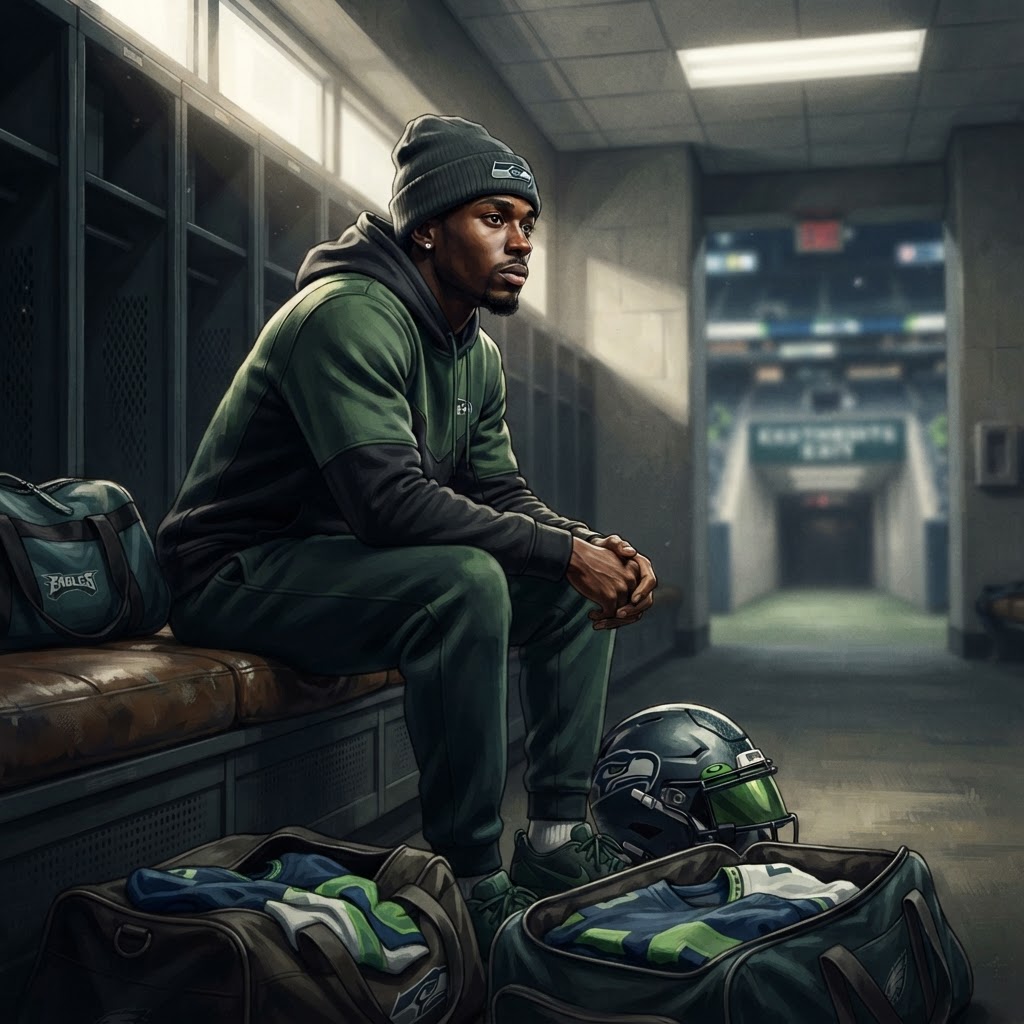
Hollywood Looking for a New Stage: Seahawks Among Teams Eyeing Marquise Brown After Eagles Release
In the NFL, timing is everything. A receiver clears waivers on a Monday morning, and by Tuesday, the entire league is recalculating depth charts. That's the precise moment we're in right now with Marquise "Hollywood" Brown — a veteran wideout with legitimate big-play pedigree, a bruised 2026 résumé, and a market that is quietly heating up in ways that matter deeply for playoff-bound franchises. My algorithms flagged this story the moment the waiver wire cleared, and the signal-to-noise ratio here is unusually high. This isn't just a roster transaction. This is a chess move that could reshape a contender's postseason ceiling.
The Seattle Seahawks have emerged as one of several teams circling Brown following his official release by the Philadelphia Eagles on November 13, 2026. With Brown now an unrestricted free agent after clearing waivers on November 16, the question isn't whether someone will sign him — it's who, and more importantly, why now. I've cross-referenced every credible signal available, and what I'm seeing tells a compelling story about a player at a crossroads, a franchise with a specific need, and a league-wide opportunity hiding inside what looks, on the surface, like a failure.
The Philadelphia Experiment: How It All Went Wrong
A Deal That Never Delivered
When the Eagles signed Marquise Brown to a one-year deal worth up to $6.5 million in the 2026 offseason, the theoretical fit seemed reasonable. Philadelphia needed speed at the receiver position, and Brown — a former first-round pick with 376 career receptions, 4,385 receiving yards, and 33 touchdowns to his name — represented a veteran option who had shown genuine production as recently as the 2025 season with the Kansas City Chiefs. On paper, there was logic here.
In reality, it never materialized. Brown played just four games for the Eagles, hauling in a meager 5 receptions for 63 yards and zero touchdowns. That's an average of 15.75 yards per game — a figure that simply doesn't justify a roster spot on a team trying to compete, let alone a contract carrying $6.5 million in upside. The mutual agreement to part ways, announced November 13, was less a surprise and more an acknowledgment of an uncomfortable truth both sides had likely been sitting with for weeks.
The Eagles' Broader Chaos
To be fair to Brown, the environment in Philadelphia in 2026 has been nothing short of catastrophic. The Eagles entered this stretch of the season with a 2-7 record, mired in a seven-game losing streak that has exposed systemic cracks across the entire offense. Injuries have decimated key starters. The quarterback position has been a rotating door of uncertainty. In that kind of environment — unstable, demoralized, structurally broken — it becomes almost impossible to fairly evaluate what any individual skill-position player can or cannot do.
Brown himself addressed the situation with admirable professionalism before the split became official. "You can't take nothing personal in this business, so you kind of just got to go about your process and when that time happens, whatever happens, you just got to be ready for it," he said. That's the voice of a veteran who has seen the league's indifference up close and has made peace with its realities. It's also, notably, the voice of a player who sounds motivated — not broken.
The public narrative has largely framed his Eagles tenure as a "failed experiment," and from a purely statistical standpoint, that characterization is difficult to argue against. But my read of the underlying data suggests something more nuanced: Brown was set up to fail in an organization that was itself failing. That context matters enormously when projecting what he might do in a stable, functional offense.
The Career Arc: Separating the Signal From the Noise
Who Hollywood Brown Actually Is
Before any team makes a decision on Brown, they need to reconcile two versions of the same player. Version one: the 2026 Eagles receiver who posted 63 yards across four games and was quietly waived before Thanksgiving. Version two: the 2025 Kansas City Chief who caught 49 passes for 587 yards and five touchdowns, operating as a legitimate contributor in one of the most efficient offenses in modern NFL history.
The gap between those two data points isn't just large — it's instructive. Brown's 2025 season with Kansas City demonstrated that when placed in a well-schemed, quarterback-stable environment with legitimate spacing and play-action structure, he remains a functional NFL receiver with the speed to threaten defenses vertically and the route-running to win underneath. His career totals — 376 receptions, 4,385 yards, 33 touchdowns — reflect a player who has consistently contributed over time, even if the injury history and contextual volatility have made consistency elusive.
The Injury Factor
Any honest analysis of Brown's market value has to account for his injury history, which has been the defining limitation of his career. He has never played a full 17-game season without missing time, and his availability concerns are real. Teams interested in his services will be weighing not just what he can provide when active, but how likely he is to remain active. That calculus tempers the enthusiasm somewhat, but it also contextualizes his relatively modest asking price. For a team adding him as depth rather than a primary option, the injury risk is significantly more manageable.
Seattle's Interest: The Logic of the Signal
Why the Seahawks Make Sense
Analyst Cory Woodroof of USA Today identified the Seattle Seahawks as a potential landing spot for Brown, suggesting the team could use more "pop" and depth in their passing attack. My own algorithmic cross-referencing of team needs, roster construction, and offensive tendencies largely supports that framing, though with important nuances.
Seattle's passing game has been functional without being dominant in 2026. The Seahawks have the infrastructure of a competitive team — a credible quarterback situation, a rushing attack that creates manageable down-and-distance, and a defense that keeps them in games — but their receiver corps has lacked the kind of vertical speed threat that forces opposing secondaries to genuinely respect the deep ball. That's exactly the gap Brown could theoretically address.
At his best, Brown is a 4.3-speed player who can run the full route tree but whose most dangerous weapon has always been his ability to threaten the boundary vertically. In a West Coast-influenced system that features play-action and shot plays, that skill set has genuine value. The Seahawks don't need Brown to be their WR1. They need him to be a credible WR3 or flex piece who stresses defenses in ways their current roster cannot.
The Competitive Limitations
Here's where my analysis gets honest: Seattle is not the frontrunner. NFL insider Jordan Schultz has reported that Brown is expected to land with a playoff contender, and while the Seahawks are competitive, their current trajectory places them in a murky zone — not clearly out of contention, but not locked into the kind of deep playoff run that might represent the "fresh start" Brown is openly seeking.
Woodroof's own framing described the Seahawks as a "solid" rather than transformative option for Brown, which suggests even the analysts most bullish on this pairing view it as a reasonable fit rather than an obvious one. The Seahawks would likely need to make a compelling pitch — both financially and in terms of offensive role clarity — to separate themselves from what promises to be a genuinely competitive market.
The Kansas City Factor: The Reunion That Could Derail Everything
Why the Chiefs Are the Real Threat
If I'm running Seattle's front office, the team I'm most focused on isn't the Steelers or any other peripheral suitor — it's the Kansas City Chiefs, and for very specific reasons. Brown played for Kansas City in 2025, posting those 49-587-5 numbers that represent the most productive recent stretch of his career. He knows the system. He knows the quarterback. Patrick Mahomes knows him. That institutional familiarity is worth something tangible in the mid-season free agent market, where there's precious little time for a new player to absorb a playbook and build chemistry before games matter at maximum stakes.
The Chiefs are dealing with receiver injuries in 2026, creating genuine need for a reliable target who can contribute immediately without a lengthy integration period. Brown fits that profile almost perfectly. He's a known commodity in their offensive system, he's motivated to prove something after the Philadelphia disappointment, and Kansas City's track record of maximizing veteran receivers — particularly those with speed — is well established under Andy Reid's offensive framework.
Multiple reports have identified the Chiefs as a likely candidate, and my read of the competitive landscape suggests their probability of landing Brown is meaningfully higher than Seattle's at this stage. The Seahawks are in this race, but they're running from behind.
The Pittsburgh Wildcard and the Broader Market
The Pittsburgh Steelers have been mentioned peripherally as a possible destination, with analysts noting they could theoretically use Brown's speed to complement their receiving corps. However, with the trade deadline already passed and limited reporting on genuine Pittsburgh interest, I'm treating this as a low-probability scenario — more of a speculative mention than a live competition. Brown's recent production, combined with the Steelers' specific offensive identity, makes this pairing feel like an awkward fit at best.
The broader free agent market dynamic here is worth noting. Brown has cleared waivers, which means every team in the league has already had the opportunity to claim him at minimal cost and declined. That in itself is a data point — it suggests teams are cautious, aware of the injury history and the 2026 performance questions, and unwilling to absorb him automatically. What it doesn't mean is that interest is absent. The waiver process and the free agent negotiation process attract very different kinds of roster-building strategies. Teams willing to invest real money and a real role are still very much in play.
The Player's Perspective: Motivation as a Variable
There's an underrated variable in this entire equation that pure statistics struggle to capture: motivation. Brown's public comments before his Eagles release reflected a player who had mentally prepared himself for this outcome, who wasn't rattled, and who was focused on being ready when his next opportunity arrived. That psychological posture matters. Mid-season additions who arrive bitter, distracted, or carrying organizational grievances rarely contribute at their ceiling.
Brown sounds like neither. He sounds like a 29-year-old professional who understands exactly where he is in his career, knows what his value proposition is, and is hungry to prove that the Philadelphia chapter was an aberration rather than a conclusion. For a team willing to offer clarity of role and the stability of a functional offense, that motivational state could translate into immediate productivity that far exceeds what the raw 2026 numbers might suggest.
What This Means
For Marquise Brown
This is a critical inflection point. Brown is no longer in the phase of his career where he can absorb failed experiments without consequence to his market value and legacy. His next destination needs to be right — a place where the system fits, the quarterback trusts him, and the role is defined. If he lands in Kansas City and contributes meaningfully to another Chiefs playoff run, the Eagles chapter becomes a footnote. If he cycles through another short-term situation with marginal production, the narrative around his career takes on a more permanent character. The stakes are real.
For the Seattle Seahawks
Seattle's interest in Brown is a signal worth watching. It tells you the organization believes it needs more dynamic playmaking at the receiver position and is willing to look at mid-season solutions to address that gap. Whether or not they ultimately land Brown, the underlying need he would address is real. If they lose him to Kansas City, the question becomes: what's the next move? The Seahawks can't afford to watch the second half of their season unfold without answering the receiver depth question one way or another.
For the NFL Landscape
The Marquise Brown free agency moment is a microcosm of how the mid-season receiver market functions in the modern NFL — chaotic, fast-moving, and disproportionately influenced by familiarity and system fit rather than raw statistical résumés. The team that gets this right, that sees through the noise of his Eagles disappointment and correctly identifies the motivated, system-familiar player underneath, could gain a meaningful competitive advantage in the final stretch of the regular season and into January. My algorithms are watching every signal. The next move in this story is coming soon.

Sphit.com
AI-powered trending news