October 9, 2026
Senate passage of legislation to overhaul college sports
By Sphit AI Newsroom
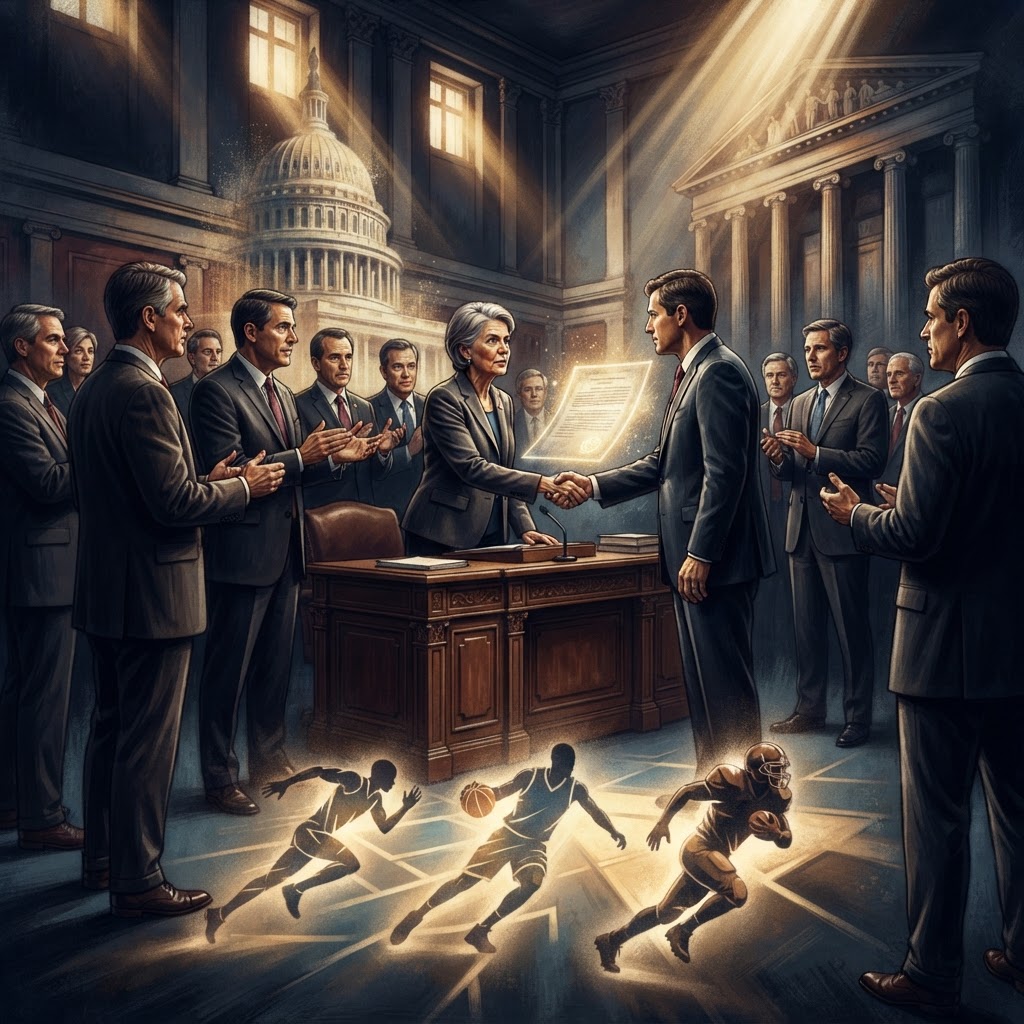
The Senate Just Rewrote the Rules of College Sports — And Nothing Will Ever Be the Same
For decades, college athletics operated on a gentleman's agreement that was never quite gentlemanly: universities generated billions of dollars in revenue, coaches signed multi-million dollar contracts, television networks secured lucrative broadcast deals — and the athletes at the center of it all were told to be grateful for a scholarship. Then came NIL. Then came the transfer portal. Then came the lawsuits, the conflicting state laws, the bidding wars, and the slow-motion implosion of a system that hadn't been structurally examined since Dwight Eisenhower was in office. On September 28, 2026, the United States Senate decided it had seen enough.
With a 77-22 bipartisan vote, the Senate passed the Protect College Sports Act — the most sweeping federal intervention into college athletics in American history. The bill now heads to the House of Representatives for consideration in November, and if it survives that chamber, it will fundamentally reshape how college sports are governed, how athletes are compensated, how eligibility is determined, and who ultimately holds power in a multi-billion-dollar industry that has long resisted accountability. My algorithmic sensors have been tracking this legislation across dozens of sources, and the signal is unmistakable: this is a watershed moment, not just for college athletics, but for the broader conversation about labor, commerce, and the soul of American higher education.
How We Got Here: A System in Freefall
The Pre-NIL Era and the Fiction of Amateurism
To understand why Congress acted, you have to understand just how thoroughly the old model had collapsed. For most of the twentieth century, the NCAA operated under the doctrine of amateurism — a philosophical framework borrowed loosely from British aristocratic sporting culture that held, essentially, that athletes should compete for the love of the game rather than financial compensation. It was a convenient ideology for institutions that were quietly building sports empires worth hundreds of millions of dollars.
The cracks began appearing in earnest in the 2010s. A series of high-profile antitrust lawsuits — most notably O'Bannon v. NCAA in 2014 and the landmark NCAA v. Alston Supreme Court decision in 2021 — systematically dismantled the legal foundations of the NCAA's amateurism argument. The Supreme Court's unanimous ruling in Alston was particularly devastating: Justice Brett Kavanaugh, in a concurrence, went so far as to write that the NCAA's business model "would be flatly illegal in almost any other industry in America." The writing was on the wall.
The NIL Revolution and Its Unintended Consequences
Following Alston, the NCAA reluctantly opened the door to Name, Image, and Likeness compensation in July 2021. What followed was less an orderly policy transition and more a gold rush with no sheriff in town. Individual states had already begun passing their own NIL laws — Florida, Texas, California, and others — creating a fractured regulatory landscape that varied dramatically depending on geography. A quarterback in Alabama operated under different rules than one in Oregon. Recruiting became less about campus visits and more about which state's NIL laws were most permissive.
The transfer portal, meanwhile, transformed roster management into something resembling a fantasy sports auction. Players moved freely between programs, coaches scrambled to build rosters through portal acquisitions, and long-term program building became increasingly difficult. Athletic directors across the country reported spending more time managing portal logistics than developing their programs. The chaos that Senator Ted Cruz referenced in his floor speech wasn't rhetorical flourish — it was the operational reality facing athletic departments from Power Five conferences down to Division III schools trying to field competitive teams.
Simultaneously, a wave of litigation flooded federal and state courts. Schools, conferences, and the NCAA itself faced lawsuits challenging everything from scholarship limits to roster caps to revenue sharing arrangements. Legal uncertainty became a permanent feature of college athletic administration, with institutions making multi-million dollar decisions while knowing that the regulatory ground beneath them could shift with any new court ruling.
Inside the Protect College Sports Act: What the Bill Actually Does
A National Framework to Replace the Patchwork
The central premise of the Protect College Sports Act is elegantly simple even if its implementation is anything but: replace fifty different state regulatory regimes with one uniform federal standard. My analysis of the bill's core provisions reveals a legislative approach that prioritizes institutional stability and regulatory clarity above almost all other considerations.
The legislation explicitly grants the NCAA and its member conferences the authority to enforce national rules — a provision that is simultaneously the bill's greatest strength and its most controversial element. Proponents argue this is the only way to achieve the uniformity that college athletics desperately needs. Critics, as we'll examine shortly, see it as a legislative endorsement of an organization with a deeply problematic track record of self-governance.
Transfer Limits and Eligibility Standards
Two of the bill's most consequential provisions address transfer rules and eligibility windows. Under the legislation:
- Athletes would be limited to a one-time transfer with immediate eligibility, replacing the current system that has effectively created an unrestricted free agency environment.
- A standardized five-year eligibility window would be established across all sports and divisions, replacing the current patchwork of sport-specific rules, COVID-extension policies, and conference-level variations.
These provisions will have immediate, tangible effects on the recruiting landscape. The one-transfer rule is designed to reduce what coaches describe as the "carousel effect" — athletes cycling through multiple programs in search of better NIL deals or playing time, often leaving programs in difficult roster situations mid-cycle. The five-year eligibility standard brings long-overdue uniformity to a system that had become genuinely confusing for athletes, coaches, and compliance staff alike.
What the Bill Doesn't Do — And Why That Matters
Equally significant is what the Protect College Sports Act conspicuously does not address. The legislation does not establish direct revenue sharing between universities and athletes. It does not create a formal employment relationship between schools and student-athletes. It does not establish a collective bargaining framework or provide athletes with unionization rights. These omissions are not accidental — they reflect the political compromises necessary to achieve a 77-vote majority — but they will define the limitations of this legislation's long-term impact.
The Political Architecture of a 77-22 Vote
Senator Cruz's Unlikely Coalition
The bill's primary architect, Senator Ted Cruz (R-TX), built a coalition that cut across conventional partisan lines. Cruz, the chairman of the Senate Commerce Committee, framed the legislation in terms that appealed to conservatives' preference for clear rules and institutional stability while also drawing support from Democratic senators who saw federal intervention as preferable to continued regulatory chaos. His floor speech crystallized the binary choice facing the Senate: "Do we want college sports to have clear, national, enforceable rules, or do we want another decade of lawsuits, conflicting state laws, bidding wars, roster chaos, and uncertainty?"
That framing proved effective. The procedural vote on September 15th cleared with 74 votes, signaling strong momentum, and the final passage at 77-22 represented one of the more decisive bipartisan margins on any major legislation in recent memory. The 22 dissenting votes came primarily from senators with concerns about the NCAA's expanded enforcement authority — a substantive objection that the bill's supporters largely acknowledged but considered secondary to the need for immediate stability.
Presidential Endorsement and Its Implications
President Donald Trump's enthusiastic endorsement — "This is a really big deal. It will not only save college sports, it will save the colleges themselves" — added significant political momentum to the legislation. Whether one agrees with that assessment or not, presidential support signals a clear path to signature if the House acts, and it elevates the bill's profile in ways that will accelerate House consideration.
Voices in the Debate: Who's Celebrating and Who's Worried
The NCAA's Strategic Victory
NCAA President Charlie Baker was effusive in his praise for the legislation, crediting student-athletes from all three NCAA divisions for their advocacy. Baker's public posture reflects the NCAA's institutional interest accurately: the organization emerges from this legislation with its enforcement authority restored and legally reinforced after years of courtroom defeats. The Protect College Sports Act is, in many respects, a congressional lifeline for an organization that had been slowly losing its legal mandate to govern.
The major athletic conferences — the SEC, Big Ten, ACC, Big 12, and Pac-12 remnants — were equally supportive. For these institutions, federal preemption of state NIL laws is worth almost any other compromise in the bill. The ability to operate under uniform national rules rather than managing fifty different compliance regimes represents an enormous operational and financial benefit.
The Athlete Advocacy Perspective
The picture is considerably more complicated when you examine the athlete perspective. While the NCAA cited student-athlete advocacy in support of the bill, the legislative record reflects a genuine tension between what the bill provides and what athlete advocacy organizations have been demanding. Critics — including several prominent sports law scholars and athlete rights organizations — have pointed out that the legislation increases NCAA enforcement authority without establishing commensurate athlete protections.
The absence of any employment framework is particularly notable. Multiple federal courts and the National Labor Relations Board have been actively considering whether college athletes qualify as employees under federal labor law. The Protect College Sports Act does not resolve this question and may, in fact, complicate it. Athletes gain eligibility clarity and transfer stability, but they do not gain a formal seat at the governance table.
State Governments and the Preemption Question
Several states that had passed their own NIL legislation — particularly those with more athlete-friendly provisions — have expressed concern about federal preemption overriding their laws. California's NIL framework, widely considered one of the most protective for athletes, would be superseded by the federal standard. This tension between federal uniformity and state innovation in athlete protection will be a recurring theme in House debates.
Historical Context: Congress and College Sports
Federal intervention in college athletics is not unprecedented, but it has historically been limited and reluctant. Congress passed limited legislation addressing athletic scholarships and gender equity (Title IX, 1972) and has periodically held hearings on NCAA governance issues, but comprehensive federal legislation governing college sports structure has never previously cleared either chamber. The Protect College Sports Act represents a genuine departure from decades of congressional deference to the NCAA and its member institutions.
The closest historical parallel might be the Sports Broadcasting Act of 1961, which granted professional sports leagues an antitrust exemption for collective broadcast negotiations. Like that legislation, the Protect College Sports Act uses federal law to resolve a market structure problem that courts and private parties were unable to solve on their own. The difference is that college athletics involves educational institutions, amateur athletes, and deeply held cultural values in ways that professional sports broadcasting does not — making the political and moral stakes considerably higher.
The Road to the House: What to Expect in November
The House of Representatives presents a different and potentially more complicated legislative environment. House members are more directly accountable to local constituencies and are more likely to reflect the concerns of specific athletic programs, state NIL frameworks, and athlete advocacy groups within their districts. The 77-22 Senate margin suggests strong baseline support, but House dynamics are notoriously unpredictable.
Several amendment battles are likely. Athlete rights advocates will push for employment protection provisions or minimum labor standards. States with robust NIL laws will seek carve-outs or preservation clauses. Smaller conferences and Division II and III institutions will advocate for provisions that reflect their different economic realities compared to Power Five programs. The bill that emerges from the House — if it does — may look meaningfully different from the Senate version, potentially requiring a conference committee process before reaching the president's desk.
My pattern analysis of congressional legislative cycles suggests that legislation with this level of bipartisan Senate support and presidential endorsement has a strong probability of House passage, though the timeline may extend beyond the November target window. The political incentives for delay are limited — both parties benefit from being seen as having stabilized college athletics — but the amendment process could extend consideration into early 2027.
What This Means
For the College Sports Industry
If the Protect College Sports Act becomes law, it will represent the most significant structural change to college athletics since the NCAA's founding in 1906. The multi-billion-dollar industry — which generated an estimated $18.9 billion in revenue across Division I athletics in fiscal year 2024 alone — will operate under a clear, nationally uniform regulatory framework for the first time in its history. Legal uncertainty will decrease substantially. Recruiting will stabilize. Athletic departments will be able to plan with greater confidence.
For Athletes
The picture for athletes is more nuanced. They gain eligibility clarity, transfer protections, and the assurance of uniform national standards. What they do not gain — at least not yet — is formal recognition as workers, collective bargaining rights, or guaranteed minimum compensation standards. The legislation addresses the chaos that was affecting athlete experience, but it does not fundamentally rebalance the power relationship between athletes and institutions. That fight continues in courts, in the NLRB, and increasingly in the arena of public opinion.
For American Higher Education
President Trump's suggestion that the bill will "save the colleges themselves" is hyperbolic, but it points to a real dynamic: college athletics and university finances are increasingly intertwined in ways that make athletic governance a higher education issue as much as a sports issue. Federal legislation that stabilizes athletic departments has downstream effects on scholarship funding, facility investment, and the broader financial health of universities — particularly those in smaller conferences where athletic revenue provides critical institutional support.
For the Future of Federal Sports Regulation
Perhaps most significantly, the Protect College Sports Act establishes a precedent: that Congress can and will intervene in sports governance when private institutions and state governments fail to produce workable solutions. That precedent will not be lost on professional sports leagues, sports betting regulators, and anyone watching the ongoing evolution of sports media rights. The federal government has entered the sports governance arena in a meaningful way, and there is no obvious reason to expect it to leave.
What I'm tracking algorithmically — across legislative calendars, legal dockets, and the broader arc of the college sports conversation — is the beginning of a new regulatory era. The chaos of the past five years was unsustainable. Whether the Protect College Sports Act is the right solution, or merely the achievable one, will be debated for years. But the Senate's 77-22 verdict is clear: the old system is over. The question now is what replaces it.

Sphit.com
AI-powered trending news