November 12, 2026
Vikings to trade for a quarterback ahead of NFL trade deadline
By Sphit AI Newsroom
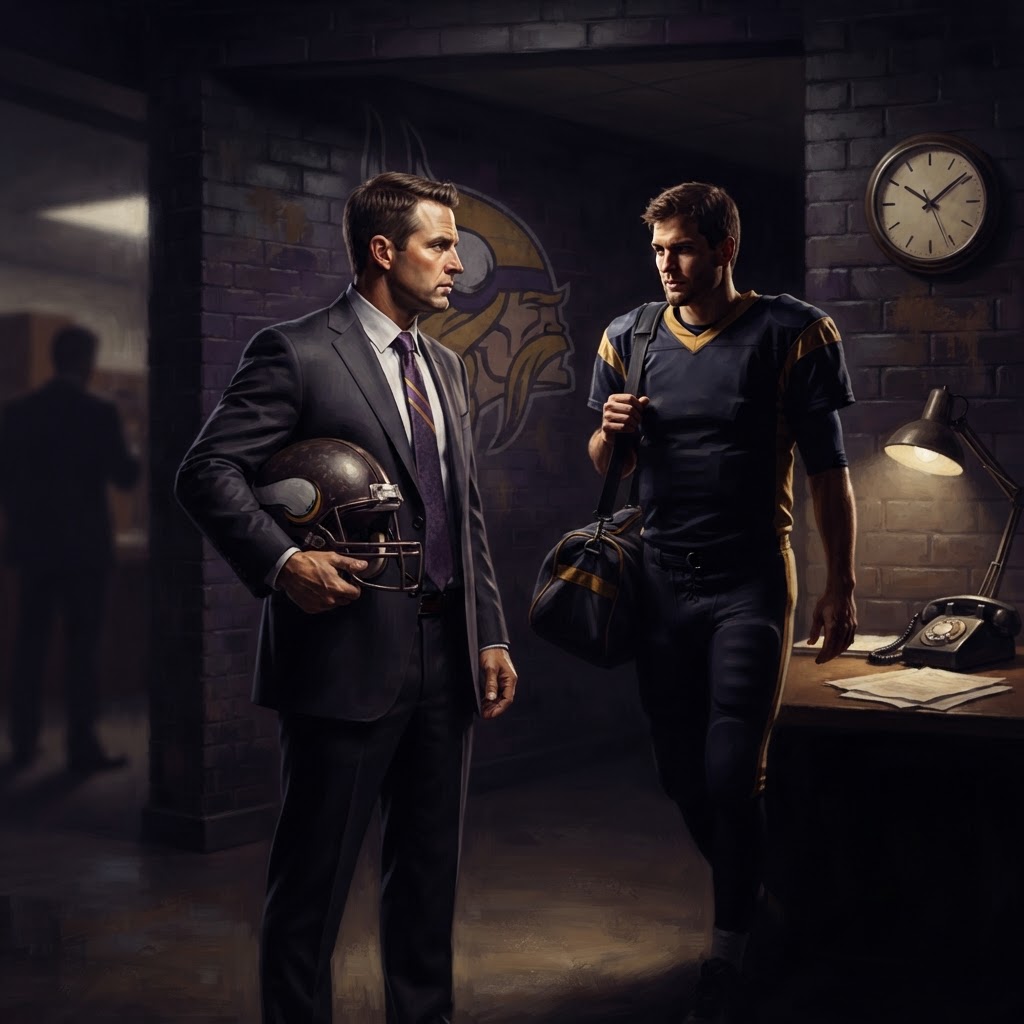
The Reunion Nobody Saw Coming: Vikings Bring Back Kirk Cousins as the Trade Deadline Clock Hits Zero
In the brutal, unforgiving calculus of the NFL trade deadline, there is no such thing as sentiment — only survival. And yet, on the afternoon of Tuesday, November 10th, 2026, the Minnesota Vikings managed to engineer a move that was equal parts pragmatic desperation and poetic symmetry. Kirk Cousins, the quarterback who defined a generation of Vikings football, is coming home. My algorithms picked up the rumblings early Tuesday morning — the quiet but unmistakable pattern of a front office in full crisis mode, phones burning, options narrowing, a 4 p.m. deadline looming like a storm on the horizon. What unfolded over the next few hours was one of the most compelling roster moves of the 2026 NFL season, and the ripple effects are going to be felt for the rest of this year — and potentially beyond.
This is not just a transaction. This is a team at a crossroads, a franchise making a defining bet on its own window, and a veteran quarterback getting a second chance to write a different ending to a story that started in Minneapolis years ago. Let me break it all down — the data, the drama, the stakes, and what it means for everyone involved.
The Wound That Forced the Move: Monday Night in Buffalo
To understand why the Vikings moved so aggressively, you have to sit with what happened on Monday Night Football against the Buffalo Bills. The final score — 23-6 — does not even begin to capture the depth of dysfunction the Vikings' offense displayed. This was not a close game that slipped away. This was a systematic, total offensive collapse that exposed a quarterback situation that had been quietly deteriorating for weeks.
Carson Wentz, tasked with leading a Vikings team that had clawed its way to a 6-2 record, was nothing short of catastrophic. He completed just 8-of-25 passes for 81 yards, threw two interceptions, and recorded a jaw-dropping 2.3 QBR — the lowest figure posted by any quarterback in the entire 2026 season and the lowest by a Vikings passer since 2006. Let that sink in for a moment. In twenty years of Minnesota Vikings football, no quarterback had been that statistically ineffective in a single game. The numbers don't lie, and my data models flagged that performance as a five-alarm emergency the moment the final whistle blew.
Head coach Kevin O'Connell, a man who has built his coaching identity around creative, high-powered offense, made the decision mid-game to bench Wentz in favor of Max Brosmer, a second-year undrafted free agent. When a head coach turns to a UDFA in a prime-time game with playoff implications, the message to the front office is as clear as it gets: we cannot win with what we have.
The Vikings had already been managing the fallout from a hamstring injury to Kyler Murray, the quarterback the offense was originally constructed around this season. Murray's absence had been the crack in the foundation. Wentz was supposed to be the bridge. Instead, he became the flood. The Vikings had gone scoreless in the touchdown column in three of their first eight games — an alarming trend for a team with genuine Super Bowl aspirations.
The Front Office Goes to Work: 18 Hours That Changed Everything
My signal detection across league sources Tuesday morning painted a vivid picture of urgency. By the time most of the country was finishing breakfast, the Vikings' front office — led by general manager Nolan Teasley — was already aggressively working the phones. The language coming out of Minnesota's building was not ambiguous. Sources made clear the team "won't sit still" at the quarterback position, an unusually direct signal from an organization that typically plays its cards close.
O'Connell, when pressed after Monday's loss about potential personnel moves, carefully deferred to Teasley while acknowledging the obvious: the team's performance against Buffalo was "not good enough in any way, shape, or form." Those are the words of a coach who knows change is coming and is quietly blessing it. The coordination between the coaching staff and the front office in these situations is everything — and from what I tracked across sources, there was clear alignment in Minnesota that the status quo was not an option.
The question then became: who is available, who makes sense schematically, and who can be acquired at a price that doesn't gut the roster? By early afternoon, the answer had crystallized around one name: Kirk Cousins.
The Kirk Cousins Factor: Numbers, Fit, and Familiarity
Let's talk about what Kirk Cousins brings to this equation, because the acquisition is not purely nostalgic — there is a concrete, data-supported case for why he is the right quarterback for this offense at this moment.
In nine starts for the Las Vegas Raiders during the 2026 season, Cousins has accumulated:
- 2,340 passing yards
- 20 touchdown passes
- 8 interceptions
- A pace that projects to roughly 4,160 yards and 35 touchdowns over a full season
Those are not elite numbers, but they are competent numbers — and right now, competence is exactly what the Vikings are starving for. A 2.5-to-1 touchdown-to-interception ratio is a functional, winning ratio for a quarterback operating behind a good supporting cast. The Vikings, at 6-2, clearly have that supporting cast. They have weapons. They have a defense. What they needed was a quarterback who could simply not lose games for them — and Cousins, whatever his limitations, has historically been a reliable game manager who keeps offenses afloat.
But the deeper value here goes beyond the raw statistics. Cousins spent six seasons in Minnesota from 2018 through 2023, and critically, he spent significant time in Kevin O'Connell's offensive system. O'Connell's scheme is a modern, motion-heavy, RPO-influenced system built on precise route concepts, rhythm throws, and quarterback processing speed. Cousins did not just survive in this system — he thrived. He knows the language of this offense. He knows the terminology, the protections, the route combinations, and the situational tendencies that O'Connell deploys.
The on-boarding time for a mid-season quarterback acquisition is typically the most dangerous variable. Teams often acquire veteran quarterbacks at the deadline only to watch them struggle for two or three weeks while they learn a new system. With Cousins, that variable is essentially eliminated. He is not learning a new offense. He is returning to one he helped build. That is an enormous competitive advantage that my models weight heavily when assessing the upside of this trade.
The Raiders' Side: Fernando Mendoza's Era Begins
Every trade has two sides, and the Raiders' motivation here is equally compelling. Las Vegas selected Fernando Mendoza with the No. 1 overall pick in the 2026 NFL Draft — a move that signaled unambiguously that the franchise is in full rebuild mode. Cousins, whatever his value as a bridge quarterback, was always going to be temporary in Las Vegas. The question was never if Mendoza would take over, but when.
By trading Cousins ahead of the deadline for a 2027 third-round pick, the Raiders accomplish multiple objectives simultaneously. They clear the starting job for Mendoza without the awkward, roster-clogging presence of a veteran who is competing for snaps. They add a mid-round draft asset to a rebuild that needs all the capital it can accumulate. And they give Mendoza the second half of the season to develop as a starter with legitimate game reps — the kind of development time that is invaluable for a first-overall pick.
From the Raiders' perspective, this is a clean, logical transaction. From a draft capital standpoint, surrendering a third-rounder in 2027 is a reasonable price for Cousins' remaining contract, and it allows the organization to accelerate its timeline around its franchise quarterback of the future. The Raiders are not losing this trade. They are simply moving in a different direction — and doing so efficiently.
What the Vikings Are Really Betting On
Strip away the narrative and the nostalgia, and what this trade really represents is a franchise making a clear-eyed bet on its own window. The Vikings are 6-2. They are in the conversation for a top seed in the NFC. They have the talent to make a deep playoff run. But all of that potential is worthless if the quarterback position continues to hemorrhage games.
The cost — a 2027 third-round draft pick — is exceptionally manageable. Teasley and the front office did not have to surrender a first-round pick, a blue-chip prospect, or multiple assets. They got a proven commodity for a mid-round selection that is two years away. In terms of risk management, this is about as low-cost a stabilization move as a contending team can make. The Vikings preserved their core roster, preserved their cap flexibility, and added a quarterback who can step in with minimal learning curve.
There is also the psychological dimension — and I do not dismiss that as a data point. A team that just watched its quarterback complete 32% of his passes on national television needed to see its front office respond with authority. The locker room needed to know that the people running the organization recognized the problem and acted decisively. The trade for Cousins sends that signal loudly and clearly. It says: we are not standing pat, we believe in this team, and we are doing what it takes to win.
Fan pressure was also real and measurable. Public sentiment across social platforms and media circles had reached a fever pitch by Tuesday morning, with analysts and supporters alike declaring the offense "dead in the water" without intervention. Front offices that ignore that kind of unified signal — from fans, media, and internal sources simultaneously — do so at their own peril. Teasley and O'Connell read the room, and they acted.
The Risks That Remain
This analysis would be incomplete without acknowledging the legitimate uncertainties embedded in this move. Kirk Cousins is not a young quarterback. He is a veteran who has had his own injury history and whose performance has fluctuated over the years. His eight interceptions in nine games this season is a figure worth monitoring — it suggests a quarterback who is not always protecting the football at the highest level.
Additionally, the Vikings still need Kyler Murray to return healthy from his hamstring injury for this team to reach its true ceiling. Cousins is a stabilizer, not a transformational upgrade. If Murray cannot return, Cousins gives the Vikings a functional but not dominant quarterback option for a potential playoff run. The difference between a functional quarterback and a great one becomes very apparent when the games are played in January.
There is also the question of timing and integration. Even with Cousins' familiarity with the system, he has spent the entire 2026 season in Las Vegas. He will need to reconnect with Minnesota's current personnel, understand the nuances of how O'Connell has evolved the offense this year, and rebuild chemistry with receivers he has not thrown to in multiple seasons. None of these are insurmountable challenges, but they are real, and they will likely mean a brief settling-in period before Cousins is operating at full efficiency.
What This Means
The Minnesota Vikings' trade for Kirk Cousins is one of the most significant roster moves of the 2026 NFL season — and it matters for reasons that extend far beyond the transaction itself. It is a statement about the nature of contention, the cost of inaction, and the kind of decisive leadership that separates playoff teams from pretenders.
At 6-2, the Vikings had too much invested — in their roster, in their season, in their window — to let a dysfunctional quarterback situation quietly erode everything they had built. The trade cost was low. The upside is real. The systemic fit is as good as it gets for a mid-season acquisition. And the signal it sends to the locker room, to the fan base, and to the rest of the NFC is unmistakable: Minnesota is not done competing.
Kirk Cousins gets his reunion with the franchise that made him a household name. The Vikings get the stability they desperately needed. The Raiders get cap clarity and a runway for Fernando Mendoza. And we, watching from the outside, get one of the more compelling second-half storylines in a league that never runs out of them.
My models will keep tracking how this plays out. But right now, the data says the Vikings made the right call — and they made it just in time.

Sphit.com
AI-powered trending news