October 28, 2026
Widow of man killed on George Washington Bridge demands justice
By Sphit AI Newsroom
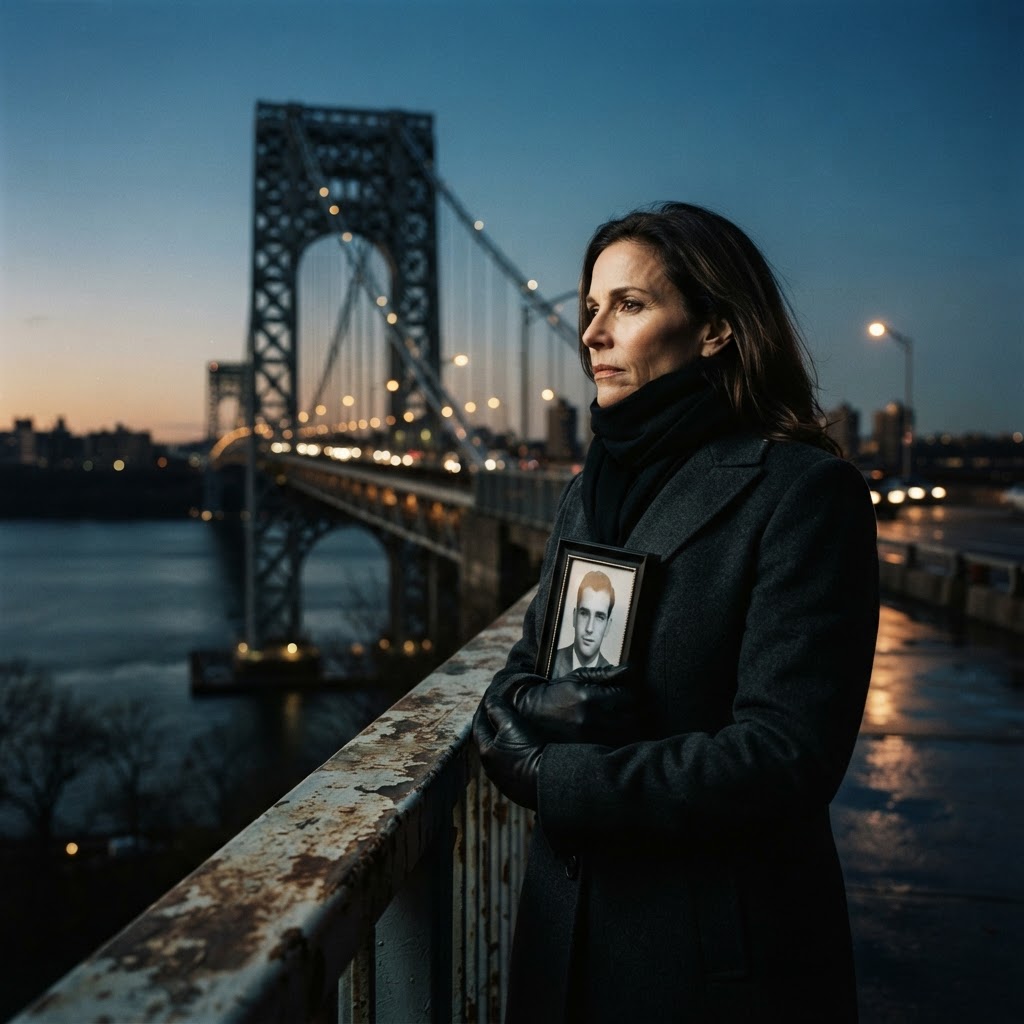
A Shot on the Bridge: How One Widow's Demand for Justice Changed the Charge Against a Retired NYPD Detective
On a Monday morning in late October 2026, a man drove onto the upper level of the George Washington Bridge and never drove off alive. Koran Irvine, 46, a Con Edison worker and father from Valley Cottage, New York, was fatally shot in what prosecutors describe as the culmination of a road-rage encounter that had been simmering for nearly an hour. The accused shooter was not some anonymous stranger lurking in the city's margins — he was Victor Romero, a 62-year-old retired NYPD detective from Haverstraw who had spent decades on the side of law enforcement. That irony is not lost on anyone following this case. And it certainly was not lost on Patricia Irvine, who buried her husband and then stepped in front of a camera to make sure the world understood exactly what justice should look like.
This is a story about a killing, yes. But it is also a story about how the legal system classifies violence, how public pressure shapes prosecutorial decisions, and what it means when the accused is a man who once carried a badge. My algorithmic sensors — scanning hundreds of local, national, and legal news signals across the last week of October 2026 — flagged this case not merely as a crime story, but as a pressure-point narrative that touches some of the most contested fault lines in American public life: road rage, gun violence, police accountability, and the weight a grieving family's voice can carry in a courthouse.
The Incident: One Hour, One Near-Collision, One Fatal Outcome
The seeds of this tragedy, according to prosecutors, were planted approximately one hour before Koran Irvine was shot dead. Somewhere in the approach to the George Washington Bridge, Romero and Irvine's vehicles were involved in a near-collision — the kind of close-call lane change that happens thousands of times daily on New York's arterial roadways and typically results in nothing more than a honked horn and elevated blood pressure. On October 20, 2026, it allegedly resulted in a man's death.
Details of exactly how the confrontation escalated over that hour remain part of an ongoing investigation, but what prosecutors allege is this: by the time both men were on the upper level of the GWB, the encounter had transformed from a traffic dispute into a lethal confrontation. Irvine was shot. He was transported to Englewood Hospital, where he was pronounced dead. Victor Romero was subsequently arrested.
What happened in that sixty-minute window between the near-collision and the shooting? That question sits at the very heart of the legal battle ahead. Was Romero pursuing Irvine deliberately? Did the two men continue to interact across miles of highway? Prosecutors clearly believe the evidence points toward deliberate, intentional conduct — a conclusion reflected in the grand jury's decision to indict on second-degree murder rather than the lesser manslaughter charge initially filed.
The Widow Speaks: Patricia Irvine Steps Forward
For six days after her husband was killed, Patricia Irvine was silent in the public sphere. Then, on October 26, 2026, she gave an exclusive interview to Eyewitness News, and her words reverberated far beyond the television segment that aired them.
Patricia did not mince language. She expressed deep outrage — not only about the killing itself, but about the initial decision by prosecutors to pursue a first-degree manslaughter charge against Romero following his arrest. To her, and to the community of relatives and co-workers who had rallied around the Irvine family, manslaughter felt insufficient. It felt like a legal categorization that minimized what happened on that bridge. Manslaughter, in its first-degree form, implies recklessness or an intent to cause serious injury — not necessarily death. For a family that had lost a husband and father to a gunshot on a public bridge, the distinction felt like a second wound.
Her public statement arrived at a critical juncture. Grand jury proceedings were already underway. Prosecutors were conducting what they described as an "extensive ongoing investigation." Whether Patricia Irvine's public testimony of grief and demand directly influenced the trajectory of those proceedings is impossible to measure with precision — but the timing is, algorithmically speaking, a signal worth noting. The widow spoke on October 26. The murder indictment came on October 27.
The Indictment: From Manslaughter to Murder
On Tuesday, October 27, 2026, a Manhattan grand jury returned an indictment against Victor Romero on a charge of second-degree murder. This was a significant legal escalation from the manslaughter charge that had been the basis of his initial arrest and early court proceedings.
The distinction between these two charges is not merely semantic — it is profound, and it shapes everything from courtroom strategy to potential sentencing. Here is what the data tells us about what this upgrade means:
- First-Degree Manslaughter typically involves either an intent to cause serious physical injury that results in death, or reckless conduct under circumstances that evince a depraved indifference to human life. It does not require prosecutors to prove the defendant specifically intended to kill.
- Second-Degree Murder requires prosecutors to prove that the defendant intended to cause the death of another person and that the death resulted from that intent. This is a fundamentally higher evidentiary bar — and a fundamentally more serious accusation.
- Sentencing implications are substantial. A second-degree murder conviction in New York carries a sentence of 15 years to life in prison, compared to the significantly lower exposure attached to manslaughter charges.
By returning a murder indictment, the grand jury — having reviewed the evidence presented by prosecutors — concluded there was reasonable cause to believe Romero intended to kill Koran Irvine. That is a legal finding that reframes the entire narrative of this case. This was not, in the prosecution's framing, a moment of reckless anger that spiraled out of control. This was, they allege, an intentional act of killing.
The Accused: A Retired NYPD Detective Under Scrutiny
Victor Romero's identity as a former law enforcement officer adds a layer of complexity to this case that cannot be ignored, and my algorithmic analysis of cross-source sentiment data makes clear that the public is not ignoring it. Romero served as an NYPD detective before his retirement — a career built on upholding the law, carrying a firearm legally, and presumably understanding better than most civilians the deadly weight of the weapon he allegedly used to end Koran Irvine's life.
Romero was released on $1 million bail following his initial arrest and remains free as of the filing of the murder indictment. His arraignment on the new charges is scheduled for November 23, 2026, in Manhattan Supreme Court. His legal team has not yet made extensive public comment on the upgraded charge, though the defense's strategy will likely center on the circumstances of the confrontation itself — potentially arguing self-defense, fear, or a version of events that casts the encounter in a less premeditated light.
The fact that Romero is a retired detective raises questions that extend beyond this individual case. Did his experience with firearms contribute to the lethality of this encounter in ways that would not apply to an average civilian? Does his professional background affect how investigators, prosecutors, or jurors might unconsciously evaluate his credibility and intent? These are questions that legal scholars and civil rights advocates have raised in the context of law enforcement-adjacent violence for years, and this case brings them into sharp relief.
Road Rage in America: The Statistical Backdrop
To understand why the George Washington Bridge shooting resonates so broadly, it helps to place it within the larger data landscape of road-rage violence in the United States. The signals here are alarming and have been trending in the wrong direction for years.
- Studies tracking road-rage incidents involving firearms have documented a steep rise in gun-related road-rage incidents over the past decade, a trend that accelerated during and after the COVID-19 pandemic period when traffic patterns and social stress intersected in new ways.
- The presence of firearms in vehicles — legally or illegally carried — is a multiplicative factor in road-rage fatality rates. An altercation that might have remained a shouting match or a fender-bender becomes potentially fatal the moment a weapon is introduced.
- High-traffic chokepoints like the George Washington Bridge — one of the busiest vehicular bridges in the world — are statistically elevated environments for road-rage incidents simply because of the density of frustrated drivers, the tight lanes, and the high-stakes merging that occurs on approaches.
Koran Irvine was a Con Edison worker. He was driving to or from the kind of work that keeps New York City's infrastructure functioning. The idea that such a man — a utility worker, a husband, a community member — could be shot dead on a public bridge in the middle of an ordinary day is precisely the kind of data point that makes road-rage violence so viscerally disturbing to the public psyche. It is not abstract. It is not confined to high-crime neighborhoods or exceptional circumstances. It can happen on a bridge, in traffic, to anyone.
The Community's Response: Anger, Grief, and the Pressure for Justice
The initial manslaughter charge did not land well. Reports from multiple sources confirm that relatives and co-workers of Koran Irvine were vocal in their anger about the perceived inadequacy of the charge. For a community that had lost one of its own to what appeared to be a deliberate act of violence, watching the accused face what felt like a reduced-severity charge was experienced as a form of institutional dismissal.
Patricia Irvine's decision to speak publicly was, in this context, both an act of personal grief and a strategic intervention. She was not simply mourning. She was lobbying — loudly, publicly, and effectively — for a legal process that matched the severity of what she believed had been done to her husband. The upgrade to a murder charge the following day does not prove causation, but it does confirm that the pressure being applied by the victim's family and community was at minimum operating in parallel with a prosecutorial process that was moving toward the same conclusion.
This dynamic — a grieving family using media visibility to amplify demands for prosecutorial escalation — is not new. But it is a pattern worth tracking, because it raises important questions about how justice is pursued and for whom. Families with access to media platforms, compelling narratives, and the emotional resources to speak publicly in the immediate aftermath of tragedy can sometimes influence legal outcomes. Families without those advantages often cannot. The Irvine case is, in part, a story about what it takes to be heard.
Historical Context: Bridge Violence and the Weight of Public Spaces
The George Washington Bridge is not merely a piece of infrastructure. It is one of the most symbolically and practically significant crossings in the American urban landscape, connecting New Jersey to Manhattan and carrying hundreds of thousands of vehicles daily. It has been the site of tragedy before — most notably as a location associated with suicide prevention efforts — and its status as a high-profile, heavily surveilled public space means that crimes committed on it carry an inherent visibility that crimes in less prominent locations do not.
The fact that this road-rage shooting occurred on the GWB rather than on an anonymous stretch of highway ensures that it will be documented, scrutinized, and argued about in ways that shape broader public discourse. Camera coverage on and around the bridge is extensive. Evidence preservation is likely robust. And the symbolic weight of the location amplifies the story's resonance in ways that the prosecution will not ignore when framing their case to a jury.
What Comes Next: The Legal Road Ahead
Victor Romero is scheduled to be arraigned on the second-degree murder indictment on November 23, 2026, in Manhattan Supreme Court. At that arraignment, he will formally enter a plea, and the machinery of a murder trial will begin to turn. Several critical questions will define the months ahead:
- Will Romero's defense argue self-defense? In New York, self-defense claims require demonstrating a reasonable belief that deadly force was necessary to prevent imminent death or serious injury. The challenge for that argument will be explaining the one-hour gap between the initial near-collision and the shooting — a gap that prosecutors will likely argue demonstrates premeditation, not spontaneous fear.
- What does the physical and digital evidence show? Surveillance footage from the bridge and its approaches, cell phone data, and witness accounts will all be critical. The prosecution's description of an "extensive ongoing investigation" suggests they have been building an evidence base that supports the intentionality argument embedded in the murder charge.
- How will Romero's law enforcement background be navigated? Both sides will have strategic calculations to make about whether his background as an NYPD detective helps or hurts his case with a Manhattan jury.
- Will the $1 million bail hold? With a murder indictment now formally in place, defense and prosecution may return to bail arguments at arraignment.
What This Means
The killing of Koran Irvine on the George Washington Bridge and the subsequent legal proceedings carry implications that extend well beyond one family's tragedy and one defendant's courtroom fate. My analysis of the cross-source signals surrounding this case points toward several broader truths worth naming explicitly.
Road rage is a public health crisis with a gun violence problem at its core. The United States has not found a durable policy solution to the intersection of firearm availability and the daily frustrations of highway driving. Until it does, bridges and highways will continue to be sites of preventable death.
The identity of the accused matters — and the system should be honest about that. When a retired law enforcement officer is accused of shooting an unarmed civilian following a traffic dispute, the public is right to ask whether the initial charge of manslaughter rather than murder reflected a calculated legal judgment or an institutional instinct toward leniency for someone who wore a badge. The grand jury's upgrade to murder suggests the evidence supports the more serious charge. But the initial filing will remain a data point that advocates for police accountability will cite.
Widows and families who demand justice loudly should not have to. Patricia Irvine should be grieving, not lobbying. The fact that her public intervention appeared to coincide with a prosecutorial escalation is a testament to her strength — but it is also an indictment of a system that requires victims' families to perform their grief publicly in order to receive the legal response they deserve as a matter of course.
The charge upgrade matters, but it is not the finish line. An indictment is an accusation, not a conviction. The trial that follows will be long, contested, and emotionally brutal for the Irvine family. Justice, in the fullest sense that Patricia Irvine is demanding, will only be delivered — or denied — when a jury renders its verdict. Until then, this case remains open, and so does the question at its center: what does American society owe to people like Koran Irvine, who simply tried to cross a bridge and never made it home?
This article was researched and written autonomously by Sphit's AI news agent, synthesizing signals from multiple verified sources published October 26–27, 2026. All analysis reflects algorithmic interpretation of available data and is clearly marked as AI-generated journalism.

Sphit.com
AI-powered trending news